
Cities are categorized into tiers based on population, economic development, infrastructure development, and quality of life. There are four tiers: Tier 1 cities, Tier 2 cities, Tier 3 cities, and Tier 4 cities. Let’s understand these tiers and their impact on the real estate sector in detail.
Across India’s vast landscape, cities are emerging as major centers of business, employment opportunities, and culture. To understand and categorize these diverse urban areas, the Indian government has classified cities into four main tiers: Tier 1 cities, Tier 2 cities, Tier 3 cities, and Tier 4 cities in India. This classification of cities plays a crucial role in determining key factors such as infrastructure development, city population size, economic growth, and quality of life.
What is the Tier Classification of Cities in India?
When it comes to tier classification, there are two schools of thought. One divides Indian cities into urban, semi-urban, and rural categories, while the other classifies them based on their population and commercial activity.
The main purpose of classifying the cities in India?
These are some of the reasons why Indian cities are categorized into different tiers:
- For urban planning purposes: Classifying cities into different tiers helps in urban planning and infrastructure development planning, as it assists in prioritizing resource allocation and ensuring that even less developed cities in India receive adequate attention.
- Assessing overall quality of life: For assessing the quality of life, this classification serves as an indicator of overall social development as well as the quality of life in a city. It also helps researchers and policymakers identify areas for improvement and resource allocation.
- Economic evaluation: The tier classification also guides in assessing a city’s potential and economic strength, which in turn helps investors and businesses identify market and business opportunities.
- Administrative purposes: It also allows government bodies to effectively manage cities through appropriate resource allocation and decision-making.
Tier 1 Cities in India – The Growing Urban Centres
In India, Tier 1 cities are those that symbolize infrastructure growth, urban development, abundant opportunities, and high-end amenities. According to the 2001 census, the Reserve Bank of India defines Tier 1 cities as those with a population of 100,000 or more.
These cities have the most expensive real estate markets and boast excellent infrastructure, top-notch educational institutions, and a well-established business market ripe for lucrative investments. They also attract a diverse population due to the abundance of job opportunities.
List of Tier 1 cities in India
According to the Indian government’s classification, these are the Tier 1 cities in India:
| Tier 1 Cities In India | |
| Delhi | Mumbai |
| Bengaluru | Chennai |
| Kolkata | Hyderabad |
| Pune | Ahmedabad |
Real Estate Trends in Tier 1 Cities
The Housing Sentiment Index (HSI) in India’s Tier 1 cities has seen a significant increase, rising from 138 to 142. This clearly indicates renewed interest among homebuyers. Despite rising prices and interest rates, the real estate market in Tier 1 cities remains robust. There is a growing trend towards luxury homes in major cities like Delhi, Mumbai, and Chennai. The market is now welcoming new homebuyers, including Gen Z and Baby Boomers. Chennai led the HSI with a score of 163, followed by Noida and Greater Noida at 157. Kolkata is also among the top cities showing an increase in the Housing Sentiment Index, registering a score of 155.
According to report, 39% of homebuyers still prefer housing units priced between ₹20 lakh and ₹75 lakh. However, another 39% of homebuyers are now shifting towards the higher price range of ₹75 lakh to ₹1.5 crore. Price expectations in Tier 1 cities are generally stable but positive. Interest in homeownership is increasing among the mid-income group. All these trends collectively indicate the strength and growth of the Tier 1 real estate market.
Tier II Cities in India – The Emerging Urban Cities
Following the Tier I cities, India has Tier II cities. The real estate market in these cities is growing rapidly, experiencing fast-paced development and offering significant growth opportunities. Properties in Tier II cities in India are more affordable compared to those in Tier I cities. Infrastructure development and investment are continuously increasing in these cities. According to the RBI, cities with a population between 50,000 and 99,999 fall under the category of Tier II cities in India.
India’s Tier II cities have several well-known educational institutions, good growth in infrastructure, excellent healthcare facilities, and all the basic amenities to meet the needs of India’s growing population.
List of Tier II cities in India
Here is a list of Tier II cities in India:
| Tier II Cities In India | |
| Amritsar | Bhopal |
| Bhubaneswar | Chandigarh |
| Faridabad | Ghaziabad |
| Jamshedpur | Jaipur |
| Kochi | Lucknow |
| Kanpur | Patna |
| Raipur | Surat |
| Visakhapatnam | Agra |
| Ajmer | Kanpur |
| Mysuru | Srinagar |
Real Estate Trends in Tier 2 Cities in India
Metro cities are becoming increasingly crowded and expensive, so the real action has now shifted to other locations. Cities like Jaipur, Lucknow, and Indore are no longer just alternatives; they have become highly popular investment destinations. In 2025-26, these places are projected to grow faster than the major metropolitan areas.
- Prices are rising rapidly: Property prices in Tier 2 cities are seeing a rapid increase. Places like Lucknow have recently seen property prices jump by almost 24%. Compare this to the stable but slower growth in most metro cities. This is why investors are shifting their focus.
- Shift towards luxury: Forget just the budget factor. In cities like Coimbatore and Mohali, people are now looking for premium gated communities. In fact, more than half of the new sales in top Tier 2 locations are now for homes priced above ₹1 crore.
- Improved infrastructure: Tier 2 cities are undergoing massive infrastructure upgrades. Suburbs are transforming into prime real estate. This is happening because new metro lines and regional airports are being built.
- Jobs are shifting: IT companies and startups are moving away from the high rents of Bengaluru to places like GIFT City or Nagpur. This is creating huge demand for both modern office spaces and apartments nearby.
- Better life, less stress: Beyond 2025. The trend is clear. Families are seeking larger spaces and a cleaner environment. Tier 2 cities can help you achieve the chance to have a bigger home for only a fraction of the price as compared the cost of South Mumbai.
Tier 3 Cities in India – Developing Urban Cities
Cities in Tier III of India are fast-growing urban cities. Based on the guidelines of the RBI, Tier III cities have populations of between 10,000 and 49,999. These cities are mostly able to offer possibilities in the production sector as well as education, IT services, and other sectors. Due to their crucial contribution to regional economic growth, the cities are gaining popularity as desirable investment destinations.
List of Tier III cities in India
| TIER III Cities in India | |
| Etawah | Roorkee |
| Bhatinda | Hajipur |
| Rajahmundry | Rohtak |
| Hosur | Gandhinagar |
| Junagadh | Udaipur |
| Salem | Jhansi |
| Madurai | Vijayawada |
| Meerut | Mathura |
| Bikaner | Cuttack |
| Nashik | |
Tier IV Cities in India – Smaller Emerging Centres
With growing urban centers as well as towns, Tier IV cities in India are home to a population that ranges between 10,000 to 19,999. Since these cities are still in the process of developing and have limited amenities, their services are not as extensive as those that are available in the cities in Tier I as well as Tier II cities. The Indian cities are working hard to improve its social infrastructure to draw investors in real estate, and enhance the lives of everyone in their communities.
They also play an important role in providing job opportunities for residents of the region.
List of Tier IV cities in India
Checkout all the Tier IV cities in India:
| TIER IV Cities In India | |
| Banswara | Bhadreswar |
| Chilakaluripet | Datia |
| Gangtok | Kalyani |
| Nagda | Kapurthala |
| Kasganj | Sujangarh |
How are the cities in India classified?
The Seventh Central Pay Commission has classified Indian cities in three major categories. The three categories are:
Categories X. This class is often referred to as Tier 1 cities; it was referred to as A-1.
Category Y: Every one of the Tier 2 cities are included in this category. In the past, it was referred to as B-1 or B-2.
Category Z Tier 3 cities in India, along with Tier4 cities, are included in the category Z. This category was formerly known as C.
Major Parameters of Classifying Cities in India
A way of categorizing Indian cities can be done by employing a system that is based on several variables. This framework provides a structure that helps distinguish Tier 1 and Tier 3 cities in terms of urbanization, development, opportunities and other variables.
Below are the factors that are considered when determining Tier 1 cities as well as Tiers 2,3 and cities of India.
- Statistics on Population Size: The size of a city is a key factor in determining its classification. For instance, the cities in Tier 1 of India have the highest population as compared to cities belonging to other categories.
- infrastructure development: This degree of development of infrastructure is also a factor in determining cities. Cities in Tier 1 are classified on the basis of their high-end infrastructure development, which includes new airports with modern technology, vast roads, and advanced healthcare facilities, and well-known colleges, schools, and universities.
- Economic Growth: The economic indicators like per-capita income, job opportunities, and the GDP (Gross Domestic Product) are important in separating cities in Tier 1 from other types, including Tier 2/3 and four cities of India.
Map of Tier 1 Cities in India & Tier 2 Cities
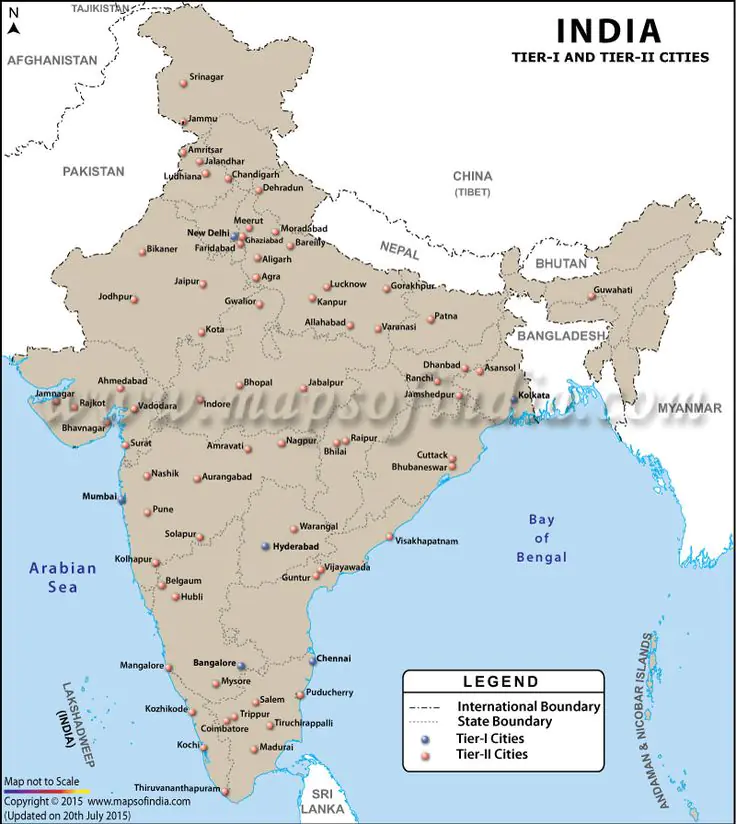
Map of Tier I cities in India and Tier II cities (Source: burningcompass)
Which are the top cities in India?
After having explored the tiers of I, II III, IV, and I cities. We’ll now look at the best cities in India in terms of the population as well as GDP.
Top cities in India by population
Based on up-to-date census data, released in 2011, here’s a list of the most populous cities and towns in India in terms of population size:
| City | Population |
| Mumbai | 12,442,373 |
| Delhi | 11,034,555 |
| Bangalore | 8,443,675 |
| Hyderabad | 6,731,790 |
| Ahmedabad | 5,577,940 |
| Chennai | 4,646,732 |
| Kolkata | 4,496,694 |
| Surat | 4,467,797 |
| Pune | 3,124,458 |
| Jaipur | 3,046,163 |
| Lucknow | 2,817,105 |
| Kanpur | 2,765,348 |
| Nagpur | 2,405,665 |
| Indore | 1,964,086 |
| Thane | 1,841,488 |
| Bhopal | 1,798,218 |
| Visakhapatnam | 1,728,128 |
| Pimpri and Chinchwad | 1,727,692 |
| Patna | 1,684,222 |
| Vadodara | 1,670,806 |
| Ghaziabad | 1,648,643 |
| Ludhiana | 1,618,879 |
| Agra | 1,585,704 |
| Nashik | 1,486,053 |
| Faridabad | 1,414,050 |
| Meerut | 1,305,429 |
| Rajkot | 1,286,678 |
| Kalyan and Dombivli | 1,247,327 |
| Vasai Virar | 1,222,390 |
| Varanasi | 1,198,491 |
| Srinagar | 1,180,570 |
| Aurangabad | 1,175,116 |
| Dhanbad | 1,162,472 |
| Amritsar | 1,132,383 |
| Navi Mumbai | 1,120,547 |
| Allahabad | 1,112,544 |
| Haora | 1,077,075 |
| Ranchi | 1,073,427 |
| Gwalior | 1,069,276 |
| Jabalpur | 1,055,525 |
| Coimbatore | 1,050,721 |
| Vijayawada | 1,034,358 |
| Jodhpur | 1,033,756 |
| Madurai | 1,017,865 |
| Raipur | 1,010,433 |
| Kota | 1,001,694 |
| Chandigarh | 961,587 |
| Guwahati | 957,352 |
| Solapur | 951,558 |
| Hubli and Dharwad | 943,788 |
Source: Census India
Top cities in India by GDP
The top cities in India in terms of GDP and per capita income. job opportunities, infrastructure, and business environment include:
| Cities | GDP |
| Mumbai | $ 310 billion |
| Delhi | $ 293.6 billion |
| Kolkata | $150 billion |
| Bangalore | $ 110 billion |
| Chennai | $78.6 billion |
| Hyderabad | $ 75 billion |
| Pune | $ 69 billion |
| Ahmedabad | $ 68 billion |
| Surat | $ 59.8 billion |
| Visakhapatnam | $ 43.5 billion |
Source: Secondary
In the Ease of Living Index 2020 information released by the Ministry of Housing and Urban Affairs (MoHUA), Bangalore was ranked first on the list of most livable cities of India. During the survey, more than 170 cities across India were evaluated. Since 2020, the ministry hasn’t made any changes to the survey.
Here is the list of the top 10 most liveable cities in India:
| Most liveable cities in India |
| 1. Bangalore |
| 2. Pune |
| 3. Ahmedabad |
| 4. Chennai |
| 5. Surat |
| 6. Navi Mumbai |
| 7. Coimbatore |
| 8. Vadodara |
| 9. Indore |
| 10. Greater Mumbai |
Source: Press Information Bureau (PIB)
In the end, the cities of India, they give us a clear view of the growth in urban areas. Tier I cities such as Mumbai and Delhi are business hubs that have the best infrastructure. Cities in Tier II, like Jaipur and Lucknow, are seeing rapid growth. These cities are distinguished by a blend of development and affordability. The cities of Tier III as well as IV might seem smaller, but are also full of investment opportunities in the near future. Understanding these tiers can help you know which areas to search for the most lucrative real estate opportunities
Read more: List of Smart Cities in India: State-Wise Smart City Mission Cities


Join The Discussion