Stamp duty is an essential part of real estate transactions. This stamp duty varies across different states in India and applies to all types of deeds or transfer instruments, such as conveyance deeds, gift deeds, agreements to sell, etc. In this article, learn about:
- Stamp duty in Tamil Nadu
- Registration charges in Tamil Nadu
What is Stamp Duty in Tamil Nadu?
Anyone engaging in a property transaction in Tamil Nadu is required to pay stamp duty and registration fees to legalize and register the property ownership. The stamp duty rates Tamil Nadu are fixed.
However, these rates may vary depending on the type of deed and the type of transaction. Since April 1, 2026, the Tamil Nadu government has been offering a waiver on registration charges for women, where the property value is less than ₹10 lakh.
Why Stamp Duty and Registration Charges Matter?
Paying the correct stamp duty and registration charges is not only necessary for every property buyer – it’s mandatory. These expenses include:
- Legally transfer ownership, placing your name in official records.
- Offer buyers protection against future disputes.
- They are required to make a sale deed enforceable in a court of law.
Without paying the correct property registration charges, your sale transaction remains incomplete and can be legally challenged—therefore, timely registration is crucial for peace of mind!
Why Is Stamp Duty Mandatory?
- This certifies that a transaction has taken place, making the sale deed a valid, government-recognized document.
- Registration grants the buyer legal ownership – which is crucial for obtaining bank loans and reselling the property in the future.
- It ensures that your name is recorded in the official land/property records, protecting your property from fraud or disputed claims.
Current Stamp Duty Rates in Tamil Nadu
If you are calculating the cost of land registration in Tamil Nadu, these are the standard rates:
| Type of Transaction | Stamp Duty | Registration Fee |
| Sale Deed | 7% (of property value) | 4% |
| Gift deed registration charges in Tamil Nadu | 7% | 1% |
| Transfer to Blood Relatives (Gift) | 1% – Concession possible | 1% |
| House registration charges in Tamil Nadu | 7% | 4% |
| Resale Property | 7% | 4% |
| Agricultural Land | 7% | 4% |
Note: Effective April 1, 2025, the house registration charge/registration fee for women purchasing properties up to ₹10 lakh has been reduced to 3% (from 4%). Land registration in Tamil Nadu apply uniformly to apartments, plots, and houses, but always double-check for specific urban or rural exemptions.
Also Read: Full List of Tier 1, Tier 2, Tier 3 & Tier 4 Cities in India 2026
Registration Charges in Tamil Nadu
In addition to stamp duty, you will also have to pay a registration charge of 4% of the property value in Tamil Nadu. This fee is only 3% for female buyers purchasing properties priced below ₹10 lakh. This rule applies to most transactions, whether you are buying a plot, apartment, house, or agricultural land.
Documents Required for Registration
The government has created this registration checklist to ensure that every transaction is transparent. For smooth paperwork, you will need the following items:
- Sale Deed (executed and signed by buyer/seller)
- Identity Proof (Aadhaar Card, PAN, Passport, Voter ID)
- Property Card/Parent Deed (previous sale deed, gift, or partition deed)
- Encumbrance Certificate
- Patta, Chitta, and Adangal (land revenue records)
- PAN Card (for transactions above a certain value)
- Passport-sized photographs (buyer, seller, witnesses)
- NOC (if required)
- Power of Attorney (if applicable)
Always check the official website for the latest list of document registration fees.
Also Read: Stamp Duty in Tripura: Registration Charges & Latest Rules
Step-by-Step Registration Process
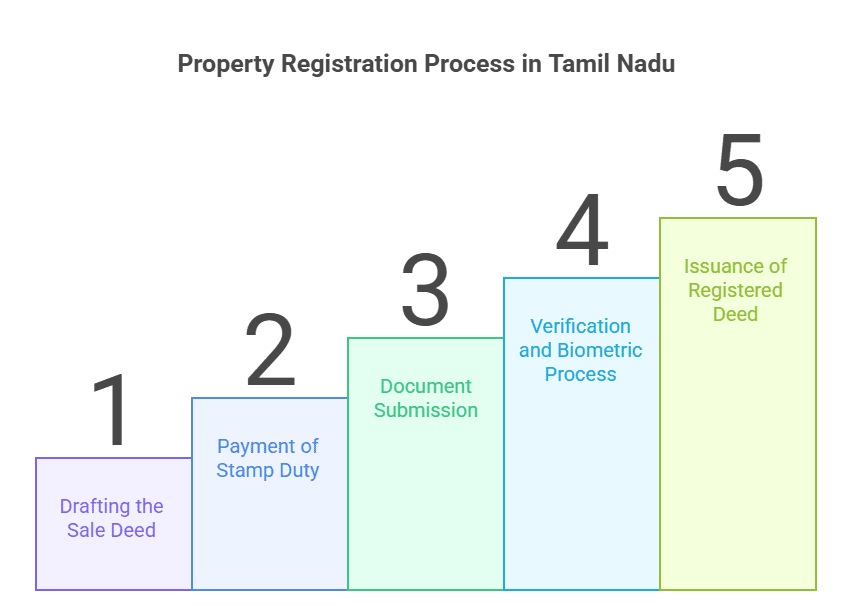
To easily complete the property registration process in Tamil Nadu, follow these steps:
- Drafting the Sale Deed: Get a draft prepared as per legal requirements and have it stamped.
- Payment of Stamp Duty: Use the online portal or generate a challan for offline payment methods.
- Document Submission: Submit all necessary documents at the Sub-Registrar’s office.
- Verification and Biometric Process: Both parties must be present for verification and fingerprinting.
- Issuance of Registered Deed: After processing, collect the registered document – this is proof of your ownership!
How to Pay Stamp Duty in Tamil Nadu?
In Tamil Nadu, you have both online and offline options for paying stamp duty. Here’s a description of both methods.
Payment of Stamp Duty in Tamil Nadu Online
- Visit the SCHIL website.
- Click on ‘E-stamping’ and select your state, ‘Tamil Nadu’, from the ‘State List’.
- Download the ‘Application Form for Stamp Duty Payment’.
- Print out the form, fill it out, and visit your nearest Stock Holding e-stamping counter.
- Pay your stamp duty using any payment method of your choice, including NEFT, RTGS, direct account transfer, etc.
Payment of stamp duty in Tamil Nadu offline
- Purchase stamp duty paper from the treasury or use franking to get your documents stamped.
- Visit the sub-registrar’s office in your city.
- Fill out the application form to pay the stamp duty.
- Pay your stamp duty using any payment method such as NEFT, RTGS, debit and credit cards, and cash.
Exemptions & Concessions on Stamp Duty in Tamil Nadu
The Tamil Nadu state government offers exemptions and concessions on stamp duty and registration fees for certain types of properties and for specific categories of people. Here is a list of the different types of concessions offered by the Tamil Nadu state government:
- Buying agricultural land: When you buy agricultural land and use it solely for farming purposes, the state government provides exemptions on stamp duty and registration fees. This encourages agriculture in Tamil Nadu.
- Government schemes for affordable housing: The Tamil Nadu state government offers exemptions on stamp duty and registration fees for affordable housing for the poor. People from lower to middle-income groups can take advantage of this opportunity to build their own homes.
The Tamil Nadu state government charges 7% and 4% respectively as stamp duty and registration fees. However, they also offer exemptions and concessions on different types of properties and deeds, such as reduced stamp duty rates on gift deeds between family members.
Common Mistakes and How to Avoid Them
- Underpayment: Always pay the full amount according to the complete calculation of property registration charges in Tamil Nadu; partial payment may lead to rejection.
- Incorrect Property Valuation: Provide the correct market/guideline value—undervaluing your property to save on land registration costs in Tamil Nadu can result in penalties or legal action.
- Missing Documents: Use a checklist and consult your legal advisor to ensure you bring all necessary documents, including proofs, certificates, and photographs.
- Delayed Registration: Failing to register immediately after purchase can lead to legal complications—timely payment ensures hassle-free ownership!