

If you want to buy a new house from a developer or builder, or even buy a house from the secondary market through resale, you can avail of the benefits of PMAY. Loans can also be taken for under-construction properties.
Interestingly, even if someone who already owns a house wants to avail of the benefits of PMAY, there is an option. The government has clarified that under the CLSS component, the mission (Housing for All by 2022) also facilitates the improvement/enhancement of existing ‘pucca’ houses. Thus, an applicant seeking a home loan to add a bedroom, kitchen, etc., to their existing house cannot be denied a home loan by the lender simply on the grounds that the applicant already owns a permanent structure.
The government has implemented several financial frameworks under the Pradhan Mantri Awas Yojana (PMAY) for beneficiaries in these groups: Economically Weaker Sections (EWS), Low Income Group (LIG), Middle Income Group-I (MIG I), and Middle Income Group-II (MIG II). The Credit-Linked Subsidy Scheme (CLSS) is a common financial assistance program. The subsidy benefit is determined based on carpet area and income. A maximum subsidy of INR 2.67 lakh can be availed under the CLSS system.
You can take a home loan for house construction, home purchase, home repair/remodelling, and home expansion. Under the Pradhan Mantri Awas Yojana (PMAY), use the PMAY subsidy calculator to find out how much subsidy you are eligible for from the central government.
The government has laid down certain eligibility criteria for availing the benefits of the Credit Linked Subsidy Scheme (CLSS) under PMAY (Urban).
Understanding PMAY and Its Purpose
The Pradhan Mantri Awas Yojana (PMAY) is an initiative of the Government of India aimed at providing affordable housing to all by 2024. It targets economically weaker sections (EWS), low-income groups (LIG), and middle-income groups (MIG) by providing interest subsidies on home loans through the Credit Linked Subsidy Scheme (CLSS).
Buy Lands & Plots in Delhi
The scheme encourages:
- Homeownership among first-time buyers
- Housing for all income groups
- Improved access to affordable housing in both urban and rural India
Can I Apply for PMAY After a Loan Transfer?
However, borrowers are allowed to transfer their existing home loans, even if they have already availed of the subsidy benefit. But they are not permitted to claim the subsidy again with the balance transfer. Furthermore, if you transfer your existing home loan after the notified date, you will not be able to avail of the incentives under this scheme, as the subsidy is only applicable when a house is purchased or constructed for the first time. The house you wish to purchase does not necessarily have to be a new one. It can also be a resale property from another owner or builder.
| Loan Providers | Home Loan Balance Transfer Rates (in per annum) |
| Axis Bank | 7.7% – 8.5% |
| Tata Capital | 9.2% and above |
| Citibank | 7.1% – 8.0% |
| PNB Housing Finance (PNBHFL) | 7.5% – 9.2% |
| Piramal Capital & Housing Finance (PCHF) | 9.6% and above |
| LIC Housing Finance (LIC HFL) | 6.9% – 7.9% |
| State Bank of India (SBI) | 6.9% – 7.6% |
| Indiabulls Housing Finance | 9.0% and above |
| Bank of India | 6.8% – 7.7% |
| ICICI Bank | 6.9% – 8.0% |
Can I Apply for PMAY After Loan Disbursement?
Yes, you can still apply for PMAY even after getting a home loan, provided certain conditions are met.
To be eligible post-disbursement:
- Your loan must have been sanctioned on or after June 17, 2015.
- You must not have previously availed of the PMAY subsidy.
- The lending institution must be listed with NHB or HUDCO, which are the nodal agencies for PMAY.
Even if all conditions are met, you can still apply for the subsidy through your lending bank or financial institution. Keep in mind that some banks may have internal cut-off timelines for processing PMAY applications after loan disbursement.
Are you wondering, “Can I apply for PMAY after getting a loan?” The answer is yes, provided you meet the eligibility criteria. If your loan is eligible, you can still apply for the PMAY subsidy even after receiving the loan. However, it’s important to note that some banks may have internal deadlines for processing PMAY applications after loan disbursement, so it’s best to check with your lender as soon as possible.
PMAY after Home Loan Transfer: Impact on Subsidy
Applying late doesn’t just risk rejection; it can also physically alter the amount of money you receive from the government.
Does it reduce the subsidy?
Technically, no, but practically, yes. The subsidy is calculated as a Net Present Value (NPV)-essentially a lump sum of all the interest you would have saved over 12–20 years.
- Even if you apply late, the subsidy is still calculated on the original eligible loan amount (e.g., up to INR 8 lakh).
- However, according to the new 2026 rules, the subsidy is disbursed in 5 annual instalments instead of a lump sum, so a delayed application means a delay in the first credit. This results in you paying full interest on a larger principal amount for a longer period, thereby reducing your overall financial “benefit.”
Is the subsidy still available with certain conditions?
Yes, but you must pass the “50% Rule”:
- 50% Principal Clause: In 2026, for subsidy instalments to be credited, your loan must remain active, and more than 50% of the original principal amount must still be outstanding.
- No Balance Transfer: If you took out a loan, did not apply for PMAY, and then transferred the loan to another bank, you will lose the opportunity to apply. If the first lender disbursed the funds without an active PMAY claim, you cannot claim PMAY from the second lender.
- Geo-tagging Requirement: If the house is already constructed before you apply (100% completion), your application for the “construction” subsidy will be rejected. The condition is that the house must still be in a verifiable stage of construction.
Distinct Features of PMAY
The subsidy is credited directly to your loan account, which reduces the principal amount and consequently lowers your EMI.
- Each family will receive only one PMAY benefit.
- Ownership by women is mandatory in the EWS and LIG categories.
- Persons with disabilities and senior citizens will be given priority in ground floor allotments.
- Aadhar card is mandatory for application.
Why is PMAY a Game-Changer for Homebuyers?
PMAY helps reduce the financial burden on new homebuyers. Let’s look at a practical example:
A homebuyer in the MIG-I category takes a home loan of ₹9 lakh for 20 years at an interest rate of 9%. Without the subsidy, the EMI would be approximately ₹8,094. With the 4% PMAY subsidy, the EMI reduces to ₹6,806. This results in a monthly saving of ₹1,288 and a total subsidy saving of approximately ₹2.35 lakh.
The Digital Record Revolution (BHOOMI and SWAMITVA)
By 2026, the way banks view your farm has changed. Gone are the days when a dusty, handwritten ledger was enough to secure a loan. Now, speed and digital evidence are everything.
- “Digital First” Rule: In states like Karnataka, Maharashtra, and UP, banks are now prioritizing digitized RTCs (Records of Rights). If your land records are not on the official state portal (such as BHOOMI), most central banks will put your application on hold.
- The Swamitva Advantage: If your land is in a village’s “Abadi” (settled) area, you likely have a Swamitva property card. This card is like a financial passport for your home. By 2026, banks will use it as the primary “collateral document,” making it much easier for rural families to access credit without the legal hassles of old mutation papers.
- Why This Matters to You: Digitised records are “tamper-proof.” If a bank can verify your ownership in 5 minutes via a QR code, instead of waiting weeks for a manual report from a local official, they are more likely to offer you a loan at a lower interest rate.
Saving Money with Section 54B
Most people think that taking out a loan only involves spending money, but if you’re using it to expand your farm, it can actually save you a lot of money on taxes.
- Tax-Free Swapping: If you sell a piece of agricultural land and use the proceeds (or a loan taken against it) to buy new agricultural land, you can claim an exemption under Section 54B.
- 2-Year Time Limit: To keep your profits “tax-free,” you must purchase the new land within 2 years of selling the old land. If you don’t find suitable land immediately, you can park the money in a Capital Gains Account Scheme (CGAS) account in your bank to retain the tax benefit.
- 2-Year Usage Rule: There’s a small catch – the land you sold must have been used for agricultural purposes by you or your parents for at least 2 years before the sale. If you meet this condition, the government allows you to reinvest your profits without taking a “tax cut” from your pocket.
Points to Keep in Mind when Applying for PMAY
- The benefits of PMAY cannot be availed twice, even if the loan is transferred.
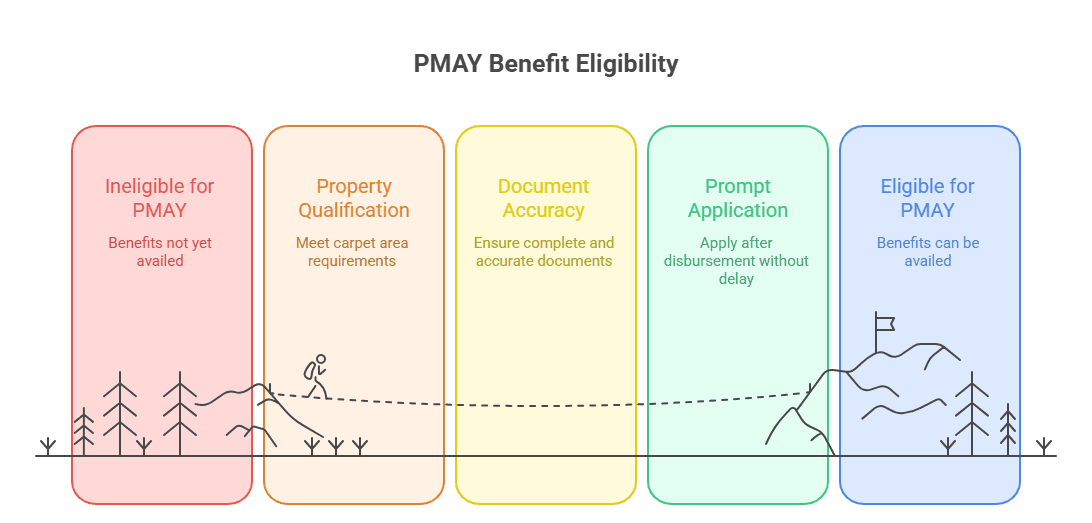
- To qualify, the properties must be within the prescribed carpet area limits.
- Ensure that all submitted documents are complete and accurate.
- Apply promptly after disbursement, as delays can affect approval.


Join The Discussion