
Are you planning to buy a home in Mumbai this year? Along with location and budget, one question that invariably confronts every buyer is: What about GST? Understanding the GST applicable to flat purchases in Mumbai in 2025 can help you avoid any last-minute, unexpected expenses during your cost calculations.
The fundamental rule is straightforward: GST applies only to flats that are currently under construction. If you are purchasing a ‘ready-to-move’ apartment—one that possesses an ‘Occupancy Certificate’ (OC)—then no GST is applicable.
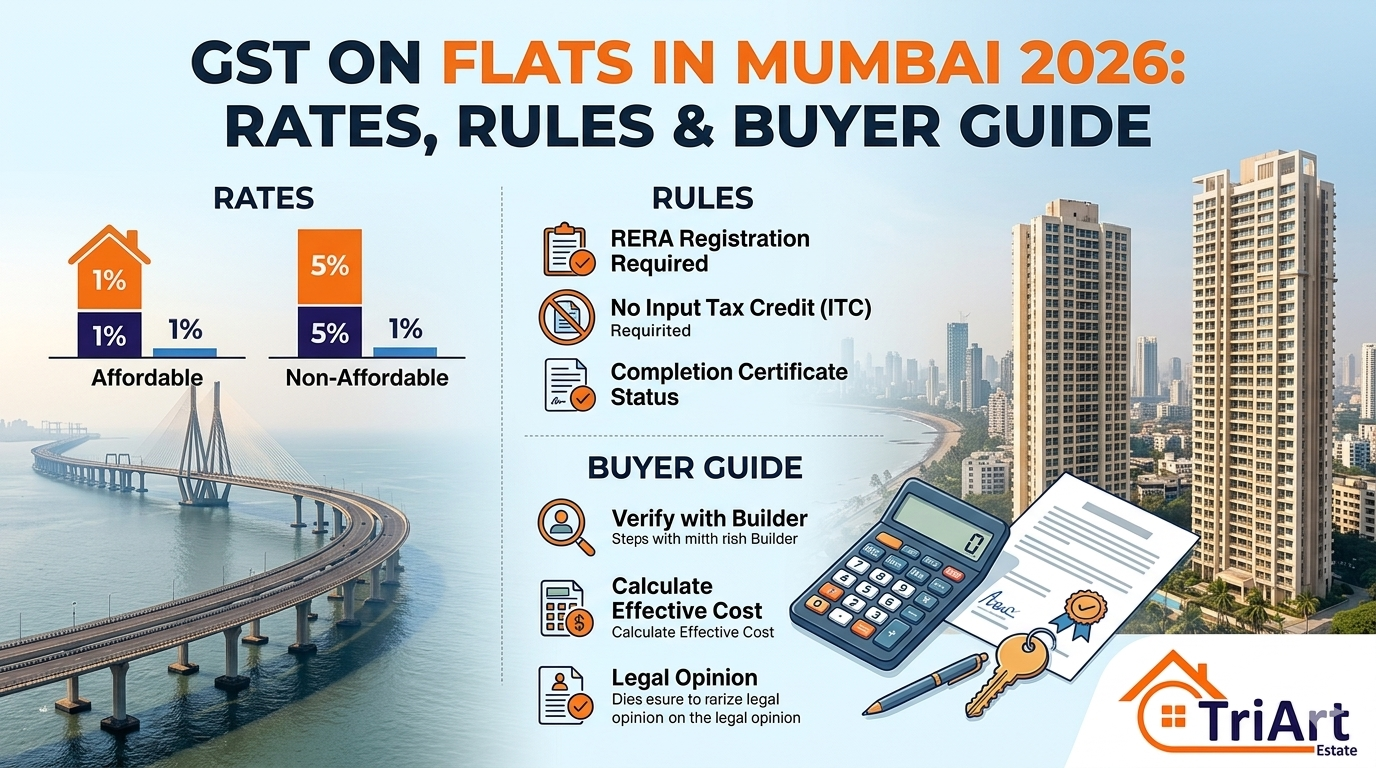
GST Rate on Flats in Mumbai 2026
The government has kept GST rates steady in 2025:
- 5% GST on under-construction flats.
- 1% GST on affordable housing.
- No GST on ready-to-move homes with OC.
So, if you’ve been eyeing a brand-new tower still being built in Thane or Navi Mumbai, factor in GST when planning your finances.
GST on Apartments in Mumbai
Activity surrounding apartments in Mumbai is always in full swing. Whether it is a high-rise building in Goregaon or a new project in Powai, most recently launched projects are still under construction. Consequently, GST will typically apply to apartments in Mumbai. Even if developers quote “all-inclusive” rates, it would be prudent to verify whether the stated total price includes GST.
Luxury Flats in Mumbai under GST
Are you looking to purchase a sea-facing flat in South Mumbai or an apartment in Lower Parel? The prices of luxury flats are exceptionally high—and so are the taxes applicable to them. In Mumbai, the GST on luxury flats stands at 5%, provided they are currently under construction. For properties worth several crores, this tax amounts to lakhs of rupees; consequently, ready-to-move luxury flats often prove to be a more prudent investment.
GST Impact on Property Buyers in Mumbai
For buyers, the impact of GST on property in Mumbai is mixed. On the positive side, GST has replaced several legacy taxes and simplified the payment process. However, conversely, it drives up the prices of under-construction properties. Consequently, in 2025, many people in Mumbai are increasingly gravitating toward ‘ready-possession’ homes—which are exempt from GST, allow for immediate occupancy, and entail lower risk.
Current GST Rates on Property
| Property Type | Previous GST Rate | Current GST Rate | Input Tax Credit (ITC) |
| Affordable Housing | 8% | 1% | Not available |
| Non-Affordable / Luxury Housing | 12% | 5% | Not available |
Effective from April 1, 2019, these revised rates were implemented by the GST Council to promote affordable housing.
Key Impact of GST on Property Transactions
The GST framework reduces tax complexities, particularly for buyers; however, developers may face increased costs due to the removal of ITC on luxury projects. This streamlined tax system promotes more affordable property ownership and aims to make the real estate market more transparent.
Pre-GST Vs. Post GST – What Has Changed?
Before the implementation of GST on July 1, 2017, the Indian real estate sector bore a heavy burden of various taxes, such as VAT, Service Tax, and Stamp Duty. These multiple taxes resulted in a ‘cascading effect’ (the impact of taxes being levied on taxes), which drove up the overall cost of property. Buyers were required to pay these taxes separately, making the process even more complex and increasing the overall cost.
With the introduction of GST, the tax regime became more streamlined; it introduced a uniform tax rate and simplified the entire process.
GST on Flat Purchase in 2026
1. GST on Under-Construction Flats
Generally, under the GST framework, a 5% tax is levied on under-construction properties; however, rates may vary depending on the type of project and its location. Developers can claim Input Tax Credit (ITC) on the materials and services utilized during construction; however, they are not obligated to pass this benefit on to the buyers. Buyers should explicitly inquire with developers regarding any ITC benefits, as this can impact the final price of the property.
2. GST on New Flats
The GST rate for new apartments under construction has been fixed at 5%. The final price of a new apartment may depend on whether or not the developer passes on the benefit of ‘Input Tax Credit’ (ITC) to the buyer.
Developers can claim ITC on the materials and labor used in construction, but passing this benefit on to buyers is not mandatory.
3. GST Rates for Flats Below ₹45 Lakhs
For flats priced under ₹45 lakh, the GST rate has been reduced to 1% (without Input Tax Credit, or ITC). The objective is to boost the affordable housing sector and the government’s “Housing for All” initiative. This concessional rate applies to under-construction properties that meet the prescribed size and price criteria for affordable housing.
| Criteria | Metro Cities | Non-Metro Cities |
| Carpet Area Limit | Up to 60 sq. m. | Up to 90 sq. m. |
| Maximum Price | ₹45 lakhs | ₹45 lakhs |
| GST Rate | 1% (without input tax credit – ITC) | 1% (without input tax credit – ITC) |
| Property Type | Under-construction affordable housing | Under-construction affordable housing |
The objective of these conditions is to make housing more accessible—particularly in growing urban areas—and to promote development within the affordable housing sector.
4. GST on Flat Purchase Above ₹50 Lakhs
| Criteria | Details |
| Applicable Property Type | Under-construction properties |
| Price Range | Above ₹50 lakhs (exceeds ₹45 lakhs limit) |
| GST Rate | 5% |
| Input Tax Credit (ITC) | Not available |
| GST on Completed/Ready-to-Move-in Property | Not applicable |
5. GST on Ready-to-Move Flats
- GST does not apply to ready-to-move-in properties holding a valid Occupancy Certificate, as they are classified as ‘goods’ rather than ‘services.’
- However, if a flat lacks a Completion Certificate or if interior work is still underway, it may still be deemed ‘under construction,’ and GST may be applicable to it.
6. GST on Registration of a Flat in India
- In India, GST does not apply to the registration of ready-to-move-in flats. Properties that possess a valid ‘Completion Certificate’ are exempt from GST.
- A ‘Completion Certificate’ is a legal document issued by the local municipal corporation or development authority. It certifies that a building (flat or property) has been constructed in accordance with the approved building plan and complies with local laws and regulations.
GST on Additional Property Costs in Mumbai
When purchasing a flat in Mumbai, the base price is merely the starting point. Developers often levy various hidden or additional charges for amenities and utilities. Under the current 2026 guidelines, most of these supplementary services are taxed at a flat GST rate of 18%—a figure significantly higher than the 5% rate prescribed for the primary residential unit itself.
Taxation on Amenities and Utility Connections
Although a concessional rate applies to the flat, the government treats additional services as separate taxable events. This encompasses everything—from parking spaces to the meter installed in your name.
- Utility Connections: Builders charge fees for the installation of electricity and water meters. Since these are considered administrative or construction services provided by the builder, they attract a GST of 18%.
- Infrastructure Charges: EDC (External Development Charges) and IDC (Internal Development Charges) are often collected directly from the buyer. If the builder acts as the service provider for these services, they are typically subject to an 18% tax.
- Parking and Clubhouse: If the charges for parking space or clubhouse membership are billed separately from the price stipulated in the apartment agreement, the applicable GST rate is 18%.
Summing Up on GST on Flats in Mumbai
In 2026, GST remains a significant cost factor in Mumbai’s real estate market. While ‘ready-to-move’ homes holding an Occupancy Certificate are exempt from this levy, under-construction properties attract a GST rate of 5% (or 1% in the case of affordable housing). Notably, additional charges—such as those for parking, club memberships, and utility connections—are taxed at a higher rate of 18%. Buyers often show a strong preference for ‘ready-possession’ properties to avoid these taxes, as they can add hundreds of thousands of rupees to the final cost of luxury and mid-segment apartments.
Read more: What is EOI in Real Estate? Full Form, Meaning & Key Benefits


Join The Discussion