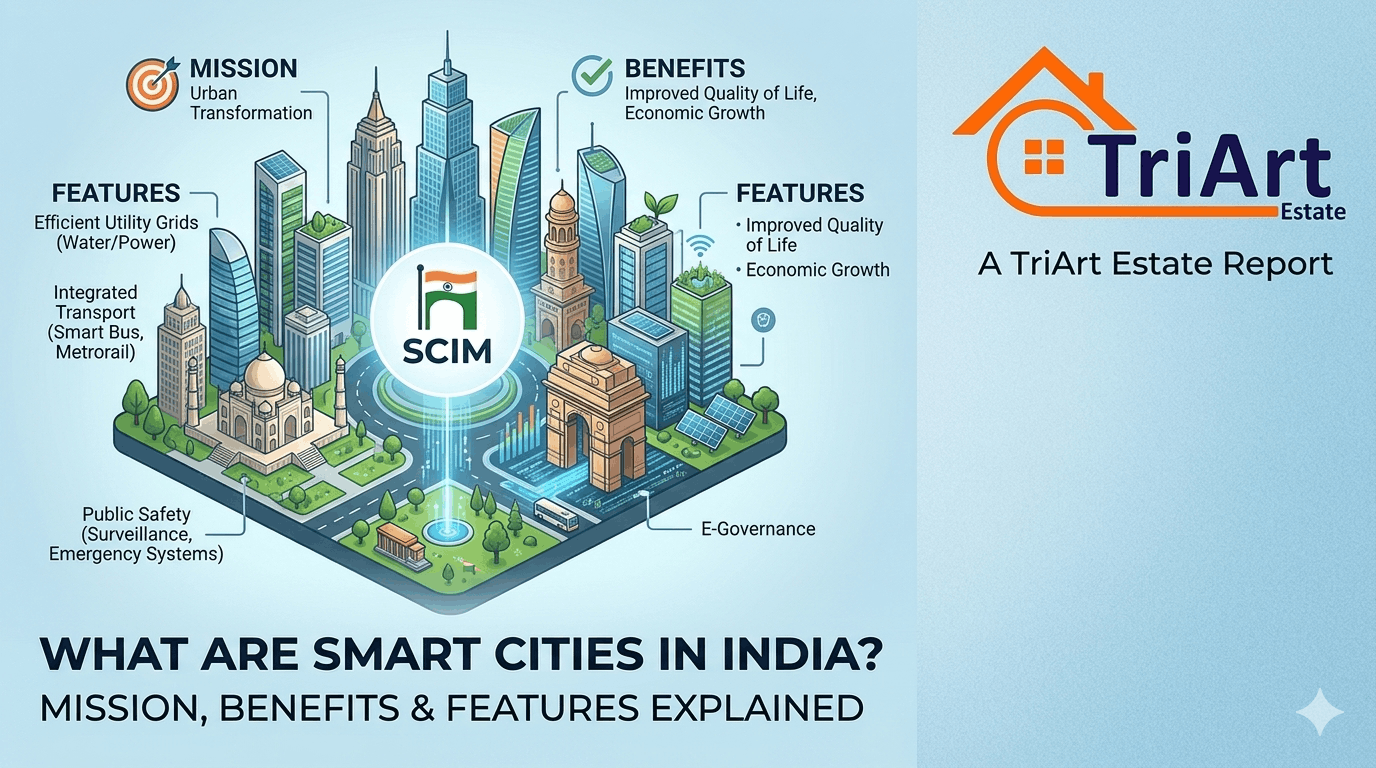
In 2015, the Government of India launched the Smart Cities Mission. Its objective was to improve infrastructure and foster economic growth in 100 cities across the country. Another aim of this mission was to create models within these cities that could be replicated in other urban centres, thereby inspiring other cities nationwide to aspire to become “smart.” The Smart Cities Mission assists urban residents in addressing socio-economic and environmental challenges.
In 2016, the first list comprising 20 cities was released, with the plan to complete the development of these 20 cities by 2022. These 20 cities were: Ahmedabad, Bhubaneswar, Pune, Coimbatore, Jabalpur, Jaipur, Surat, Guwahati, Chennai, Kochi, Visakhapatnam, Indore, Bhopal, Udaipur, Ludhiana, Kakinada, Belgaum, Solapur, and Bhuvanagiri; the area falling under the NDMC in New Delhi was also included in this list. In subsequent phases, additional cities were added to this list. The government has since updated the list to include 110 cities, and you can view the complete list of these 110 Smart Cities here.
An Overview of Smart Cities
As of 2023, 57% of the world’s population resides in cities. The United Nations estimates that by 2050, this figure will rise to 68%. This growing urban population will continue to exert constant pressure on the availability of urban services and resources—critical sectors that are already under strain. Against this backdrop, it comes as no surprise that the concept of the “Smart City” is gaining rapid popularity.
By definition, a Smart City is a municipality that leverages technology and data to enhance every facet of urban life. By integrating the Internet of Things (IoT), AI, and Big Data analytics, Smart Cities aim to create a seamless and interconnected environment where everything—from utilities like electricity and water to public services—operates with greater efficiency.
The ultimate objective is to create urban spaces that are more livable, resilient, and prepared to confront future challenges—such as population growth and climate change. Whether through energy-efficient buildings, smart transportation systems, or digital governance, the Smart City represents a modern and welcome approach to improving urban living. But where can city leaders begin this journey?
Features of the Smart Cities
Smart cities encompass a wide range of features, including a smart healthcare system, governance and administration, transportation systems, enhanced surveillance for security, smart infrastructure, improved employment opportunities, and all other facilities and amenities conducive to a comfortable life.
A city can be considered a smart city when it possesses the following characteristics:
- Society requires well-developed healthcare services, education, housing, and infrastructure.
- Providing essential services to the community reliably and affordably.
- Improved housing.
- Enhancing the economic growth of society.
- Effective management of resources to mitigate scarcity.
- Creating increased employment opportunities.
- A well-developed “smart plan” incorporating data analysis and broad-based community participation.
- Boosting the local economy.
- Proper management of urbanisation, along with strategies to address population growth and climate change.
- Leveraging smart technology to meet community needs.
- A well-organised transportation system.
These characteristics distinguish smart cities from other cities. Smart cities are developed with the specific aim of inspiring other cities to also improve their infrastructure to foster urban economic growth. The ‘Internet of Things’ (IoT), public safety, smart mobility, tourism growth, social infrastructure, and physical infrastructure—all these elements collectively facilitate the process of transforming a city into a smart city.
The key insights derived from the roadmaps of leading smart cities across the globe have been summarized into four pillars. These pillars include:
- An IoT-enabled infrastructure featuring a robust network of devices and applications.
- Intelligent Transport Systems, shared mobility services, and other elements help achieve effective mobility for smart cities.
- Cyber resilience strikes a balance between functionality and data privacy.
- Involving the community in smart city initiatives.
The foundation of smart cities is laid upon these very pillars. The integration of these amenities within the Smart City Project makes the transformation of cities into smart cities possible.
Transform a Normal City into a Smart City
To transform a city into a smart city, essential metrics are established following the collection of data. Subsequently, local authorities initiate specific smart projects and, upon their successful implementation, scale them up. Reviewing the experiences gathered from the community facilitates improvements in areas where they are most needed.
The steps to make a normal city a smart city are
Step 1: Gather data regarding the city and the key areas within it that require improvement.
Step 2: Define the scope for the city’s desired transformation, and simultaneously establish the available timeline and budget.
Step 3: Begin with one or two small-scale projects and complete them within the stipulated timeframe. During the execution of these projects, the city’s existing standard operating infrastructure and IT processes may be altered or modified.
Step 4: Scale up all of the city’s processes.
Step 5: Review the experience gained and initiate work on additional projects aimed at transforming a conventional city into a Smart City.
By adopting a step-by-step approach, officials can transform ordinary cities into smart cities for a better life.
Smart City Evolution and Technological Advancements
While smart cities may seem like a futuristic concept, their roots trace back to the early 2000s, when urban planners began integrating digital technologies into city infrastructure to enhance operational efficiency and improve the quality of life. Over the past decade, rapid technological advancements have significantly evolved the concept of smart cities. The incorporation of capabilities offered by IoT devices, AI, advanced data analytics, and 5G has fundamentally transformed the way cities function. This has paved the way for innovative AI solutions for smart cities, even as some companies continue to grapple with identifying and implementing effective strategies for leveraging AI.
One of the most common applications of AI in smart cities is traffic management. By utilizing real-time data gathered from sensors and cameras, AI can help alleviate traffic congestion by anticipating emergencies and responding to them with greater efficiency. Public transportation systems can also become smarter, providing real-time updates and seamlessly integrating with other modes of transport. Furthermore, smart grids, intelligent water infrastructure and management systems, and renewable energy sources are assisting cities in reducing their carbon footprint.
In essence, technology has transformed smart cities from a futuristic concept into a tangible and impactful reality, thereby setting a new benchmark for future urban development.
These emerging technologies—5G, IoT, AI, and Big Data—are driving the advancement of the smart city landscape. Examples from smart cities such as Singapore, Barcelona, and Toronto demonstrate how initiatives—ranging from autonomous public transportation to smart waste management systems—can be brought to life in novel and exciting ways. Further innovations in AI within the utilities sector could trigger the next wave of urban transformation, empowering city leaders to address critical issues such as sustainability and resource management.
Selection of Smart Cities
The task of transforming cities into Smart Cities is a monumental undertaking that entails numerous challenges. Therefore, to streamline this process, the Government of India established a specific procedure for the selection of Smart Cities. The detailed parameters and stages involved in the Smart City initiative can be accessed and understood by visiting the website of the Ministry of Housing and Urban Affairs at @mohua.gov.in.
States were required to submit an application to nominate their cities. Based on the submitted letters and detailed questionnaires, the Smart City Panel shortlisted the cities. Once the cities were shortlisted, each was assigned a consultant and an external agency. The role of the consultant and the agency is to assist the cities in planning and implementing the prescribed activities. Currently, the shortlisting process has been completed, and no new nominations will be accepted henceforth by the Smart City Panel constituted by the Government of India.
Why are Smart Cities Needed?
Smart cities help people lead better lives. Particularly during the pandemic and in the post-pandemic era, smart cities function more efficiently and are better equipped to support people in their daily lives. Here are some factors that underscore why smart cities are necessary.
- Enhanced Connectivity: Smart cities go hand-in-hand with smart infrastructure, which plays a pivotal role in improving connectivity across various parts of a city. This is achieved through the development of new and improved roadways, as well as enhanced public transportation systems. A key focus of this initiative is also on strengthening “last-mile connectivity”—ensuring seamless access right up to the final destination.
- Utility Management: In the modern era, the demand for utilities—such as electricity, water, and the like—has surged significantly. Consequently, the efficient and prudent management of resources has become imperative to meet this escalating demand. Through the framework of “connected smart cities,” various agencies can manage these utilities with greater efficacy. Furthermore, even in instances of power outages or technical malfunctions, issues can be addressed and managed in “real-time.”
- Improved Amenities: The smart city concept has led to substantial improvements in the civic amenities available within urban areas. Moreover, the capability to track usage-related activities allows for more effective planning regarding the maintenance and management of these facilities. For instance, numerous parks are being established in cities where gym equipment is made available free of charge. By utilising a monitoring system, authorities can detect wear and tear or malfunctions in this equipment—as well as in other sections of the park—and formulate maintenance plans accordingly.
Advantages of a Smart City
Smart cities offer numerous benefits to residents and service providers. Some of the key benefits of a smart city are listed below.
- Environmental improvement through the use of various systems
- Improved urban transportation
- Better utilization of time in hospitals and other public service centers
- Creation of safer communities
- Efficient and automated urban management
- Reduction in economic and natural input costs
- Evolution towards the ‘Internet of Things’ (IoT)
- Implementation of new business opportunities
- Creation of services tailored to citizens’ needs
- Effective data-driven decision-making
Disadvantages of a Smart City
Along with numerous benefits, transforming a city into a smart city also entails certain disadvantages. Some of the major disadvantages of a smart city are listed below.
- Dependence on technical service companies
- Increased asset costs, as construction and implementation become more complex
- A significant increase in electronic waste
- The need for greater technical capital investment
- The technological divide between smart cities and other cities widens even further.
Insights from the Implementation of Smart City Mission
As part of the implementation of the Smart Cities Mission, one hundred cities were shortlisted through several rounds of nominations and competitions. Some of the lessons learned from the implementation of the Smart Cities Mission are as follows:
- Developing the ‘Ease of Living Index,’ which facilitates a process of cross-learning among cities.
- Constituting a Special Purpose Vehicle (SPV) to implement the Smart Cities Mission.
- To date, Work Orders have been issued for approximately 7,959 projects across various cities. The total value of these orders stands at approximately ₹1,71,224 crore.
- Of these, approximately 6,271 projects have been completed. The value of these completed projects amounts to approximately ₹1,16,269 crore.
- Out of the total funds released for the implementation of the Smart Cities Mission (approximately ₹78,749.88 crore), 90% has been utilised. This utilized amount totals approximately ₹71,135.70 crore.
- At every level, an autonomous committee monitors the implementation of the Smart Cities Mission.
- The progress of Smart Cities is continuously monitored through a ‘Real-time Online Geospatial Management Information System’ (GMIS); this system is utilised for both project implementation and the tracking of fund utilisation.
Conclusion to Smart Cities in India
Smart cities are being developed on a large scale to enhance people’s standard of living and provide society with amenities that extend far beyond necessities. The concept of smart cities has improved infrastructure and ushered in the integration of technology across governance, surveillance systems, waste management, manufacturing, efficient transportation, and enhanced connectivity. Many cities across India are now implementing new policies and working on projects related to smart cities with the aim of transforming themselves into smart urban centres.
Read more: Smart Cities in West Bengal: Growth, Projects & Property Trends 2026