
Between 2016 and 2026, the Indian investment landscape underwent a dramatic transformation. You may recall the days—prior to the 2016 demonetization, which ushered in the era of digital transformation—when cash reigned supreme in financial transactions. Over the past decade, the way you manage your money has evolved in numerous ways—ranging from simple savings to more sophisticated asset allocation strategies.
Investors frequently ask how traditional safe havens like gold, growth engines such as mutual funds, and tangible assets like real estate stack up against one another. Over the last decade, we have witnessed both global health crises and significant market volatility; consequently, this is the opportune moment to analyze the Compound Annual Growth Rate (CAGR) of these three investment stalwarts.
Real Estate Performance: 2016-2026
Following the implementation of RERA, the real estate market ceased to be an unregulated “Wild West.” This regulation transformed a speculative market into a transparent environment where one could effectively monitor project timelines. Over the past decade, property prices in India have not followed a linear growth trajectory. Tier-1 cities like Mumbai and Bengaluru witnessed a consistent appreciation in prices (approximately 5–7% annually). Nevertheless, Tier-2 cities—driven by rapid construction activity—often outperformed these major metropolitan markets.
Most residential properties yield rental returns ranging from 2% to 3%. In contrast, commercial properties typically generate returns reaching 8% to 10%. When calculating one’s total financial assets, it is crucial to take into account the “leverage amount.” If you utilize a home loan to purchase a property, you can secure ownership of a substantial asset by making a relatively modest down payment. Furthermore, the tax benefits available under Section 24(b) can effectively reduce your interest burden and contribute to an increase in your overall net worth.
- The shift in regulation RERA and GST gave much-needed control to the development timetables
- Expanding Urban Areas – Brand new highways and metro corridors transformed the suburbs into hubs of high-value
- REITs are now available You are now able to purchase property through the stock market in less money
The Equity Engine: Mutual Funds, Real Estate, & the SIP Revolution
Between 2016 and 2026, the stock market demonstrated tremendous resilience. Despite a market downturn in 2020, the Nifty 50 staged a rapid recovery, thereby benefiting those who had invested in the market. Mutual funds emerged as a household name, as they eliminated the substantial upfront capital required for investing in real estate. You can initiate a Systematic Investment Plan (SIP) with as little as ₹500—something that is simply not feasible when investing in land.
Large-cap funds provided stability to the market, while the Mid-cap and Small-cap segments witnessed rapid growth during bullish phases. Diversifying investments across various sectors helped safeguard your capital, even if the growth momentum in certain sectors slowed down.
| Investment Type | 10-Year Estimated CAGR (2016-2026) |
| Nifty 50 Index Fund | 12% – 14% |
| Mid-Cap Mutual Fund | 15% – 18% |
| Fixed Deposit (For comparison) | 5.5% – 7% |
Outlining Gold’s Steady Climb Against Real Estate
For Indian families, gold serves as the most reliable safeguard during times of crisis. Between 2020 and 2024—a period marked by global market turbulence and skyrocketing gold prices—it acted as a natural hedge against rising inflation. Typically, when the Rupee depreciates against the Dollar, the price of gold tends to rise.
The most significant shift witnessed this decade has been a move away from physical jewelry toward alternative options. Sovereign Gold Bonds (SGBs) have now emerged as the premier investment choice for gold enthusiasts in India. In addition to appreciating in value alongside gold prices, these bonds also yield interest at an annual rate of 2.5 percent. This modest additional income significantly enhances the overall value of your assets compared to simply keeping gold bars locked away in a safe.
Direct Investment Comparison in India – Real Estate & 10-Year Growth Trajectory
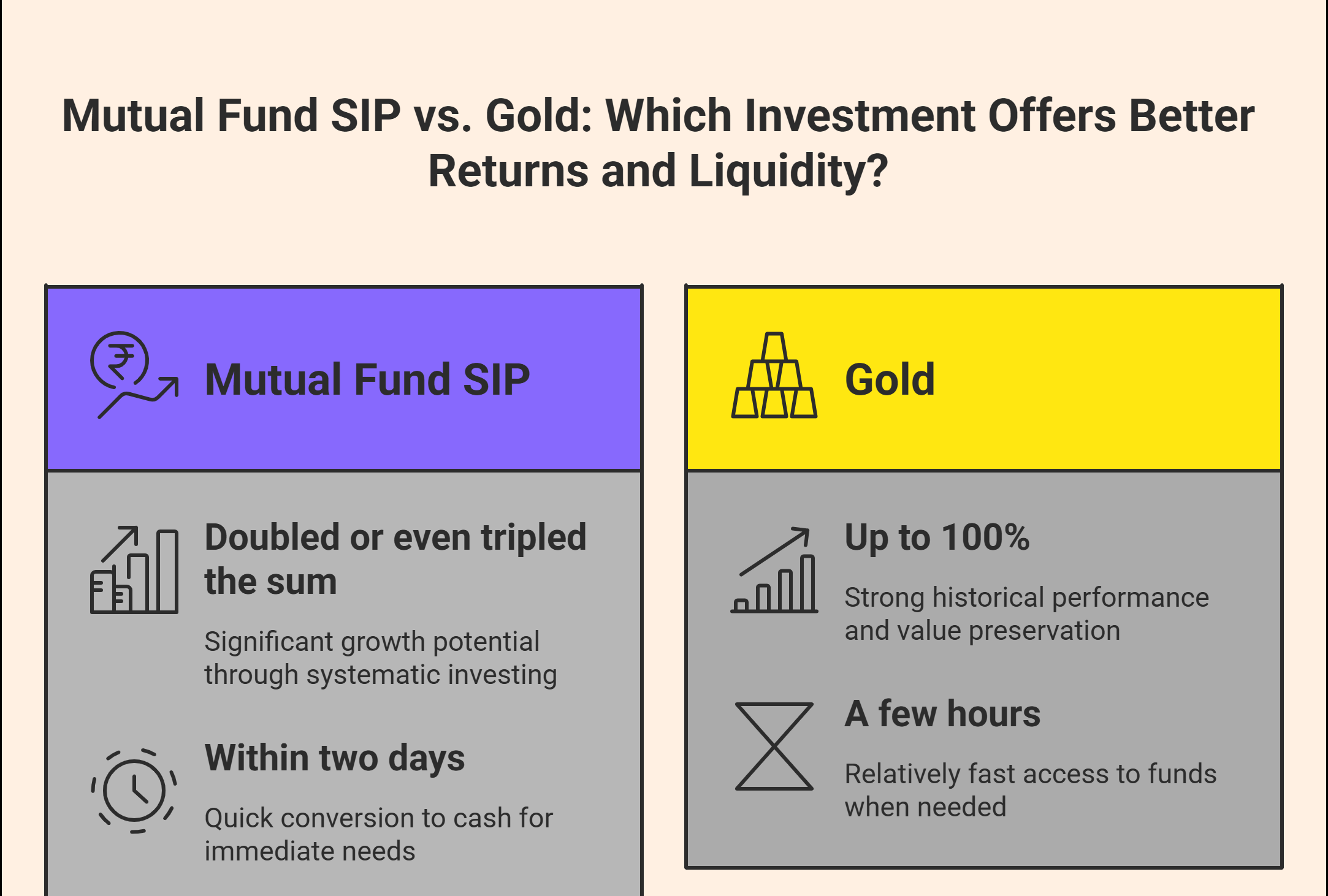
If you had invested ₹10 lakh in 2016, how much would that amount be worth in 2026? A wisely chosen mutual fund SIP might have doubled or even tripled that sum. Gold could have yielded returns of up to 100%, while simultaneously preserving your purchasing power. Returns from real estate vary significantly depending on the location. A plot of land in a rapidly developing suburb could appreciate fivefold, whereas an apartment with a stagnant valuation might fail to keep pace with the rate of inflation.
Liquidity—the ease with which an asset can be converted into cash—is the area where these investments differ most significantly. You can sell mutual funds and receive cash within two days. Selling gold might take a few hours. Looking to sell your home? That process could take up to six months. To compare investments over the long term, you must consider “exit velocity”—the speed at which you can liquidate your assets—alongside the actual returns generated.
Understanding the Hidden Costs
It is impossible to accurately analyze actual returns on your own. Real estate investments entail not only property taxes but also registration fees and maintenance costs (expect to incur an annual expense of 1% of the property’s value for maintenance). The cost of property registration alone can consume a significant portion of your initial capital. Mutual funds are governed by an “expense ratio,” which typically ranges from 0.5% to 2.2%. Gold investments carry storage-related risks, and when purchased in the form of jewelry, “making charges” are also applicable.
Taxation constitutes a distinct consideration. For equities, the Long-Term Capital Gains (LTCG) tax is levied at a rate of 12.5% on gains exceeding a prescribed threshold. Under specific circumstances, indexation may be applicable to real estate assets; this mechanism helps reduce the tax liability by factoring in the impact of inflation.
Identifying the Winner for 2026: Real Estate and Beyond
There is no single “winner,” as your needs are constantly evolving. If you require an apartment to live in while simultaneously growing your wealth, real estate is the best option. If you seek higher growth without the hassle of managing tenants, mutual funds are the ideal choice. The past decade has proven that a blended strategy constitutes the safest approach; relying solely on a single type of investment is not a sound idea.
When comparing returns from gold and property, bear in mind that gold serves primarily as a form of insurance, whereas property is often viewed as a traditional asset class. The most successful investors of 2026 maintain a diversified portfolio comprising a mix of these three assets to effectively manage both risk and returns.
Critical Factors for Choosing Your Next Investment
When it comes to inflation, indexation is your most reliable ally. You should seek out assets that appreciate even faster than the prices of essentials like milk or fuel. Typically, equities and real estate outperform inflation over the long term. The second factor is management effort—a crucial element. Mutual funds are the kind of assets that you can simply set and forget. Real estate, on the other hand, requires an active manager capable of handling maintenance tasks and legal due diligence.
Frequently Asked Questions
Q1. Which investment performed best in the last 10 years?
Ans: Mutual funds generally delivered higher returns compared to real estate and gold over the last decade.
Q2. Is real estate still a good investment option?
Ans: Yes, real estate offers stable returns, rental income, and long-term value appreciation despite slower growth than equities.
Q3. How did gold perform as an investment?
Ans: Gold provided safe and steady returns, especially during economic uncertainty, but lower growth than mutual funds.
Q4. Should I invest in mutual funds, gold, or real estate?
Ans: It depends on your goals—mutual funds for high growth, real estate for stability, and gold for safety and diversification.