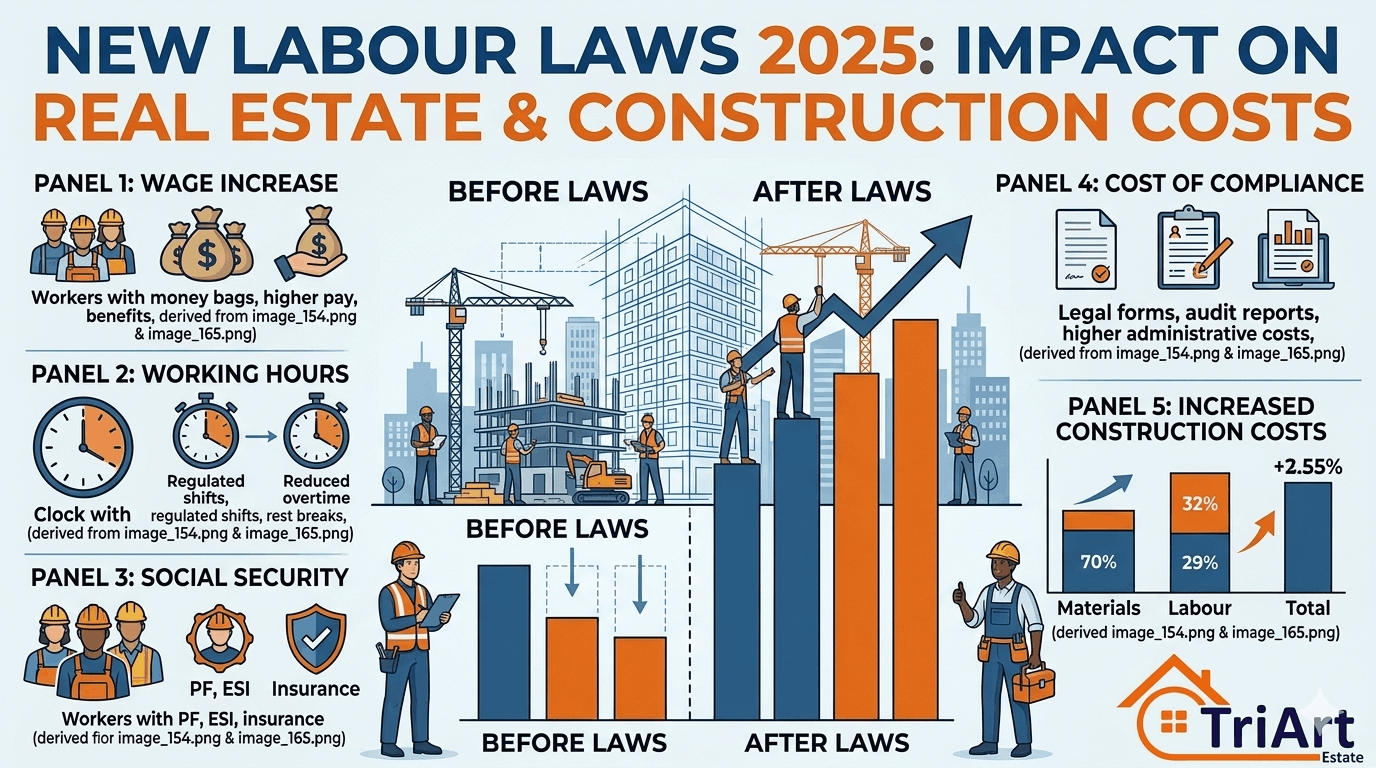
India’s updated labour laws, implemented in 2025, have introduced enhanced benefits for employees, stricter regulations, and increased project costs. Real estate and infrastructure developers may face longer project completion times and heightened pressure to comply with the new regulations. Here is a clear overview of what is changing and why it matters.
In November 2025, India finally implemented four major labor laws. These codes replace 29 old laws, which were scattered across various departments and caused considerable confusion. Now, everything falls under four comprehensive laws: Wages, Industrial Relations, Social Security, and Safety.
This shift is monumental for real estate and infrastructure companies. Construction work relies on thousands of laborers, long shifts, and strict deadlines. When regulations change on such a massive scale, the entire system is impacted. Developers across the country are attempting to gauge the extent to which construction costs will rise, how much the pace of work commencement might slow down, and how contractors will adapt.
This change will not be the same for everyone. Large builders with established processes may adapt quickly, while smaller players could face greater pressure. However, almost everyone agrees on one thing: the coming year will be a period of learning.
New Labour Laws 2025 Affecting Construction and Real Estate
This change will not be the same for everyone. Large builders with established processes may adapt quickly, while smaller players could face greater pressure. However, almost everyone agrees on one point: the coming year will be a time for learning.
- A new wage formula that will lead to increased PF and Gratuity contributions
- Appointment letters for all employees
- Overtime will be paid at double the standard rate
- Stricter health and safety inspections at worksites
- Documentation procedures for migrant and fixed-term employees will be streamlined
- Contractors will bear greater responsibility for maintaining accurate records
These changes may seem daunting right now, but they steer this sector toward a more organized labor system.
A workforce that built India, now getting overdue recognition
For years, India’s construction sites relied on thousands of workers—many of whom were migrants—who labored without fixed working hours, proper documentation, or established safety protocols. This often led to disputes, covert project delays, and inconsistent work quality across different projects. The new labor codes seek to address precisely these shortcomings. With fixed working hours, standardized wage structures, digital record-keeping, and stricter safety regulations, these reforms introduce a system of order where chaos once prevailed.
Higher costs now, smoother projects later
Changes in wages and new compliance regulations are likely to increase initial labor-related costs; however, the sector also believes that viewing these reforms merely as a financial burden would be to overlook the complete picture. N. Nagabhushan Reddy, MD of the NBR Group, stated, “Standardized processes are expected to reduce operational bottlenecks, enhance productivity, and make delivery cycles more reliable. While contractors and developers may initially require extra time to reorganize payroll, documentation, and digital tracking systems, the long-term outcome is expected to manifest as more streamlined and predictable project management.”
Why homebuyers may notice small shifts
Builders anticipate that, during this transitional phase, there may be some adjustments to project delivery timelines. However, over time, better-organized labor practices are likely to improve both construction quality and the consistency of delivery. “Real estate cannot progress on uncertain foundations. When the people building our projects feel safe, secure, and respected, the entire delivery chain is strengthened. These reforms reinforce this confidence and steer us toward more responsible and future-ready practices,” stated N. Nagabhushana Reddy.
“A stable workforce benefits not just the developers. It contributes to healthy urban development, boosts the purchasing power of workers’ families, and enhances investor confidence. A more organized labor framework can also attract long-term institutional capital into real estate projects—a goal the sector has been striving toward for years,” Reddy added.
Labour Cost Impact on Real Estate and Infra Projects
The most significant impact of the new codes is an increase in labor costs. Since the definition of wages has now become more comprehensive, developers are required to contribute higher amounts towards PF, gratuity, and insurance.
According to industry estimates, labor costs could rise by 5–12%, particularly in projects that rely heavily on unskilled or semi-skilled labor.
To understand where these costs are increasing, a simple table is provided below:
| Cost Component | What Changed After Codes | Effect on Developers |
| Wages + PF | More allowances in “wages” | Higher monthly payout |
| Gratuity | Wider eligibility | Larger long-term cost |
| Overtime | Double-rate payment | Expensive extended shifts |
| Compliance | More paperwork, audits | Need extra admin staff |
Developers now need to update their budgets and assess the extent to which the increase in costs will impact the selling price or project margins.
How Labour Laws Are Slowing Timelines and Construction Speed
Deadlines in the real estate and infrastructure sectors have always been stringent, but labor laws have introduced additional complexities. Workers are now required to undergo proper training before commencing work at the site.
This includes:
- ID checks
- Appointment letters
- Basic safety training
- Health checks when needed
- Digital attendance setup
Previously, contractors could mobilize hundreds of workers on very short notice. Now, gathering workers takes much longer. Developers state that even a one-week delay in each cycle of worker mobilization can prolong a major project by several months.
This impact is even more pronounced on infrastructure projects—such as highways, metro lines, and bridges—as they rely on the round-the-clock availability of workers.
Real Estate Sector Impact Under New Labour Codes
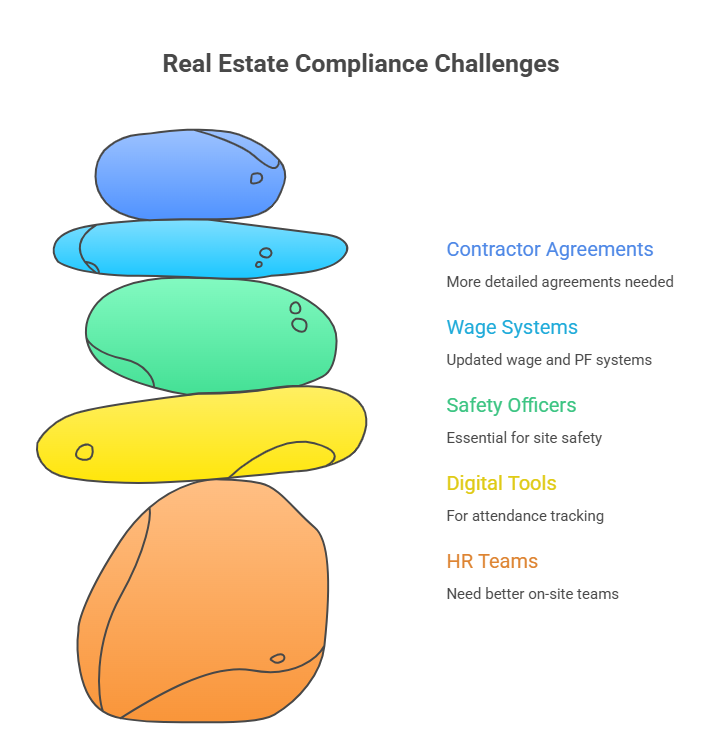
Real estate developers now require even more robust back-end systems. They must adhere to more stages of compliance, maintain streamlined records, and provide better training to their employees.
Many builders now require the following:
- Better HR teams on site
- Digital tools for attendance
- Safety officers
- Updated wage and PF systems
- More detailed contractor agreements
Small developers may face pressure, particularly if they still rely on informal labor arrangements. While this transition may be easier for large developers, it could still prove costly.
Infrastructure Sector Challenges Under Labour Law Compliance
Infrastructure projects require a large-scale workforce and multi-shift work systems. New laws have made this even more difficult, as shifts can no longer operate as independently as they did previously.
The challenges facing infrastructure projects are as follows:
- Strict working-hour limits
- Costly overtime
- Need for proper housing and sanitation in big camps
- More medical facilities
- Frequent compliance inspections
Since infrastructure projects already face delays due to land-related issues, weather, or utility shifting, changes in labor laws pose yet another hurdle.
Worker Benefits Under Labour Laws 2025 and Long-Term Outcome
However, while short-term pressures are real, the long-term outlook is more stable. Workers receive better protection, which means:
- Lower turnover
- Better skill levels
- Fewer disputes
- Fewer accidents
- More predictable labour availability
Developers who invest in training and utilize some mechanization can maintain their productivity, even when labor costs are high.
State-wise Labour Law Rules and Their Effect on Execution
Although the Labour Codes are central laws, states will implement them in varying ways. Some states may act swiftly, while others may take time.
Developers operating across different states will have to adhere to distinct procedures in each state, which could impact their planning and timelines.
Long-Term Impact of Labour Laws on India’s Realty and Infra Market
The coming year may witness cost pressures and a slow pace of project commencement; however, in the long run, this could result in a robust construction ecosystem. A more organized labor market brings with it enhanced safety, improved governance, and greater confidence for global investors.
Over time, as all stakeholders adapt to this new framework, instances of work stoppages in the real estate and infrastructure sectors will diminish, and project execution will proceed much more smoothly.
Conclusion: Labour Laws Bring Long-Term Structure
New labor laws increase costs and slow down the pace of projects, but they also incentivize the industry to upgrade itself. Real estate and infrastructure companies that quickly adapt to these changes will face fewer difficulties. The coming year may prove challenging, but the long-term structural framework can help this sector advance in a more stable manner.
Read more: MHADA Mumbai Lottery 2026: Apply Online, Dates, Eligibility & Prices