According to an administrative order issued in Jammu and Kashmir, the collection of J&K Property Tax will commence in the state’s municipal corporation areas starting April 1, 2023. The property tax rates have also been announced: 5 percent for residential properties (based on the annual taxable value) and 6 percent for commercial properties. It is reported that the Jammu and Kashmir government expects to generate revenue of approximately ₹150 crore from this property tax. It has also been noted that this tax is being levied in the Union Territory for the first time. Officials assert that these tax rates will be lower compared to those in neighbouring regions.
How To Calculate Property Tax in Jammu and Kashmir?
Residents of the state can calculate their property tax on the official website operated by the J&K Housing and Urban Development Department (JKHUDD).
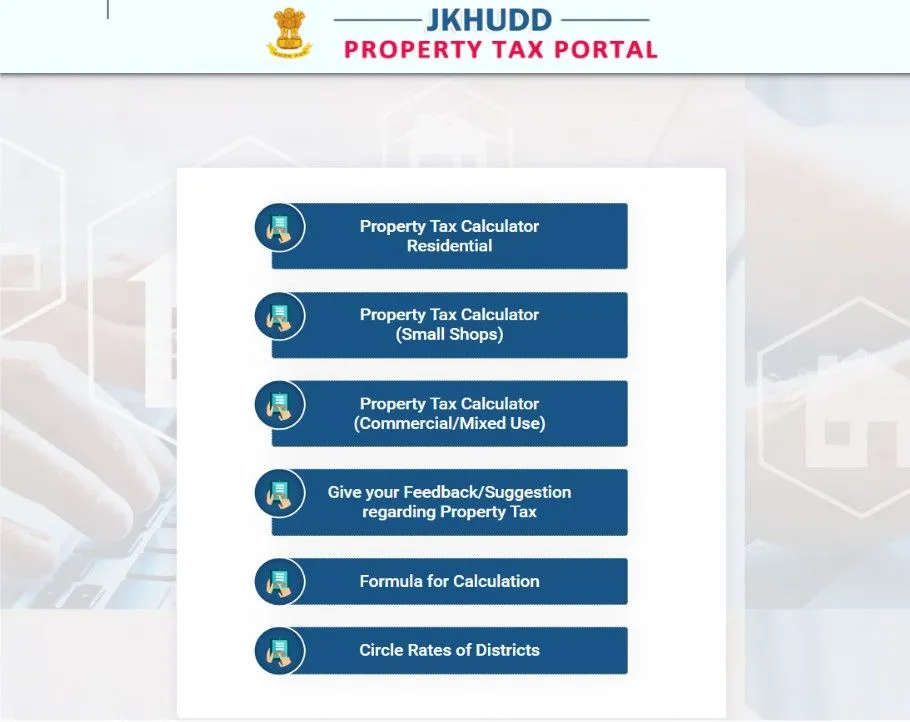
This website has the following options:
- Property Tax Calculator (Residential)
- Property Tax Calculator (Small Shops)
- Property Tax Calculator (Commercial/Mixed Use)
- Feedback/Suggestion regarding Property Tax
- Formula for Calculation
- Circle Rates of Districts
You can choose to apply for residential and commercial properties based on their size. This also includes complete details regarding the formula for calculating property tax. By selecting the ‘Circle Rate’ option, you can determine the circle rate for your location.
You can calculate the tax on residential property using these figures:
- Type of municipality
- Circle Rate (per Kanal)
- Builtup area (in Sq. ft)
- Usage type
- Construction type
- Age of building
- Occupancy
Formula to Calculate Property Tax
To calculate property tax in Jammu and Kashmir, you can use the formula given below:
Property Tax = Base Value of Built-up Area × Age Factor × Building Type × Usage Classification × Floor Factor.
How to Pay Property Tax in J&K Online?
Citizens can search for property details through the interface provided by the tax-levying department. You can also download property tax bills, make online payments, and obtain a copy of the payment receipt. The process for paying property tax in Jammu and Kashmir involves the following steps.
- First, the citizen must visit the official website of the Ministry of Defence, Jammu Cantonment Board, at https://jammu.cantt.gov.in/.
- The home screen will appear. On the screen, you can click on “Property Tax” under the “Public Services” section.
- The Property Tax page will appear as shown here. After scrolling down the page, click on the “APPLY” button.
- The eChhawani website will open and prompt you to select your preferred language. It is mandatory to select the language you wish to use.
- After selecting the language, the “Login” window will appear. To access the system, you must enter your mobile number along with an OTP.
- If you are not yet a member, click on ‘Register’. Sign up by entering your name and mobile number, selecting your Cantonment, and then clicking the ‘Continue’ button.
- Once registered, you will be able to log in using your mobile number and OTP.
- After logging in, you must select the “Search Property” option to locate the specific property you are looking for.
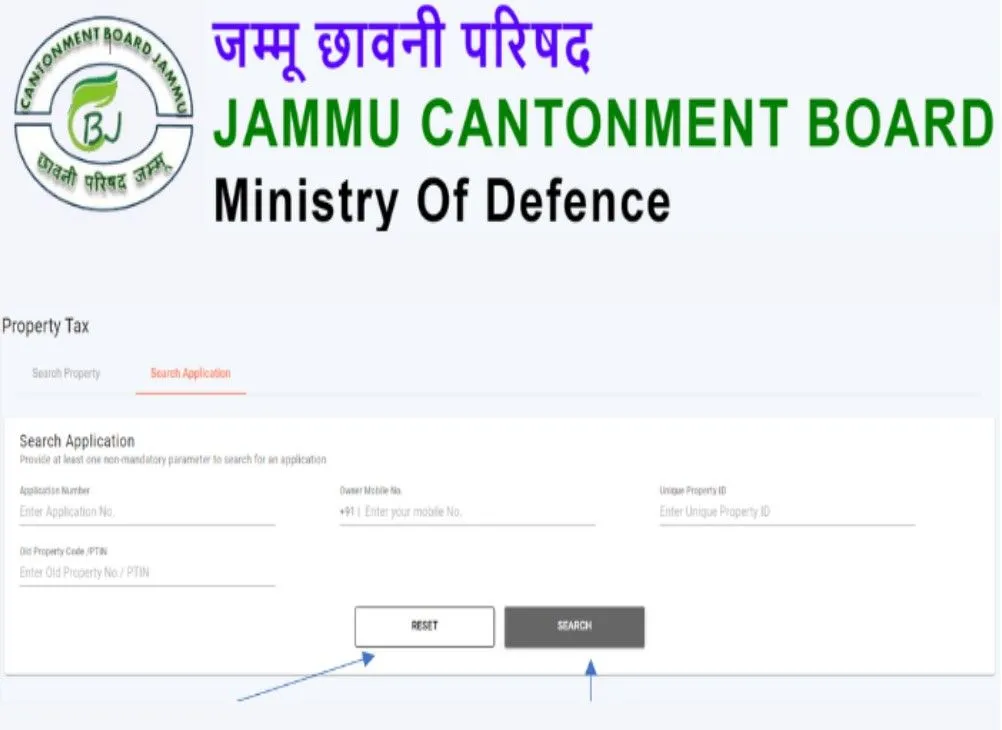
- Your property tax details will be displayed on the screen.
- After carefully reviewing the bill, you must use the property tax payment website—or the link received via SMS or email—to pay your property tax.
- Once this is done, you should save the invoice.
- You will be notified of any changes in the payment status via SMS and email.
- Download and print your J&K property tax bills and receipts for future reference.
How to Pay Property Tax in Jammu and Kashmir Offline?
If you wish to pay your property tax offline in Jammu and Kashmir, simply visit the office of your local Municipal Corporation, Committee, or Council. Obtain your property tax bill or challan by providing details related to your property, such as the owner’s name or ID.
Next, you will need to fill out the necessary forms at the office. Once the forms are completed, deposit the required amount with the Municipal Corporation officials. This payment can be made via cash, cheque, or demand draft. For future reference and as proof of payment, ensure that you safely retain your stamped and signed receipt.
Note: always verify the office’s working hours, carry the necessary property-related documents with you, and adhere to the prescribed deadlines.
Jammu and Kashmir House Tax on Residential Properties
The house tax in Jammu and Kashmir on residential properties is mentioned below-
| Residential Property | 5% of Taxable Annual Value (ATV) |
Jammu and Kashmir House Tax on Vacant Plots
The tax details are given below-
| Vacant Plots | No Tax Levied |
Jammu and Kashmir House Tax on Commercial Spaces
The tax details are given below-
| Commercial Spaces | 6% of Taxable Annual Value (ATV) |
J & K Property Tax
In the Union Territory of Jammu and Kashmir tax rates have been structured in a manner that minimizes the impact on small and home-based businesses, as well as on ordinary households, while ensuring that the incidence of taxation remains progressive.
- The tax levied as stamp duty in this region is analogous to the J&K Property Tax. To determine the taxable value of a property with greater precision, the property undergoes valuation using various methodologies; particular emphasis is placed on factors such as the age of the property, its usage, and the type of building structure.
- When calculating the Municipality Type Factor (MTF), the value has been fixed at 0.5 for Municipal Committees. For Municipal Councils, this value is set at 0.75.
- Unless specific circumstances outlined in the Act necessitate an alteration in the calculation (to facilitate an amendment or modification), the property tax computation for any given building shall remain valid for a block period of three years. A block commencing on April 1, 2023, is expected to remain in effect until March 31, 2026. Subsequent blocks shall be calculated in a similar manner.
- According to the regulations: “For new buildings constructed subsequent to the commencement of a block, the property tax liability shall be determined based on the start date of that specific block. Regardless of the duration for which such buildings were utilized during the three-year tax period, their tax liability shall be re-determined entirely afresh by the Corporation upon the commencement of a new three-year block.”
- If a property is subject to taxation for only a portion of a calendar year, the amount payable shall be calculated on the basis of complete months; incomplete months shall be excluded from the calculation.
Penalties for late payment of J&K Property Tax
Failure to file a tax return by the deadline may result in a penalty of ₹100 or 1% of the outstanding tax—whichever is higher—for every month in which the tax remains unpaid, provided there is no acceptable justification for such failure. The maximum penalty is capped at ₹1,000.
Factors Deciding Jammu and Kashmir Property Tax
Within Jammu and Kashmir the tax on property is figured according to the following criteria:
- Municipality Type: The type of municipal area in which a property is situated influences the calculation of taxes. Specific factors have been designated for this purpose—such as the Municipal Committee (0.5) and the Municipal Council (0.75).
- Land Value: In Jammu or Kashmir, the area of the land on which the property is situated or constructed.
- Built-up Area: The total size of the property, on which tax is levied only on the built-up portion.
- Usage: The purpose for which a property is being used—such as commercial or residential—is a significant factor. Residential properties are lower in value compared to commercial properties.
- Age of Property: In Jammu and Kashmir, taxes on older properties are likely to be lower compared to newly constructed properties.
- Occupancy: A property that is inhabited is more likely to be subject to property tax; however, vacant properties are also liable for property tax.
- Slab: The tax slab that is applicable for the particular property.
J&K Property Tax Rebates
No one enjoys paying taxes; however, taking timely action regarding the tax system in Jammu and Kashmir will help you save money. To help simplify this process for everyone, the government has introduced certain ‘Early Bird’ benefits for those who pay early.
The 10% Discount
The biggest benefit of this could be a 10% tax rebate. If you pay your entire annual property tax during the first few months of the financial year (typically by the end of July), a 10% deduction will automatically be applied to your total tax bill. This is an easy way to save money simply by staying organized.
Paying in Parts
If you are facing a financial crunch and do not wish to bear the entire expense at once, you can split it up. You can make the payment in two installments. You can pay the first half in July and the second half on November 30.
Who Gets a Free Pass?
The most appealing aspect to this J&K rule is the fact that it does not affect every person. If your home is smaller than 1000 square feet you won’t have to pay a single penny. You are totally exempt. Small-sized business owners who have tiny stores (up 100 sq ft) also receive a substantial break.
Avoiding the Penalty
Be sure not to allow the deadline to slip. If you’re not on time and they’ll charge you one month’s penalty equal to one percent of your tax, or Rs 100, or the more. It could go as high as 1000 rupees. It is always advisable to monitor the JKHUDD website, since they may change the goalposts, and offer users additional time should the site is acting up.
Properties Exempt from J & K Property Tax
If there exists a master plan in this area that prohibits development or construction on vacant land, or if—according to the monthly crop surveys conducted by the Revenue Department—the land has been utilized for agricultural purposes, then such vacant lands that are devoid of any attached structures or buildings shall be exempted from taxation.
Furthermore, all municipal properties, as well as places of worship—including mosques, churches, temples, gurdwaras, shrines, and cremation grounds or cemeteries—shall be exempt from property tax. However, the municipalities shall pay a service charge equivalent to 3% of the ‘Taxable Annual Value’ of such properties.
Frequently Asked Questions
Ques: What is J&K Property Tax 2026?
Ans: J&K Property Tax 2026 is a tax levied on property owners in Jammu & Kashmir, based on property type, location, and usage.
Ques: How can I pay J&K Property Tax 2026 online?
Ans: You can pay J&K Property Tax online through the official municipal or government portal using property details and secure payment options.
Ques: How is J&K Property Tax 2026 calculated?
Ans: The tax is calculated based on property size, location, usage (residential/commercial), and applicable government rates.
Ques: What happens if I don’t pay J&K Property Tax 2026 on time?
Ans: Late payment may lead to penalties, interest charges, or legal action as per Jammu & Kashmir municipal rules.