

When buying a new home, the base price of the property is just the starting point. The real budget is determined by the additional costs involved. From stamp duty to parking and maintenance charges, these expenses can increase your total budget by 10 to 15 percent. To avoid such last-minute surprises, TriArt Estates is highlighting some of the hidden costs of buying a home that first-time homebuyers should be aware of beforehand.
Most homebuyers plan their budget based on the property’s sale price, stamp and registration charges, and the subsequent monthly home loan EMIs. However, what often comes as a surprise are the hidden costs of buying a home, which can add several lakhs of rupees to the total budget. Therefore, before buying your first home, it’s crucial to understand the types of additional charges that may arise at different stages of the home-buying process.
The hidden charges of buying a home
Even with thorough planning, several expenses are often overlooked when buying a home, as they are typically considered “minor.” However, these costs can ultimately add up to hundreds of thousands of rupees. Besides stamp duty and registration charges, builders may also levy several hidden charges, which are discussed below:
Ignoring your credit score and loan eligibility
One of the most common mistakes first-time homebuyers make is not checking their credit score before applying for a mortgage. Credit history is a crucial factor that lenders consider when deciding whether to approve a loan, what interest rate to offer, and what repayment terms to provide. Even a small change in your credit score can significantly impact the cost of borrowing. This helps buyers understand their true budget and avoids the disappointment of choosing a home they can’t afford. A buyer’s eligibility for a loan is determined by their income, existing debt, job security, and financial behavior.
Underestimating the total cost of homeownership
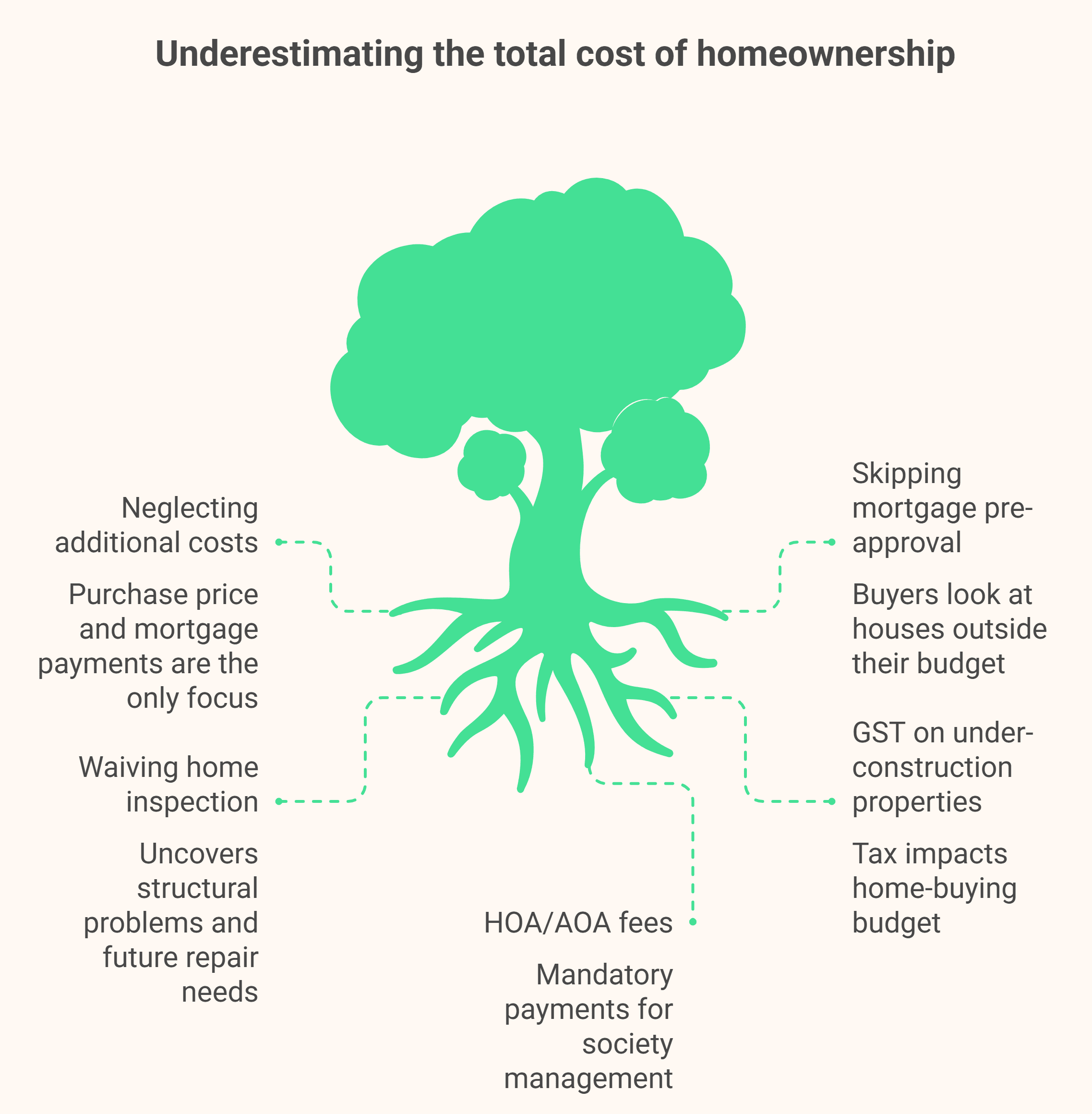
Most people focus only on the purchase price and mortgage payments when buying property, neglecting other costs such as stamp duty, insurance, legal fees, maintenance, and interior design. These additional expenses can significantly increase the true financial burden of buying a home. It’s also important to remember that property insurance, taxes, and maintenance costs continue to accrue after the purchase, meaning the actual cost of owning a property is much higher than just the mortgage payments.
Skipping mortgage pre-approval (In principle sanction in Indian context)
Another costly mistake is starting to look for a house without getting mortgage pre-approval. Mortgage pre-approval helps buyers understand how much they can afford and gives them more credibility with sellers. Without pre-approval, buyers might look at houses that are outside their budget. It also helps buyers make practical decisions rather than emotional ones, ensuring they don’t overextend themselves financially.
Waiving a professional home inspection
It’s always a good idea to get a professional home inspection before buying a house. Skipping a home inspection to save time or money can be costly in the long run. A home inspection can uncover structural problems, safety concerns, illegal modifications, and future repair needs that might not be apparent during a casual walk-through. While a home inspection involves an initial cost, it can save buyers from purchasing a home that will require expensive repairs down the road. Identifying problems early also gives buyers the opportunity to renegotiate the deal or even cancel it if they choose.
Goods and services tax (GST)
Understanding GST calculations is crucial as it directly impacts your home-buying budget. If you are purchasing an under-construction property, GST will be applicable. For residential projects, the GST rate is 5 percent, and for affordable housing, it is 1 percent. This tax is levied on the total cost of the property, which many first-time homebuyers overlook when budgeting.
However, if you purchase a ready-to-move-in property for which the builder has already received the completion certificate, you will not have to pay any GST. However, some local taxes may apply depending on the city. For example, in Mumbai, a 1 percent metro cess is levied in addition to stamp duty. Therefore, before finalizing any property, make sure to check whether it is ready-to-move-in to avoid significant tax expenses.
HOA/AOA fees
If you’re buying a home in a gated community or a large apartment complex, you’ll likely come across terms like HOA (Homeowners Association) or AOA (Apartment Owners Association). In simple terms, this is a committee or association formed by the flat owners, responsible for managing the day-to-day affairs of the society, including maintenance, cleaning, and security.
To ensure the smooth functioning of the society and to fund this committee, residents are required to pay a fixed fee. In many cases, the builder collects a one-time charge at the time of possession, or residents may be asked to pay a monthly charge after the association is formed. Since these are mandatory payments, be sure to factor them into your home-buying budget.
Electricity meter and gas pipeline installation charges
Setting up basic utilities is another expense that many homebuyers overlook. For new properties, you may have to pay an electricity meter installation charge, either to the developer or the local power provider. These charges typically range from ₹500 to ₹2,000. In resale homes, meters are usually already installed, although there might be a small fee to transfer the connection to your name.
The same applies to gas pipeline installation. This expense is mostly incurred in new homes or in areas where piped gas is available. The final amount depends on factors such as the length of the pipeline, the materials used, labor costs, and the type of property. On average, homebuyers should be prepared to spend between ₹5,000 and ₹25,000 for a gas connection.
Parking and advanced maintenance charges
When buying a new home, many people assume that parking is included in the property price. In reality, buyers often have to pay a separate and substantial amount for it. In cities, builders can charge anywhere from ₹1 lakh to ₹5 lakh for a secure, covered parking space. If you own more than one vehicle, this cost can increase even further.
Builders also charge advance maintenance fees at the time of possession for the upkeep of amenities such as security, cleaning, gym, pool, and parks. In many cases, builders demand one to two years’ worth of maintenance charges upfront, which can be a significant sum. When budgeting, be sure to factor in these expenses to avoid any unexpected financial burden at the time of possession.
Penalties for late stamp duty payment
Generally, stamp duty and registration charges are paid at the time of executing the final sale deed, after which property mutation is done to formally record the change in ownership. Any delay or underpayment in paying stamp duty may attract penalties and interest as per state laws, which are usually calculated as a monthly charge on the outstanding amount.
In serious or disputed cases, higher penalties may be imposed under the Stamp Act, but such penalties are not automatic and depend on the nature and duration of the default.
Buying a home is a milestone, and people often spend their entire life savings to have a roof over their heads. However, this process involves several payments at different stages of the home-buying process, making it difficult to keep track of unforeseen expenses. Therefore, a clear understanding of the hidden costs of buying a home is crucial so that homebuyers can budget their investment accordingly.
Conclusion
Just like the property price itself, buying a home involves several extra costs. To plan for these expenses, you need to be aware of the costs associated with buying a home, in addition to registration and stamp duty: brokerage fees, GST, and ongoing property insurance. If these costs aren’t factored into your budget, they can quickly become overwhelming. By understanding and preparing for these hidden costs, you can avoid unexpected financial stress and settle into your new home with confidence. Be sure to seek advice from trusted professionals and consider all related expenses to protect your investment and ensure your financial security.
Frequently asked questions
Q. What is the biggest cost after buying a house?
A. The biggest cost after buying a house is usually home loan EMI, followed by maintenance charges and property tax.
Q. What are the extra charges when buying a house in India?
A. Extra charges include stamp duty, registration fees, GST (if applicable), legal fees, brokerage, and maintenance deposits.
Q. What are MOD charges in a home loan?
A. MOD (Memorandum of Deposit) charges are fees paid to register home loan documents with the local sub-registrar.
Q. What is the least expensive way to buy a house?
A. Buying a resale property, negotiating the price, and avoiding brokerage can reduce overall costs.



Join The Discussion