Property tax is the most common local tax paid annually in India. This tax is paid to the local municipal body (Nagar Palika) or Gram Panchayat of the jurisdiction where the property is situated. The revenue generated from this tax is utilised to fund specific municipal services for the residents of that area—such as roads, streetlights, sanitation, water supply, and waste collection—all of which contribute to enhancing the quality of life for the people. If you own any property in any part of the country—whether it is a flat, an independent house, a commercial space, or a plot of land with a built-up structure—it is mandatory to pay property tax on it.
Property tax calculators are online tools that enable you to estimate the amount of tax payable on a specific property. These calculators compute the tax liability by utilizing details such as the property’s geographical location, its built-up area, the type of property, and its age. Most municipal bodies in India now provide their own dedicated calculators on their official websites. Additionally, several third-party real estate websites also offer calculators for general use, covering over 180 cities across all 36 states and Union Territories of the country.
Why Property Tax Matters Before You Buy
- Most buyers take stamp duty and registration fees into account when calculating the cost of acquisition. However, property tax is an annual expense that is often overlooked until the first municipal notice is issued.
- For a 1,000-square-foot home located in the mid-zone of Bengaluru, the property tax would range from approximately ₹3,500 to ₹7,000, depending on the age of the property and the floor level. In Mumbai, the same property could attract an annual tax liability of ₹8,000 to ₹18,000, determined based on the ‘Annual Rental Value’ method. In various localities across Delhi, the tax on properties—calculated based on their Annual Ratable Value—can vary significantly depending on the specific zone.
- Using a property tax calculator prior to making a purchase helps buyers understand their annual tax liability and determine whether it fits within their budget alongside maintenance fees, home loan EMIs, and other recurring expenses.
How Is Property Tax Calculated in India
India is not a country where there is a single, standardized method of calculation. The methods employed by municipal corporations vary from city to city and state to state. There are three main methods:
1. Unit Area Value System (UAS)
- This is the most widely used method. Property tax is calculated at a per-square-foot rate, determined based on the built-up area; and this rate is adjusted based on various factors.
- Formula:
Property Tax = Built-up Area × Unit Area Value × Age Factor × Floor Factor × Usage Factor × Zone Factor × Tax Rate
- The cities where this method is employed include Delhi, Bangalore, Hyderabad, Patna, and Kolkata. The unit area rate (per square foot) for each zone of the city is determined by the municipal board. Older properties are assigned a lower age factor, which results in reduced tax liability. A floor factor is applicable to upper floors. For commercial properties, the rates applicable based on usage are higher than those for residential properties.
2. Capital Value System (CVS)
- Thus, this tax is a fixed percentage of the property’s value, determined by local authorities.
- Formula:
Property Tax = Market Value x Tax Rate (typically 0.05% to 0.25%)
- Mumbai serves as a prime example of this. Since market values are higher in prime localities, this method results in higher taxes on properties situated in expensive areas. The government releases ‘Ready Reckoner Rates’ annually, which serve as the basis for this valuation.
3. Annual Rental Value System (ARV or RVS)
- Thus, this Property Tax is based on the amount that a property can potentially earn annually as rent. It is not the amount that it actually earns.
- Formula:
Property Tax = Annual Rental Value x Tax Rate
- The cities where this method is employed include Chennai, certain parts of Hyderabad, and various long-established municipalities. Based on a property’s location, size, condition, and the amenities available therein, the municipal corporation estimates its annual rental value. The applicable tax rate is then applied to this estimated value.
What Factors Affect Property Tax in India
Many inputs affect the amount of taxes a property will be subject to. Knowing them will allow you to make the most of your calculator:
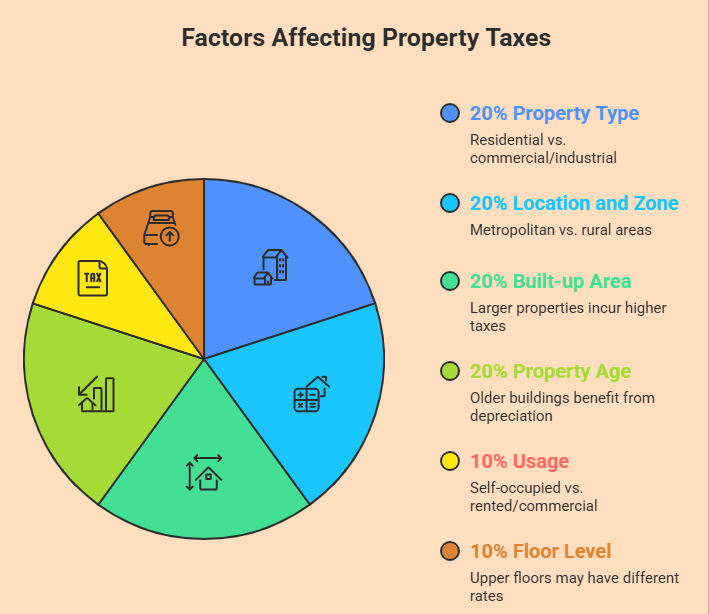
- Property Type: Residential properties attract lower taxes compared to commercial or industrial properties. In most states, agricultural land is exempt from taxation.
- Location and Zone: Properties located in metropolitan cities are subject to higher taxes than those in suburban or rural areas. Within a city, the zonal classification plays a significant role; properties situated in premium zones command a higher unit area value.
- Built-up Area: Larger properties incur higher tax liabilities. Most tax calculators require the input of either the carpet area or the built-up area, typically measured in square feet.
- Property Age: In systems where tax calculations are based on the age of the property, older buildings benefit from depreciation allowances. Generally, a 20-year-old apartment is subject to lower taxes than a newly constructed apartment of the same size.
- Usage: The applicable tax rate varies depending on whether the property is self-occupied, rented out, or utilized for commercial purposes.
- Floor Level: In cities that employ the Unit Area System (UAS), properties located on upper floors may be taxed at a different rate, in accordance with the regulations established by the municipal corporation.
Benefits of Using a Property Tax Calculator
This eliminates the need for guesswork. Instead of waiting for a municipal notification or searching for a broker who might not know the correct formula, this calculator provides an accurate estimate based on the specific guidelines used by your municipality.
It aids in planning property purchases. If you are evaluating two properties—one located in a premium locality and the other in a lower-priced area—the difference in property tax liability could amount to several thousand rupees. This figure should be factored into any cost-benefit analysis.
It highlights applicable rebates. Many calculators in India now automatically display available rebates, including early-payment discounts ranging from 5% to 15%, senior citizen concessions between 10% and 50%, and incentives for eco-friendly features such as rainwater harvesting systems. Many property owners remain unaware of these benefits simply because they lack information regarding the available rebates.
It assists in the process of determining rental rates. Property tax paid on a rented-out property is deductible from rental income under Section 24(b) of the Income Tax Act. Knowing the exact tax liability enables landlords to accurately determine rental rates and calculate their net yield.
It helps you stay on track. Failure to pay property tax can result in penalties, typically ranging from 1% to 2% per month on the outstanding tax amount. In Delhi, the maximum annual penalty rate stands at 18%. After three months of non-payment, municipal authorities may disconnect electricity and water supplies. In cases of non-payment (or insufficient payment) persisting for three years or more, the property may be put up for auction. A calculator helps keep your annual tax liability clearly in view, ensuring it is never overlooked.
How to Use a Property Tax Calculator Online
Most municipal corporations now have their own websites. On their websites, they provide an integrated calculator on the property tax payment page. Additionally, some third-party platforms, such as MagicBricks, also offer generic calculators that can be used across multiple cities.
To use any property tax calculator, the following information will generally be required:
- Your property’s location (city, zone, ward number if known)
- Built-up area in square feet
- Age of the property
- Property type (residential, commercial)
- Occupancy status (self-occupied or rented)
This calculator estimates the tax for the year. For official payments, please cross-check the figures provided on the municipal corporation’s website; this is where you will find an accurate assessment of your tax liability and details regarding outstanding dues, accessible via your Property ID.
Frequently Asked Questions
Ques. What is Property Tax?
Ans. Property tax is a yearly tax paid by property owners to local municipal authorities based on the value and type of property.
Ques. How is Property Tax Calculated?
Ans. Property tax is calculated using factors like property size, location, usage type, and government-approved valuation rates.
Ques. Can Property Tax Be Paid Online?
Ans. Yes, most municipal corporations offer online property tax payment facilities through their official websites and mobile portals.
Ques. Why is Paying Property Tax Important?
Ans. Paying property tax on time helps avoid penalties and supports public services like roads, sanitation, and infrastructure development.