
An easy guide to home loan agreements, covering essential documents and key points you should understand before signing.
Taking out a home loan involves more than just EMIs and interest rates. There is one document that essentially governs everything—the loan agreement.
This is the document you sign before receiving funds from the bank. It clearly outlines the amount you are borrowing, your repayment method, and all the associated terms and conditions.
Since home loans span many years, even the minutest details within this agreement carry significant weight. Therefore, before signing anything, it is crucial to fully understand what this document entails and how it functions.
What is a Home Loan Agreement Contract?
A loan agreement is a legally binding document signed between a borrower and a lender.
In the case of a home loan, this agreement includes the following:
- Total loan amount approved
- Interest rate (Fixed or Floating)
- EMI amount and schedule
- Loan tenure
- Property details
- Terms and conditions
Once signed, both parties must adhere to the terms outlined in this agreement.
Why is a Home Loan Agreement Important?
Many people focus solely on the EMI and interest rate, but the agreement matters just as much.
The reason for this is:
- It clearly defines your repayment terms.
- It protects both you and the lender legally.
- It prevents any future complications.
- It outlines penalties, fees, and terms.
- It serves as evidence in case of any dispute.
In the case of home loans, even the smallest details of the agreement can make a significant difference over time.
When Do You Sign a Home Loan Agreement?
In the home loan process, the agreement is typically signed after the following period:
- Your loan is approved
- Property verification is done
- Final loan terms are agreed
The loan amount is disbursed only after the agreement is signed.
Key Elements of a Home Loan Agreement Contract
A proper home loan agreement includes the following:
1. Borrower and Lender Details
Full details of both parties involved
2. Loan Amount
The total amount sanctioned by the bank
3. Interest Rate
Fixed or floating rate clearly mentioned
4. EMI Details
Monthly payment amount and due dates
5. Loan Tenure
Total repayment period (10, 20, 30 years)
6. Property Details
House or flat linked to the loan
7. Penalties and Charges
Late payment charges, foreclosure charges, etc.
8. Security
Property itself acts as collateral
Types of Home Loan Agreements
Home loans come in various types, based on how interest is charged on them and how the loan is disbursed.
| Type of Loan Agreement | How It Works | Best For |
| Fixed Rate Loan Agreement | Interest rate stays the same for a fixed period or full tenure | People who want stable EMIs |
| Floating Rate Loan Agreement | Interest rate changes based on market conditions | People okay with EMI changes |
| Hybrid Loan Agreement | Starts fixed, then becomes floating later | Those who want initial stability |
| Construction-Linked Loan Agreement | People are okay with EMI changes | Under-construction property buyers |
Home Loan Agreement Documents You Need
For a home loan agreement, the following documents are required:
- Identity proof (Aadhaar, PAN)
- Address proof
- Income proof (salary slips, ITR)
- Bank statements
- Property documents
- Sale agreement of property
These documents are used for the verification of both the borrower and the property.
How Long Does Loan Agreement Processing Take?
Once your loan has been approved, the agreement process typically takes some time.
- Drafting of Agreement: A few days
- Verification and Review: 3–7 days
- Final Signature and Disbursement: Depends on the lender
In most cases, this process is completed within 1–2 weeks.
Common Problems in Home Loan Agreements
People face difficulties even with home loans.
- Failure to properly understand floating interest rates
- Overlooking hidden charges
- Confusion regarding EMI calculations
- Not reading the penalty clauses
- Signing without reading the terms and conditions
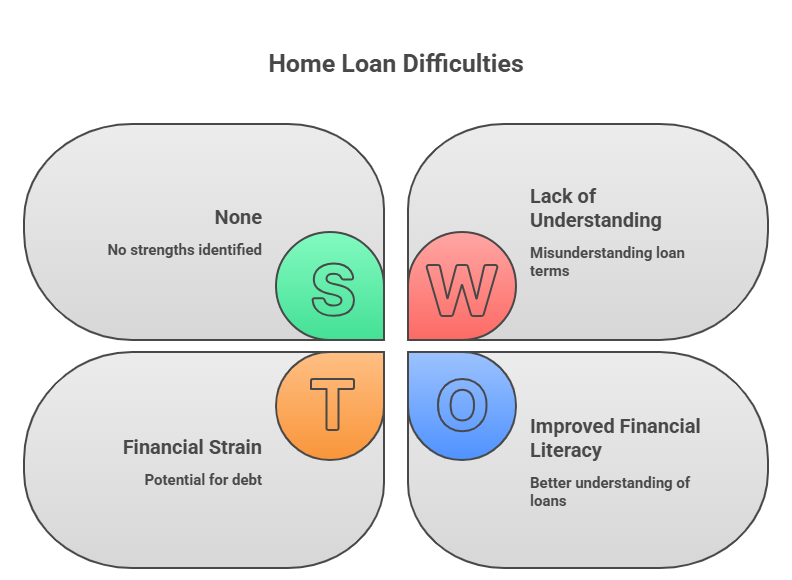
Most problems arise because people do not read agreements carefully.
Basic Loan Agreement Contract Template (Simple Format)
Here is a sample of a basic loan agreement contract:
This is merely a simple sample of a loan agreement. In reality, home loan agreements are far more detailed, but their structure remains similar to this one.
If you are using a loan agreement form, keep the following in mind:
- Fill in all details accurately.
- Cross-check the details against official documents.
- Clearly verify the loan amount and EMI.
- Do not leave any fields blank.
- Review everything before signing.
Tips Before Signing a Home Loan Agreement
Before signing your home loan agreement:
- Read all terms and conditions carefully.
- Understand the type of interest (fixed or floating).
- Check the EMI details.
- Inquire about hidden charges.
- Do not rely on verbal promises.
Take your time. This is a long-term commitment.
Is a Loan Agreement Legally Valid?
Yes, a signed loan agreement is legally valid.
In the case of a home loan:
- It can be enforced in court.
- It protects both the borrower and the lender.
- It is essential for property financing.
Final Thoughts on Home Loan Agreement
In the context of a home loan, the loan agreement is not merely a formality; it is the document that governs your entire repayment journey. Before signing, ensure you fully understand what you are agreeing to. Spending a few minutes reading it carefully can save you years of confusion down the road.
Read more:Ready Reckoner Rates Maharashtra 2026: City-Wise RR Rates & Stamp Duty
Q1. What are the most important clauses to review in a home loan agreement?
Ans: Review the loan amount, interest rates, repayment terms, fees and penalties, and terms related to default and foreclosure.
Q2. How can I negotiate better terms in my home loan agreement?
Ans: Improve your credit score, compare multiple offers, and negotiate for lower interest rates, lower fees, and easier repayment terms.
Q3. What happens if I default on my home loan?
Ans: Defaulting can result in penalties, increased interest rates, and potentially the seizure of assets. It will also have a negative impact on your credit score.