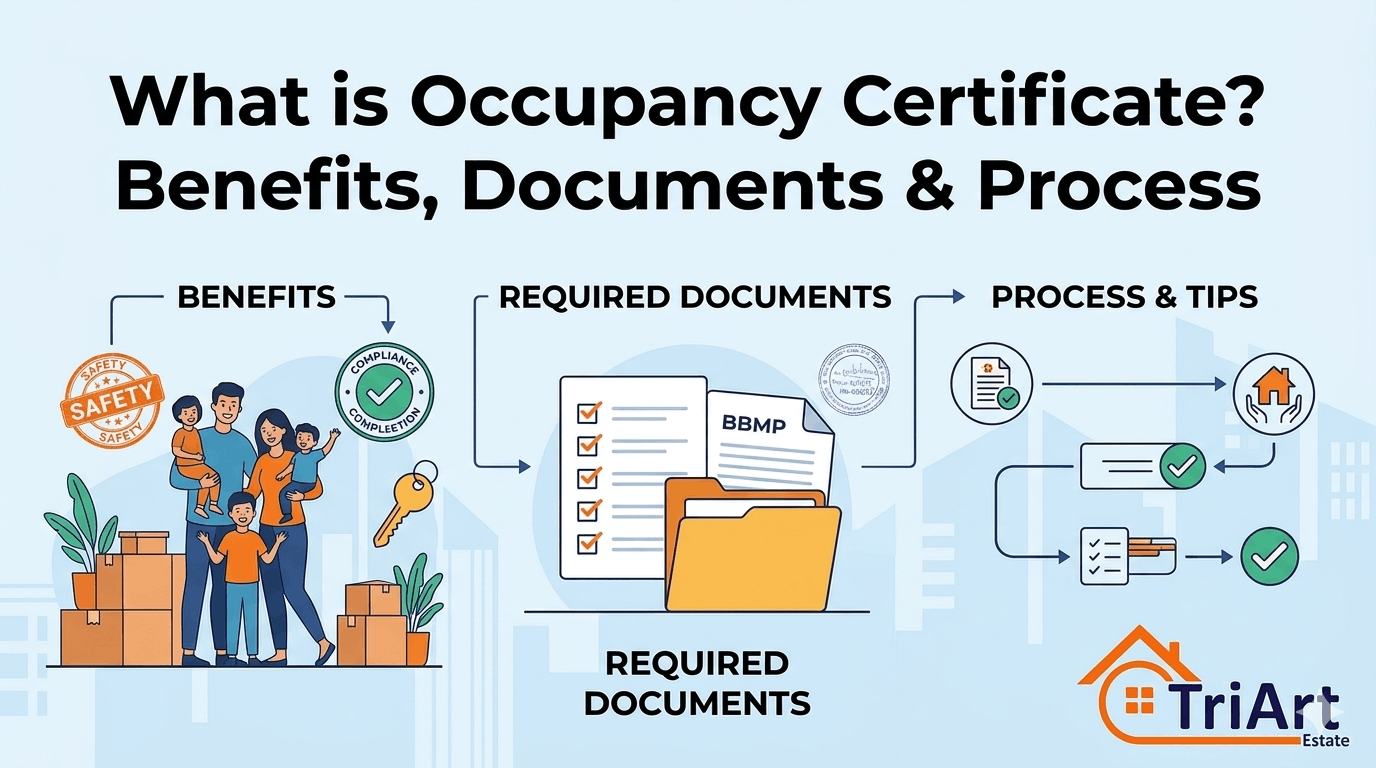
An Occupancy Certificate is a legal document issued by a local authority or government agency. It confirms that the constructed property complies with standard regulations. Read more.
When purchasing a new home, the ‘Occupancy Certificate’ is considered an essential document, as it confirms that the property has been constructed in strict compliance with prescribed laws. Let us take a look at what an Occupancy Certificate is, what it signifies, and why obtaining one is considered crucial these days.
What is an Occupancy Certificate?
An Occupancy Certificate is a document issued by the local municipal authority or the building department. It certifies that a building complies with approved building plans and safety standards. It confirms that the building is safe for habitation and has been constructed in accordance with prescribed building codes and regulations.
Key Characteristics of an Occupancy Certificate
- Safety Compliance: The OC ensures that the building complies with all safety regulations, including fire safety, structural stability, and adherence to local building codes.
- Legality: It is a legal document that is mandatory for legally occupying a building. Without an OC, the building is considered illegal for habitation.
- Approval of Building Plans: The OC verifies that the construction work has been executed strictly in accordance with the approved plans, without any deviations.
Importance of an Occupancy Certificate
An Occupancy Certificate is necessary for several reasons:
Legal Requirement
In many places, obtaining an OC (Occupancy Certificate) is mandatory before occupying a new or recently renovated building. Residing in the building without this certificate may result in legal action, fines, or even eviction.
Safety Assurance
The OC ensures that the building complies with all safety standards, including fire safety measures, electrical safety, and structural integrity. This is crucial for the safety and well-being of its occupants.
Utility Connections
Obtaining an OC (Occupancy Certificate) is often a mandatory prerequisite for securing utility connections such as electricity, water, and sewage. Utility companies typically require a copy of the OC before providing their services.
Property Transactions
When buying or selling a property, having an OC (Occupancy Certificate) is essential. It serves as proof that the building has been constructed legally and is fit for habitation, thereby making it easier to secure loans and insurance for the property.
Financial Transactions
Banks and financial institutions typically require an OC (Occupancy Certificate) to complete the home loan process. This serves as an extremely important document, assuring lenders of the property’s legal validity and safety.
What does a Property with an Occupancy Certificate mean
- That the property is constructed according to the law and the approved plan
- It has met legal requirements, making it habitable
- That the building has been constructed in compliance with the building code
- It has all the basic needs required, such as drainage, electricity, etc.
- That all the required clearances, including the NOC from the fire department, are obtained
How to get an Occupancy Certificate
To obtain the Occupancy Certificate, you will need to follow the steps listed below:
- Visit the local development authority or municipal corporation in the area physically or navigate to their official portal online. Each region is likely to have its own portal dedicated to property-related registration and other services.
- On the portal, new users need to create an account by registering their details.
- You will find the Occupancy Certificates Section, where you need to fill out the online application form.
- Provide property ID details, building permit number, and related information.
- Submit the list of documents- fire safety certificate, approved building plans, completion certificate, and structural safety certificates. Double-check to see that the documents meet the exact size and format specifications as mentioned on the portal.
- Once the documents and the form have been submitted, you will be asked to pay the application fees through the payment gateway. Ensure to retain the payment receipt for future reference.
- After successful submission, you will be able to track the application status on the portal.
- Before the certificate is issued to you, concerned authorities may carry out checks to see if the building is compliant with all required standards.
- Once the application has been approved, you will be able to download the certificate from the portal itself.
- Keep the digital copy and also take a printout of the certificate for your document folder.
Documents required for Obtaining an Occupancy Certificate
Ideally, within thirty days after project completion, a builder should submit an OC application to the Municipal Corporation. However, buildings with some design differences and which have flouted authorized building plans do not qualify for the OC. The list of documents required for obtaining an occupancy certificate is:
- A filled-out application form, either downloaded from the portal or obtained from the local municipality
- Approved architectural building plan
- A completion certificate issued by the builder or architect, confirming the completion of construction work
- Title deed certifying property ownership
- Safety certificates (such as Fire Safety Certificate, Environmental Safety Certificate, Pollution Safety Certificate)
- Structural safety certificate issued by a registered structural engineer
- A Land Use Certificate is required if the property is situated in an area subject to specific land use codes and regulations
- An affidavit declaring that the building has been constructed in compliance with applicable codes and regulations
- Receipts for utility connections, such as electricity, water, and sewage systems
- Recent photographs of the building, taken from all angles
- A site plan illustrating the position of the building within the plot
- A Tax Clearance Certificate confirming the payment of up-to-date property taxes
Other supporting documents you may be asked to submit are:
- Use the License Certificate for commercial purposes.
- If the property is part of a housing society, provide the Society Resolution Certificate.
Partial vs. Full Occupancy Certificate
Partial Occupancy Certificate
A ‘Partial Occupancy Certificate’ is issued when only a portion of a building is complete and habitable. This is a common practice in large-scale projects or development works carried out in distinct phases. For instance, in a multi-tower residential complex, if a specific tower has been completed and meets the requisite standards, a Partial OC may be issued for that particular tower.
Full Occupancy Certificate
A ‘Full Occupancy Certificate’ is issued when the entire building project is completed and complies with all regulatory requirements. This certificate indicates that the entire building is suitable for habitation.
Consequences of Not Having an Occupancy Certificate
Residing in a building without an OC can lead to various legal and financial complications:
Legal Penalties
Local authorities may impose fines and penalties on the property owner or developer for non-compliance with regulations. In severe cases, authorities may even order the evacuation of the building.
Utility Service Denial
Without an OC, obtaining essential utility services—such as electricity, water, and sewage connections—can be difficult. Utility service providers often require an OC before providing services to ensure that the building complies with safety standards.
Difficulty in Property Transactions
Selling or leasing a property without an OC can be difficult. Potential buyers or tenants may hesitate to invest in a property that lacks legal approvals. Furthermore, banks and financial institutions may refuse to grant loans for such properties.
Insurance Issues
Insurance companies may reject claims or refuse to provide coverage for buildings that do not possess an Occupancy Certificate (OC). The absence of this certificate can be interpreted as an indication of non-compliance with safety standards, thereby rendering the property a higher risk for insurers.
Legal Aspects and Disputes
Legal Framework
Local building bye-laws and regulations govern the issuance of Occupancy Certificates and the requirements associated with them. These regulations vary from one jurisdiction to another, but they generally align with national building codes and safety standards.
Common Disputes
Disputes related to occupancy certificates often arise between property buyers and developers. Common issues include:
- Delay by the developer in obtaining the Occupancy Certificate (OC)
- Deviation from approved building plans
- Non-compliance with safety standards
Resolution Mechanisms
In the event of a dispute, property buyers can approach consumer forums or real estate regulatory authorities (such as RERA in India) for a resolution. These authorities can direct developers to obtain necessary certificates and comply with legal requirements.
How to Verify an Occupancy Certificate
Verifying the authenticity of the Occupancy Certificate (OC) is crucial, especially for homebuyers and investors. Here are some ways to verify an OC:
Check with Local Authorities
Contact the local municipal authority or building department that issued this certificate. They can verify it and confirm whether the OC is genuine.
Review the Document
Verify the details provided on the OC, such as the name of the issuing authority, the date of issuance, and the property details. Ensure that these details match the property records.
Online Verification
In some regions, local authorities provide online portals where you can verify the authenticity of an ‘Occupancy Certificate.’ By entering the certificate number and property details on these portals, you can instantly confirm its validity.
Conclusion
In the real estate sector, the Occupancy Certificate (OC) is a crucial document that certifies that a building is safe, legal, and habitable. Whether you are a property buyer, a developer, or an investor, understanding the significance of the OC—as well as the process for obtaining it—is essential. This certificate not only provides legal protection but also ensures the safety and well-being of the occupants. Always verify that the property you are investing in possesses a valid Occupancy Certificate to avoid legal complications and safeguard your investment.
By thoroughly understanding the nuances of the Occupancy Certificate, you can make informed decisions within the real estate market, thereby protecting your interests and ensuring compliance with legal and safety standards.
Read more: Section 80EEA Deduction 2026: Tax Benefits for First-Time Homebuyers