
The 80 EEA deduction offers first-time homebuyers an opportunity for additional tax savings on home loan interest. This guide explains the eligibility criteria, benefits, and how you can maximise your tax deductions.
Various tax incentives are available to homebuyers in India, among which the Section 80EEA deduction stands out as a key incentive for those planning to purchase their first home. This provision was introduced in view of the growing need for affordable housing. However, this new legislation primarily benefits borrowers, as it enables them to realise greater savings—up to a specified limit—through tax deductions on the interest paid on their home loans.
However, while being informed about Section 80 EEA is essential for optimising your tax liability and reducing your total mortgage costs, it can also be the key to significantly lowering your taxable income.
What is an 80 EEA Deduction?
The EEA Deduction 80 is an additional tax benefit that can be claimed on the interest component of a home loan. Taxpayers eligible for this deduction benefit are allowed an annual deduction of up to ₹1.5 lakh.
It is in addition to the existing benefits for:
- 2 lakhs from section 24 on interest
- 1.5 lakhs from section 80C on principal
Thus, an individual can claim a total deduction of ₹3.5 lakh on the interest component of a home loan.
Deduction Under Section 80 EEA: Key Features
The deduction under Section 80EEA is specifically designed for affordable housing and first-time homebuyers.
Key Features:
- Maximum Deduction: ₹1.5 lakh per annum
- Applicable only on interest (not on principal)
- Available until the loan is fully repaid
- Applicable only under the Old Tax Regime
This makes it one of the most valuable tax-saving instruments for home buyers.
Eligibility Criteria for 80 EEA Deduction
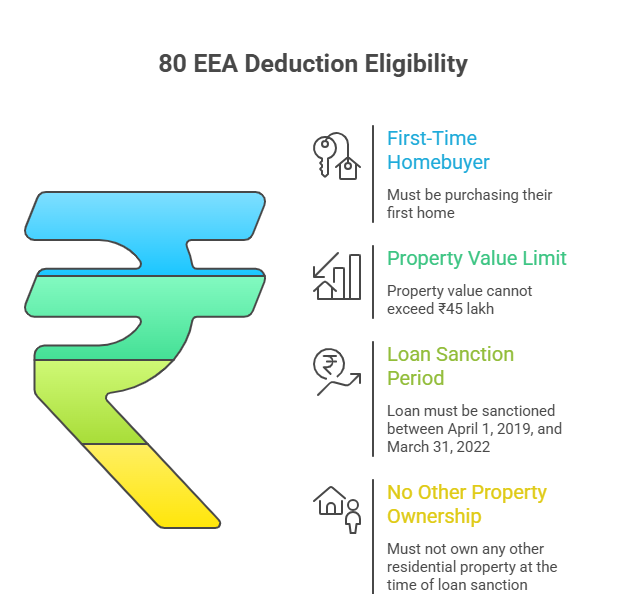
To be eligible for the deduction under Section 80 EEA, there are certain specific criteria, which include the following:
- You must be a first-time homebuyer.
- The value of the property must not exceed ₹45 lakh.
- The loan must be sanctioned between April 1, 2019, and March 31, 2022.
- At the time the loan is sanctioned, you must not own any other residential property.
These conditions ensure that this benefit accrues only to buyers of affordable housing.
80 EEA vs Other Home Loan Tax Benefits
To understand the complete picture, it is important to compare the 80 EEA deduction with other sections.
| Section | Benefit |
| Section 80C | Rs. 1.5 lakh (principal repayment) |
| Section 24 | Rs. 2 lakh (interest) |
| Section 80 EEA | Rs. 1.5 lakh (additional interest) |
This tiered benefit structure helps maximise tax savings on home loans.
Can Joint Owners Claim Deduction Under Section 80 EEA?
Yes, in the case of joint ownership:
- Each co-owner can claim Rs 1.5 lakh separately.
- It is mandatory for both to be co-borrowers and co-owners.
- It is necessary to fulfil all eligibility conditions.
This effectively doubles the tax benefits for joint buyers.
Important Conditions and Limitations of 80EEA Deduction
However, while the deduction available under Section 80EEA is beneficial, it also has certain limitations:
- Not available under the new tax regime.
- Applicable only to affordable housing.
- Cannot be claimed if you are already availing the benefit under Section 80EE.
- Only the interest component is eligible.
It is important to understand these conditions to avoid errors while filing taxes.
Impact of 80 EEA on Home Loan Cost
Tax deductions directly reduce the effective cost of borrowing. Even if home loan interest rates remain unchanged, tax savings lower your overall expenditure.
You can use a Home Loan EMI Calculator to estimate your actual savings and the impact on your EMI.
This helps in the following ways:
- Planning long-term finances
- Comparing loan options
- Understanding real cost after tax benefits
Why 80 EEA Deduction Matters?
The Section 80EEA deduction plays a significant role in promoting affordable housing in India.
Its benefits include:
- Encourages first-time homebuyers
- Significantly reduces the tax burden
- Makes homeownership more affordable
- Complements existing tax deductions
This is particularly useful for buyers in the affordable housing sector.
Conclusion: 80EEA Deduction for Income Tax on Home Loans
The deduction available under Section 80 EEA is arguably the best deduction for those looking to avail a home loan in India. With the help of this additional deduction provided under the 80 EEA scheme, you can claim a deduction of up to ₹1.5 lakh annually on the interest paid on your loan amount; this will help you save a significant amount each year on home-related expenses.
If you familiarise yourself with the deductions available under Section 80 EEA, you will be able to make informed decisions when taking out a home loan.
Read more: New Labour Laws 2025: Impact on Real Estate & Construction Costs