

Did you know that the RBI has maintained the repo rate at 6.5% for the ninth consecutive time? If your home loan is subject to a floating interest rate, any change in the repo rate could impact your interest rate. Generally, lenders are responsible for passing on the benefits of any reduction in the repo rate to borrowers. In such situations, if your lender does not reduce your rate, you can consider a home loan balance transfer to another bank offering lower interest rates, helping you reduce your EMI and overall loan cost.
So, do you think the RBI might lower its benchmark repo rate in the near future to benefit borrowers? Well, economists believe that you might have to wait a little while longer! Until then, let’s explore what you can do if you wish to reduce the interest rate on your existing home loan. One popular option is to transfer your current home loan to another bank at a lower interest rate through a ‘Home Loan Balance Transfer.’ Let’s understand how this process works.
What is Home Loan Balance Transfer?
A home loan balance transfer—also known as home loan refinancing—allows you to transfer your existing home loan to a new bank under more favorable terms and conditions. Suppose you have taken a home loan from a bank where, due to high interest rates, you are paying a higher EMI. Subsequently, you discover another bank offering home loans at lower interest rates. Furthermore, the loan repayment tenure is also flexible. In such a scenario, you decide to transfer your existing loan to that new bank.
Subsequently, the new bank pays off the outstanding loan amount to the old bank, thereby closing the existing loan account; meanwhile, you open a new home loan account with the new bank, to which you have transferred your home loan. Your EMI will be based on the interest rate charged by the new bank.
When Does a Home Loan Transfer Make Sense?
A transfer is not required in every situation. Here is when it is generally economically beneficial:
- You are in the early or middle stages of your loan tenure.
- A new lender is offering a significantly lower interest rate (at least 0.5% lower).
- Your credit score has improved since you first took out the loan.
- Despite multiple requests, your current lender has refused to lower your interest rate.
If you are in the final few years of repayment, transferring might not result in significant savings for you. This is because most of the interest has already been paid.
Key Facts Before You Transfer Home Loan
Before transferring your home loan, you should consider these key points:
1. Check the Processing Fee
The new lender will charge a processing fee, which is typically 0.5% to 1% of the outstanding loan amount. Keep this in mind as well when calculating your savings.
2. Foreclosure Charges May Apply
If your existing loan is at a fixed rate, your current lender may charge a foreclosure fee of up to 2%. This could significantly reduce your savings.
Good News: According to RBI guidelines, levying foreclosure charges on floating-rate home loans is prohibited. Therefore, if your loan is on a floating rate, you will face no issues.
3. Your New Lender Will Re-evaluate You
The new lender will treat this just like a new loan application. They will verify your credit score, income, existing debts, and property documents. Ensure that everything is in order before applying.
4. Use a Home Loan EMI Calculator First
Before proceeding, use a home loan EMI calculator to compare your current EMI with the amount you would have to repay at the new rate. This will give you a clear picture of your monthly and long-term savings.
5. Compare Interest Rates Carefully
Not all low-interest rate offers are created equal. Some lenders offer ‘teaser rates’ (initially low rates) that increase after a year or two. Before making any decision, always check the long-term interest rate and compare it with the prevailing home loan interest rates in the market.
Documents You Will Need for Home Loan Transfer
- List of all EMIs paid to date
- NOC (No Objection Certificate) from your current lender
- Foreclosure letter and details of the outstanding amount
- Property documents (Title Deed, Sale Agreement)
- Proof of income and recent bank statements
- Proof of identity and address
How to Check If You Are Eligible
Eligibility for a home loan transfer depends on several factors. The common factors are:-
- Your income
- Current outstanding balance
- Repayment history
- Credit score
By using a home loan eligibility calculator, you can quickly estimate how much of a loan you can obtain from a new lender.
Top-Up Loan Opportunity
When you opt for a balance transfer, many lenders offer you a top-up loan. This means you can borrow additional funds over and above your outstanding balance—a feature that proves useful when you need money for home repairs, education, or other necessities. The interest rates on top-up loans are generally lower than those on personal loans.
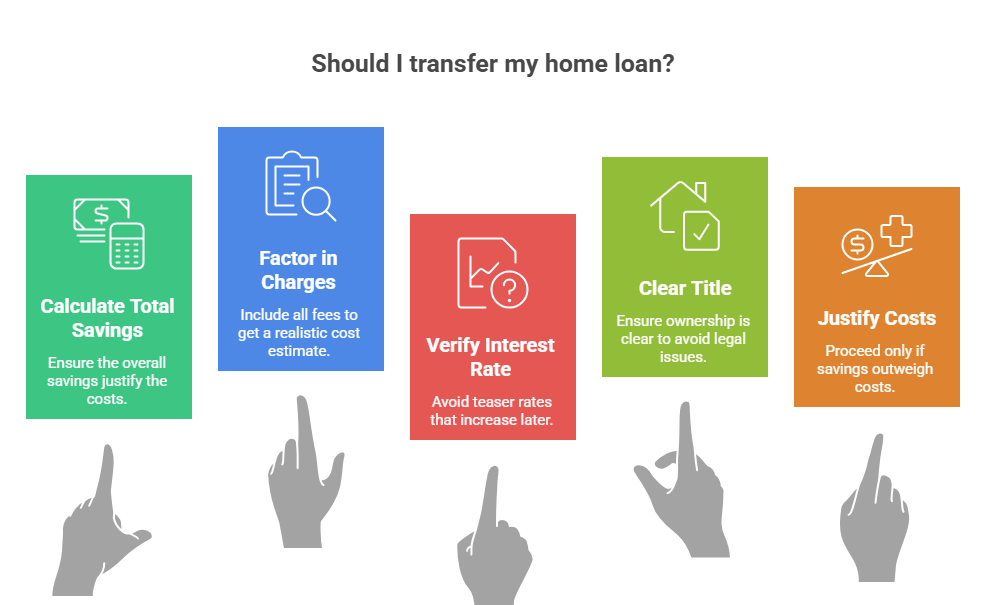
Simple Checklist Before Home Loan Transfer
- Calculate the total savings (not just the difference in EMIs).
- Factor in all charges—processing fees, legal fees, and stamp duty.
- Confirm that the new interest rate is not a ‘teaser rate’ (an attractive introductory rate).
- Verify that the title (ownership) of your property is clear.
- Apply for a home loan transfer only if the resulting savings justify the associated costs.
Final Thoughts
Transferring your home loan to another bank to secure better rates is a prudent move that can save you a significant amount of money. By conducting research, comparing interest rates, and completing the home loan transfer process, you can lower your EMIs and save money in the long run. If you are considering transferring your home loan, it is crucial to take factors such as processing fees, pre-payment charges, and customer service ratings into account.
Read more: Home Loan Fraud in India: Types, Red Flags & Prevention Tips 2026


Join The Discussion