
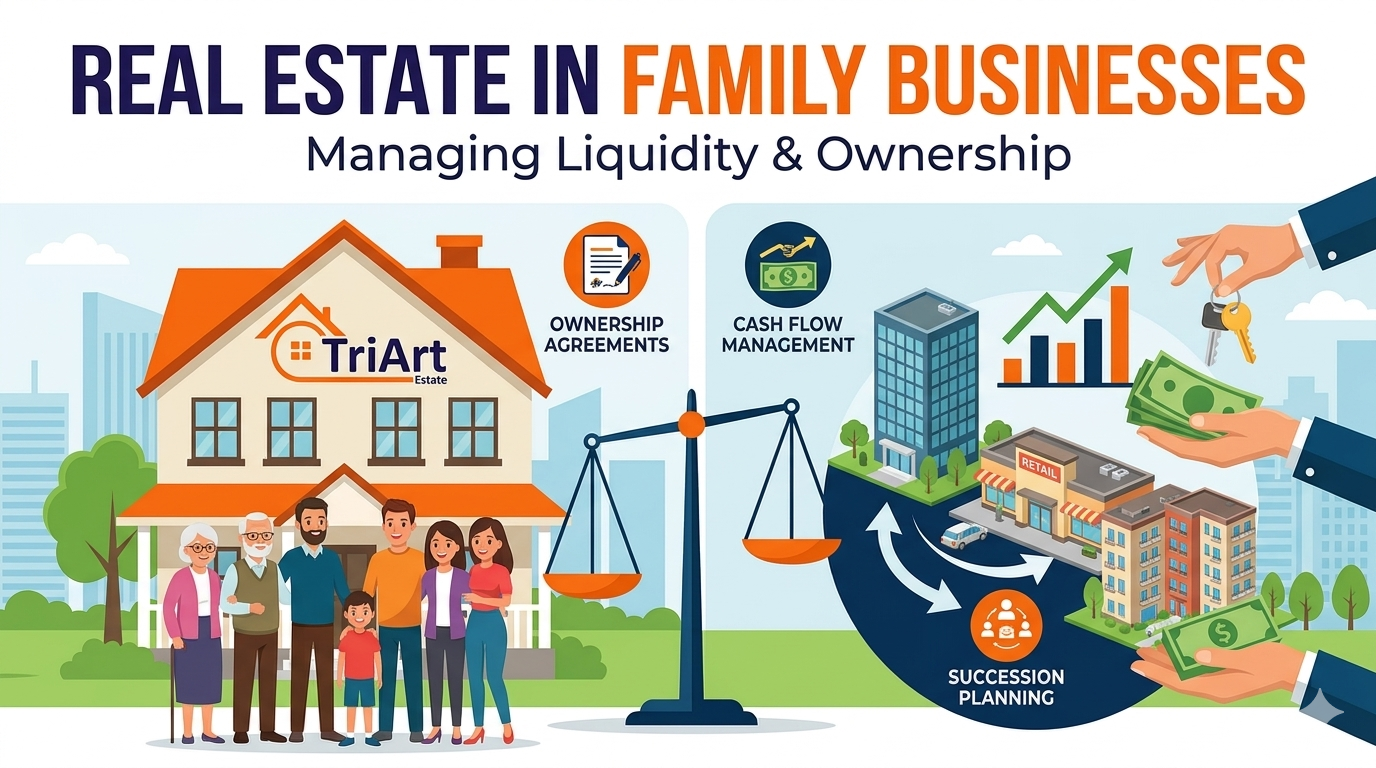
Indian business families have historically been drawn to real estate, regarding it as one of their most favored asset classes. It constitutes a tangible, visible, and long-term asset. Given the relatively low technical barriers to entry, many families have amassed substantial wealth through land banks, residential developments, commercial projects, and rental properties.
Nevertheless, these very attributes of real estate also pose long-term challenges for families. Real estate is not as liquid as financial assets. Its partition, sale, and restructuring are not easily executed and can entail serious consequences. As family size expands and ownership is transferred across generations, this can give rise to significant complexities.
Managing the liquidity and ownership of such ventures requires a mindset distinct from that of traditional business management.
The Liquidity Challenge
Even in most real estate businesses, a significant portion of wealth remains tied up in physical property. This wealth is gradually converted into cash through rental income or project earnings, while the underlying capital remains embodied in the form of land or buildings.
This can be a challenging task, particularly when family members have differing financial needs. One member might require cash for personal or business purposes, while another might wish to invest in property with the aim of generating future profits. In the absence of a robust framework, such divergences can lead to internal discord.
Liquidity-related issues cannot simply be resolved by selling assets. Doing so involves numerous considerations—such as timing, valuation, tax implications, and the potential impact on ongoing projects. Therefore, liquidity planning must be undertaken thoughtfully and in advance, rather than being addressed through hasty, reactive measures when the need suddenly arises.
Property Fragmentation Over Time
As the wealth of one generation is transferred to the next, the fragmentation of assets over time is a natural occurrence. Property that once belonged to a single founder may now be distributed among numerous siblings, cousins, and various branches of the family.
This gives rise to further complexities, particularly in matters concerning real estate. Unlike financial portfolios, real estate assets cannot always be divided into equal, fungible shares. Consequently, unanimous consent from all stakeholders becomes essential for making significant decisions—such as the redevelopment, sale, or leasing of the property.
With the passage of time, individual priorities may also diverge. Some family members may wish to take their share and exit the arrangement; others may seek to make further investments in the property, while still others may simply desire a steady stream of income in the form of rental yields. In the absence of a clear and well-defined framework, the decision-making process can become protracted, and there remains a persistent risk of disputes arising.
The Need for Clear Ownership Structures
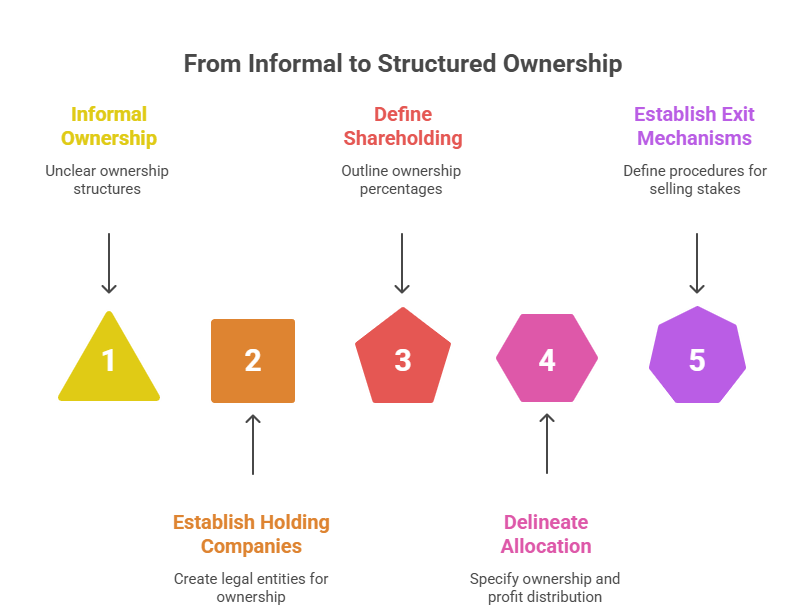
Transitioning from informal to structured ownership is one of the initial steps in resolving complexities. This may involve establishing holding companies, defining shareholding patterns, and delineating the allocation of ownership and profits. When ownership is well-documented and structured, decision-making and managing expectations become significantly easier.
Structured ownership also enables families to establish exit mechanisms. For instance, in a scenario where a member wishes to sell their stake, pre-established procedures can be applied instead of relying on informal negotiations. Transparency in ownership reduces ambiguity in the decision-making process.
Planning Liquidity Proactively
Liquidity should not be viewed merely as a requirement for emergencies; rather, it must be integrated into long-term financial planning.
Families can establish liquidity buffers by selling certain assets, refinancing them, or converting them into more liquid forms. Furthermore, the cash flow generated from rental income can be structured to ensure a predictable and steady stream of funds.
A second crucial strategy involves segregating operating capital from family assets. If all available capital is tied up in projects, the business comes under strain whenever a need for liquidity arises, such as to meet the diverse capital requirements stemming from the varied interests of family members. This challenge can be mitigated by creating a parallel pool of financial assets. The objective here is not to curtail real estate investments, but rather to maintain overall portfolio flexibility.
Given that the real estate sector is notorious for its cyclical nature, a robust real estate business requires a dedicated pool of liquidity to withstand—and navigate—such market downturns.
Governance as the Anchor
In the real estate business, the issue of governance is paramount, as it frequently involves making decisions regarding high-value properties that have long-term implications.
It is possible to establish a robust governance framework that defines decision-making processes, delineates authority, and establishes thresholds for consensus. Major decisions can be vetted by investment committees or family councils, which are capable of rendering impartial judgments.
Governance also serves as a mechanism to ensure that emotional considerations do not override strategic thinking. Real estate properties—particularly ancestral assets—sometimes hold significant sentimental value. While this reality is acknowledged, it remains essential to prioritize the achievement of long-term financial objectives. An institutional governance strategy helps strike a balance between emotional attachments and business discipline.
Aligning Perspectives Across Different Generations
The next generation often views real estate from a different perspective. While older generations may be interested in holding land as a ‘store of value,’ younger generations may prioritize the returns, liquidity, and diversification it offers.
These variations do not represent a conflict, but are rather the result of shifting economic realities. Achieving alignment requires open dialogue and periodic discussions where differing viewpoints can be debated.
In certain other instances, families may opt to retain their core investments while allowing new investments to be diversified. Options involving redevelopment or partial monetization may also be considered. The primary objective here is to introduce flexibility, rather than to forcibly impose uniformity within a specific framework.
The Role of External Advisors
Given the complexity of real estate assets, external advisors can prove to be highly beneficial. Independent advisors bring objectivity to the table and assist families in making decisions free from any internal bias—particularly because real estate-related decisions often involve substantial sums of money and, consequently, carry a higher level of risk for the family.
They can assist with ownership organization, liquidity planning, risk assessment, and governance structures. In particular, guidance that is not tied to a specific transaction can be aligned with long-term outcomes. They do not replace family decisions; rather, they facilitate thoughtful decision-making.
Building Real Estate for Continuity
The real estate business typically involves long development cycles. Projects take years to complete, and properties endure through multiple cycles. Such ventures require management across generations. Continuity does not come automatically; it necessitates planning, organization, and discipline.
Families that proactively address complexities related to liquidity and ownership are more likely to preserve their real estate legacy. Those who rely on informal arrangements may find that these issues tend to compound with each passing generation. The objective is not merely to preserve assets, but also to ensure that they remain not only productive but also relevant, and aligned with the evolving needs of the family.
Read more: NDMC Property Tax 2026: Rates, Calculation & Online Payment Guide



Join The Discussion