As Navi Mumbai emerges as one of India’s fastest-growing real estate markets, buyers have frequently raised questions regarding the GST applicable to the purchase of flats in the region. Whether you are looking for a property in an under-construction project in Kharghar, Panvel, or Nerul, or are interested in a pre-built, ‘ready-to-move’ home, it is crucial for an informed buyer to understand the GST rates applicable to apartments in Navi Mumbai in 2026.
Cracking the GST Formula for Navi Mumbai Flats
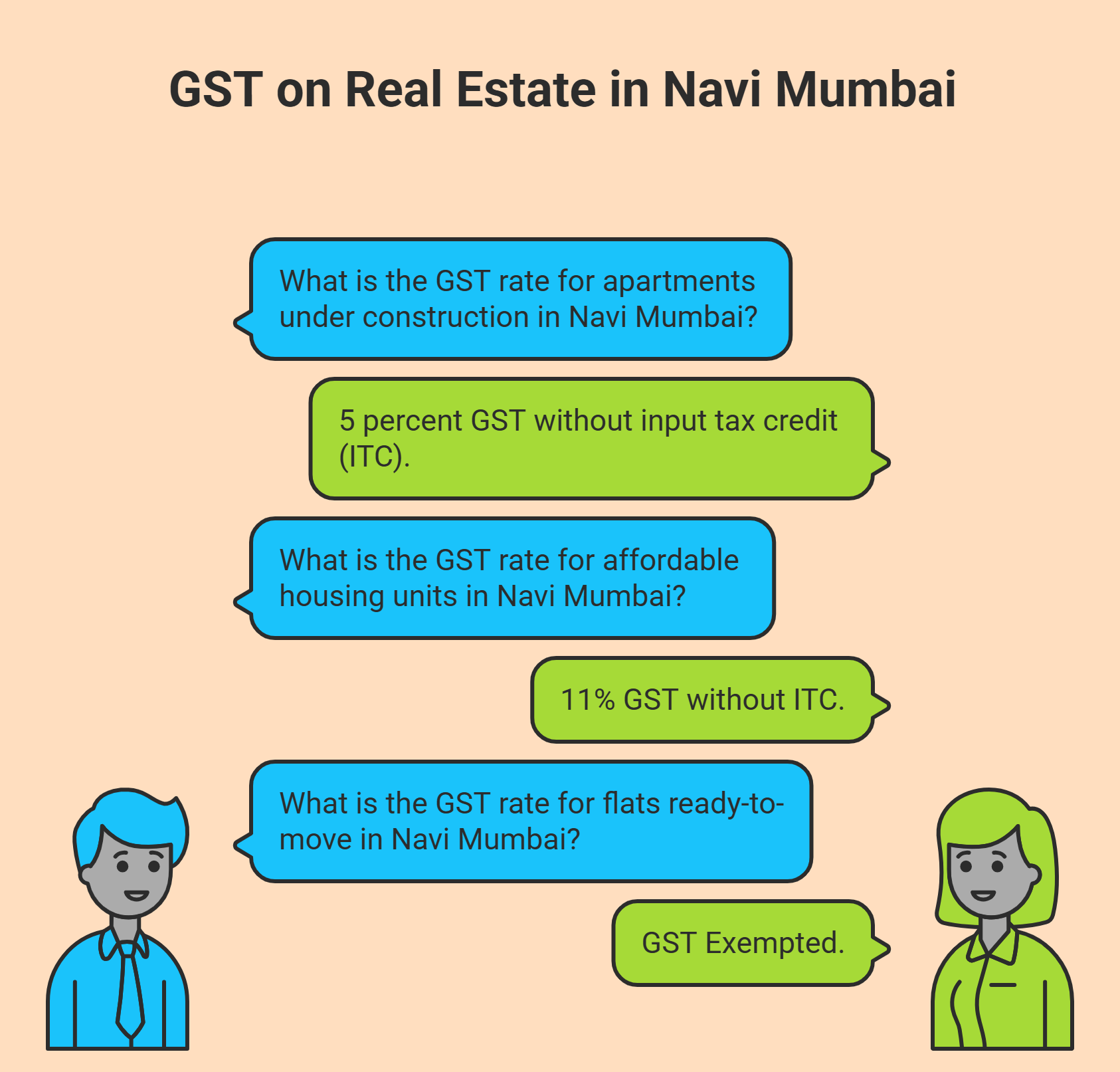
GST is applied in a different way by the government, based on whether the property is constructed or is ready-to-move:
- For apartments under construction 5 percent GST without input tax credit (ITC)
- For housing units that are affordable: 11% GST without ITC
- For flats ready-to-move : GST Exempted
This is the reason why the GST in relation to real property located in Navi Mumbai is the most pertinent to those looking for real estate projects that are under construction.
The Reality of Under-construction Projects in Navi Mumbai
In Panvel, Ulwe, and Taloja, residential projects—alongside large-scale townships—are being developed at a rapid pace. For instance, a buyer purchases a home for ₹60,00,000 (60 lakh rupees) in a project currently under construction. An additional 5% GST is applicable on the total price of the flat, amounting to ₹3,00,000 (three lakh rupees).
A Quick Example of GST Calculation in Navi Mumbai
If you buy a flat in the Kharghar under-construction project at Rs 50,00,000.
- GST @5% = Rs 2,50,000
- Total = 52,50,000
Now, if you buy an affordable housing unit at Rs 40,00,000 in Taloja.
- GST @ 1% = Rs 40,000
- Total = Rs 40,40,000.
It’s clear how GST can impact your budget based on the unit/value of your flat.
Affordable Housing Advantage in Navi Mumbai
Panvel, Ulwe, and Dronagiri—these are three areas where affordable housing projects are in the pipeline. With a GST rate of just 1%, these flats are highly attractive to first-time homebuyers as well as other consumers who are particularly price-conscious. The low GST rate is one of the primary reasons why people are opting for these apartments. GST-related guidelines for buying a home in Navi Mumbai.
Hidden Cost Alert – GST on Society Maintenance
Even after acquiring ownership of a property, homeowners must account for GST on the society’s maintenance charges. For apartments, on maintenance charges exceeding ₹7,500 per month, an 18% GST will be levied on the excess amount. For instance, if the maintenance charge for a society in Nerul is ₹9,999, an 18% GST will apply to the surplus amount of ₹1,500, amounting to approximately ₹270.
Landmark GST Relief for Redevelopment
Previously, whenever housing societies in Mumbai underwent redevelopment, they would often find themselves ensnared in a web of double taxation. However, in 2025, two landmark rulings by the High Court put an end to this uncertainty. The first verdict was delivered in April 2025 (the *Srinivasa Realcon* case). The Bombay High Court ruled that homeowners who engage an engineer to construct their homes—provided they do not sell their development rights (TDR or FSI) to a builder—are exempt from GST liability. The Court clarified that engaging a builder constitutes a service for the purpose of construction, rather than a taxable sale of land rights.
Another victory was secured on August 20, 2025 (the *Provident Housing* case), wherein the Goa Court ruled that once an investor is formally recognized as the owner of a plot via a Conveyance Deed, all prior GST claims arising from the Joint Development Agreement (JDA) are rendered null and void.
Simply put, if the plot remains under the ownership of the developers themselves, they are not deemed to be providing any service to a third party. These developments in 2025 hold immense significance for the more affluent localities of Navi Mumbai, as they have the potential to save every property owner thousands of dollars in taxes during the course of a society’s redevelopment.
GST 2.0: Savings for Developers
The implementation of GST 2.0 following September 20, along with the GST Council meeting, has completely transformed the financial landscape of the construction sector. The most significant change was the reduction of the GST rate on cement from 28% to 18%. Since cement accounts for approximately 16% of the total cost of any project, this 10% reduction will provide immediate relief to construction companies.
Other essential materials also saw deep cuts:
- Bricks, Tiles, and Sand: Reduced from 18% to 5%.
- Paints and Varnishes: Dropped from 28% to 18%.
- Marble and Granite Blocks: Now at 5%.
Although these upstream savings do not alter the 5% GST applicable to the final price, they nevertheless reduce development costs by approximately 2% to 4%. In 2026, savvy buyers in areas such as Ulwe or Kharghar are leveraging these figures to negotiate better deals on ‘all-inclusive’ packages, as builders now possess greater scope to offer discounts or price reductions during festive seasons.
Frequently Asked Questions
Ques: What is the GST rate on flat purchase in Navi Mumbai?
Ans: GST is 1% for affordable housing and 5% for non-affordable under-construction flats, without input tax credit.
Ques: Is GST applicable on ready-to-move flats?
Ans: No, GST is not applicable if the flat has received a completion certificate.
Ques: What additional charges come with GST on flats?
Ans: Buyers may also pay stamp duty, registration fees, and maintenance charges apart from GST.
Ques: Can buyers claim GST input tax credit?
Ans: No, buyers cannot claim input tax credit on residential property purchases under current GST rules.