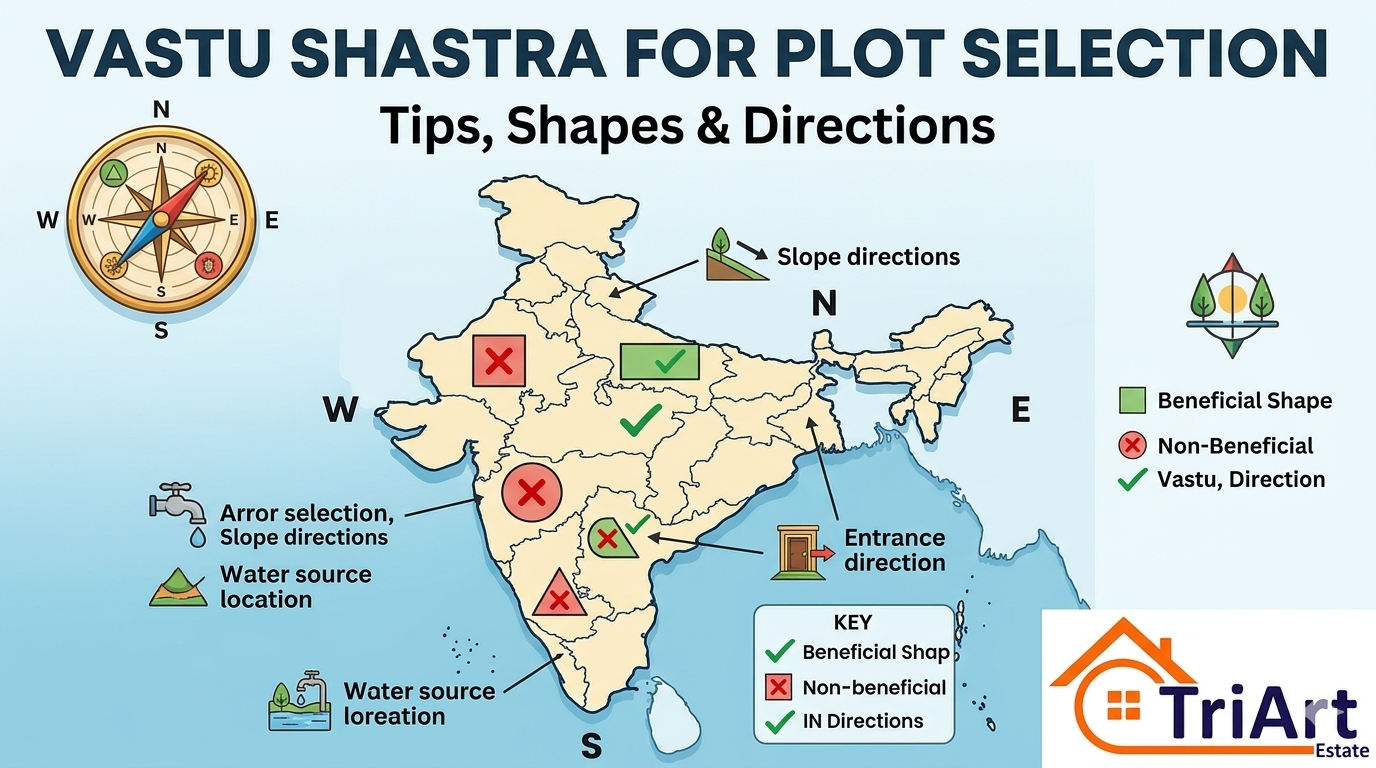
For people, purchasing a plot is not merely an investment; it serves as the foundation for building their dream home. Steeped in emotion, this decision often stands as one of the most significant choices of their lives. However, given the cultural values and traditions prevalent in India, the act of purchasing a plot or land is profoundly influenced by Vastu Shastra. Essentially, this ancient science of architecture fosters harmony by taking into account various factors, including the plot’s orientation, location, surrounding environment, and access routes. This blog delves deeply into the nuances of Vastu, offering readers guidance on the relevance of Vastu Shastra when selecting a plot of land.
What are the Vastu Guidelines for Selecting the Perfect Plot?
According to Vastu, making the right choice involves a comprehensive approach that encompasses numerous guidelines. To ensure a successful purchase, it is imperative to adhere to these guidelines regarding various aspects, such as the plot’s size, orientation, surrounding environment, access roads, and so forth. Purchasing a plot is, without a doubt, one of the most significant decisions in any individual’s life. It is not merely about becoming a landowner, but rather about building one’s future; therefore, its foundation must be laid upon prosperity and positive energy. Consequently, strictly adhering to the principles of Vastu Shastra is of utmost importance.
The key pointers to consider while selecting a plot are illustrated below:
- Plot Shape: Traditionally, the shape of a plot plays a pivotal role, as it channels the land’s energy in the proper direction. For instance, square and rectangular shapes are considered highly auspicious, whereas triangular shapes present certain complexities. Therefore, gather comprehensive information regarding the plot’s shape before making any decision.
- Direction: Another crucial factor requiring attention is the plot’s orientation. Your plot should serve as a conduit for peace and prosperity. According to Vastu Shastra, fertile soil is a definitive indicator that the land possesses positive energy.
- Surrounding Environment: It is imperative to assess the immediate surroundings, as the ambient environment holds paramount importance. According to Vastu, elements such as roads, water bodies, neighboring properties, and similar features directly influence the flow of energy.
- Road Positioning: Vastu prescribes specific guidelines for evaluating the positivity of a plot. The positioning of the road plays a significant role in this assessment. For example, a plot flanked by a road extending from the North to the North-East is considered highly beneficial; conversely, a road running from the West to the South-West is not deemed ideal.
- Slope and Leveling: The uniformity of the land is essential, as Vastu posits that the slope of the terrain impacts the health and well-being of its inhabitants. In this regard, a slope tilting towards the South-West or North-East is considered auspicious, whereas a slope tilting towards the West may give rise to unforeseen health-related complications.
Ideal Plot Shapes as per Vastu
One of the key factors to consider when selecting a plot is its shape. For plot selection, Vastu Shastra recommends specific shapes that can help attract positive energy and enable you to lead a healthy lifestyle.
- Square Plot
Square plots are ideal for both commercial and residential purposes. According to Vastu, a square plot lacks no incomplete or missing corners—a feature considered highly auspicious. To maximize returns, opt for square plots facing the Northeast, East, or North directions.
- Rectangular Plot
Much like square plots, rectangular plots also lend a sense of completeness to your residential or commercial space. While square plots are associated with peace and happiness, rectangular plots bring good health and prosperity. According to Vastu, properties with a slope towards the North or South are considered the most auspicious. For maximum benefits, choose a rectangular plot where the ratio of length to width is 1:2 or less.
- Lion Shape Plot
According to Vastu Shastra, when selecting a plot, this specific shape is wide at the front but narrows towards the rear, resembling the physique of a lion. Such plots are known as ‘Shermukhi’ plots, and they bring immense good fortune to the property owner.
The ideal orientation of the plot should be as follows:
- The broader part of the plot must have the Northside
- The roads must be on the northern or eastern side of the plot
The lion is a symbol of power, strength, control, and dominance. Therefore, lion-faced properties are ideal for commercial purposes.
What Shapes Should Be Avoided as Per Vastu?
Vastu Shastra strictly prohibits the acquisition of triangular and L-shaped plots. When purchasing a plot, people often focus their entire attention solely on factors such as price, connectivity, and other practical considerations. However, they must understand that—alongside the pursuit of good fortune and a proper shape—certain specific aspects should be strictly avoided when buying a plot. Let us explore why the acquisition of plots with these particular shapes is discouraged. Take a look:
- Triangular: Triangular-shaped plots are generally not highly recommended, as they carry a higher risk of fire hazards and potential damage. However, before proceeding with a purchase, it is crucial to thoroughly understand the Vastu principles applicable to triangular plots.
- Oval: Another shape that is not highly recommended is the oval. According to Vastu, oval-shaped plots can be a source of negativity and misfortune for their owners. Therefore, undertaking any construction work on an oval plot is not advised.
- L-shaped: Given the potential for imbalance and irregularity, L-shaped plots are also generally not highly recommended. According to Vastu principles regarding this shape, such plots can lead to issues involving financial instability and domestic discord.
Which facing plot is good for Vastu?
When selecting a plot, the North and East directions should be the preferred choices. According to Vastu Shastra, every direction possesses a distinct energy and is intrinsically linked to various aspects of life. While misconceptions often surround the Vastu principles for West-facing plots, it is equally important to understand the complexities associated with South-facing plots; similarly, every direction holds its own unique significance and influence.
Listed below are some key points regarding each direction:
| Direction | Benefits | Consideration |
| North | Main entrance in West facing plot should be northwest or mid-west. Water and similar elements should be avoided in the southwest | Ideal for Professionals, Business Owners, and Families |
| East | Governed by Saturn. Brings stability and success if aligned properlyCommonly misunderstood | Ideal for Families and government employees |
| West | Highly auspicious, governed by Kubera Results in stability, success, and financial growth | Ideal for politicians and business leaders. Main gate to be situated in Southeast-southAvoid borewell |
| South | Often feared, governed by Lord Yama and Mars. If aligned properly, then it brings power and a prosperous life | Often feared, governed by Lord Yama and MarsIf aligned properly, then it brings power and a prosperous life |
Vastu Tests to Determine the Positivity of the Land
Hindus have been following Vastu Shastra for centuries. Also known as the science of architecture, it outlines various principles aimed at ensuring the well-being of homeowners. Some of these principles pertain to the selection of a plot; specifically, Vastu Shastra suggests conducting certain tests before purchasing a plot.
- The Water Test
To begin with, dig an 18-inch pit and fill it with water. After waiting for three minutes, if the ground absorbs the water and less than 15 cm of water remains, do not purchase that land. If the water level recedes to a depth of 30 cm, the land is considered to be of medium quality. The land is deemed suitable for purchase only when it has absorbed all the water completely.
If the water in the pit (even if it has not been fully absorbed) swirls in a clockwise direction, it indicates a flow of positive energy within the land. You may purchase such land, even if the price is high.
Conversely, if the water swirls in a counter-clockwise direction, it signals a flow of negative energy. According to Vastu Shastra principles regarding land selection, purchasing such land may lead the owner to face financial losses, failure, accidents, or health-related issues.
- Seed Germination Test
This test begins by scattering Tulsi seeds on the ground. In the next step, you must water them and allow them to germinate. Tulsi is an extremely auspicious plant that thrives only on land imbued with positive energy.
If the seeds germinate and grow into healthy plants, the land is considered favorable; otherwise, you should refrain from using that land.
- Test for Smell-Taste-Colour
To conduct a test, remove the top layer of soil and dig up a small amount of soil from underneath. If the soil emits a putrid odor, that land harbors destructive energy.
Do’s and Don’ts for Plot Entry
Having understood the significance of each entrance for plots facing various directions, the following are some general ‘Dos and Don’ts’ regarding the entrance to a plot:
Do’s:
- The entrance gate must be opened in an inward direction
- Keep the entrance clean and tidy
- Use bright lights to illuminate the entrance during the evening and night
- Use a quality material gate
- Always keep the Northeast area open
Don’ts:
- Avoid the southwest corner for positioning the entrance gate
- Do not place unnecessary blockages in the form of trees, debris, etc.
- Avoid broken gates
- Downward slopes towards the south or southwest must be avoided strictly
- No septic tank near the entrance
Conclusion
In essence, selecting the right plot requires deep consideration and careful evaluation of various factors. When it comes to making the final decision to purchase a plot, Vastu Shastra undoubtedly plays a pivotal role. According to Vastu Shastra, key elements—such as the shape, orientation, placement of the entrance, and the overall topography of the plot—collectively influence its energy and vibrations. Therefore, a buyer must understand that the objective of Vastu is not to instill fear, but rather to establish the right balance. With a plot featuring excellent planning and design, one can usher harmony and peace into their life. From choosing the optimal plot shape to laying a strong foundation, the right plot will fulfill your dreams with health, wealth, and long-term prosperity, ultimately leading to your financial and spiritual advancement.
Read more: GST on Flats in Mumbai 2026: Rates, Rules & Buyer Guide