To be a legally-owned owner of a stamp duty in haryana whether it’s a brand transfer or new property, it is required to register the property to Haryana government. Haryana government. Registration requires the submission of documents and the payment of registration and stamp duty costs. The stamp duty rate in Haryana differs for different transactions. Prices differ for Mortgage and gift deed stamp duty in haryana. This blog is all about registration and stamp duty in Haryana as well as the documentation required to register as well as the process for online registration and more.
What is Stamp Duty in Haryana
Sltamp duty in haryana is essentially a fee you pay when you purchase a home. It’s similar to a tax the Haryana government collects when a home is sold. If you don’t pay the transaction isn’t legally legal. Therefore, it’s essential to pay.
Stamp Duty and Registration Charges in Haryana 2025
The stamp duty in haryana within Urban zones is 7%, while in rural areas it’s 5percent. If the owner is joint (of two people) it’s less than 1. Below are the stamp duty rates in Haryana.
| Area | Women | Men | Joint |
| Within the Municipal Limits | 5% | 7% | 6% |
| Outside the Municipal Area Limits | 3% | 5% | 4% |
Registration Charges in Gurgaon
| Property value | Registration charge |
| Up to Rs. 50,000 | Rs. 100 |
| Rs. 50,001 to Rs. 5 lakhs | Rs. 1,000 |
| Rs 5 lakhs to Rs 10 lakhs | Rs. 5,000 |
| Rs 10 lakhs to Rs 20 lakhs | Rs. 10,000 |
| Rs 20 lakhs to Rs 25 lakhs | Rs. 12,500 |
| Rs 25 lakhs | Rs 15,000 |
| Rs 25 lakh to Rs 40 lakh | Rs 20,000 |
| Rs 40 lakh to Rs 50 lakh | Rs 25,000 |
| Rs 50 lakh to Rs 60 lakh | Rs 30,000 |
| Rs 60 lakh to Rs 70 lakh | Rs 35,000 |
| Rs 70 lakh to Rs 80 lakh | Rs 40,000 |
| Rs 80 lakh to Rs 90 lakh | Rs 45,000 |
| Rs 90 lakh and above | Rs 50,000 |
Stamp Duty and Registration Charges in Haryana for Different Deeds
In Stamp duty in haryana amount changes depending on what kind of paper you’re registering, like a sale deed, a gift deed and so on.
| Document Type | Urban Area | Rural Area |
| Exchange Deed | 8% of property value or market value, whichever is higher | 6% of property value or market value, whichever is higher |
| General Power of Attorney | Rs. 300 | Rs. 300 |
| Sale or Conveyance Deed | 7% | 5% |
| Property Loan Agreement | Rs. 100 | Rs. 100 |
| Special Power of Attorney | Rs. 100 | Rs. 100 |
| Partnership Deed | Rs. 22.50 | Rs. 22.50 |
| Gift deed | 5% | 3% |
Stamp Duty Waived on Small Plots in Haryana
If you’re thinking of buying a stamp duty in haryana, this is good news for you. The state government has waived stamp duty on small residential plots, making it even easier for first-time homebuyers and families under affordable housing schemes to own a home. In simple terms, this means:
What’s covered?
- Plots up to 50 sq. yards (urban areas)
- Plots up to 100 sq. yards (rural areas)
- Properties under schemes like: PMAY, Mukhyamantri Awas Yojana (Shehri) and (Gramin)
Why now?
- Buyers were concerned about the rising collector rates (minimum property prices used for registration).
- The government recently revised these rates based on data, ensuring fairness and transparency.
- Approximately 72% of land parcels saw an increase of only 10%, while in areas with a larger market disparity, the increase was capped at 50%, which is still lower than the actual market prices.
The Benefits
- It helps reduce undervaluation and black money transactions.
- It brings clarity and transparency to property deals.
- It directly reduces the burden on families aiming to buy affordable homes.
In simple terms, this policy means real savings. For families who don’t have enough money to build their first home, not having to pay stamp duty in haryana is a huge relief. They can use that money for construction, interior design, or simply for peace of mind.
How to Calculate Stamp Duty in Haryana
The stamp duty in haryana is calculated using the circle rate for the location in which the property is located. In general, the property is listed with the circle rate or more over the circular rate. The buyer of the property can verify the stamp duty at the Jamabandi Haryana website-
- Visit the official Haryana Jamabandi website and navigate to the property Registration option on the top. From the drop-down menu, choose the Stamp Duty Calculator option.
- You will be taken to a new page to calculate the stamp duty of an actual sale deed.
- Input the amount of the transaction in Indian Rupees. Additionally, you can select your gender for the owner as well as also the Municipality Limit.
- Then, click on the Calculate tab.
- After calculating the stamp duty that needs to be paid, you need to purchase a stamp paper. Stamp papers is available for purchase by visiting the office of the sub-registrar, or through an franking technique. You can also purchase the e-stamp papers on the platform for e-stamps.
- All you have to do is go to the e-stamp site and register on the site. Once you have registered, payments can be done online or in person.
Example of How to Calculate Stamp Duty in Haryana
Suppose a man is buying a flat in Gurgaon worth 50 lakh. Now in urban areas, men have to pay 7 percent stamp duty. If the property is 50 lakh or more, then registration charge is 30,000.
So, Stamp duty is 7 percent of 50,00,000, which is 3,50,000 Registration fee is 30,000
So total extra cost is 3,80,000. That’s what he’ll pay apart from the flat cost.
Factors to be Considered for Calculation of Stamp Duty in Haryana
The following factors are considered while calculating stamp duty in Haryana:-
- Owner’s gender: In Haryana there are stamp duty rates that for females are lower they are compared with males. The state government gives discounts to females who pay tax stamps in Haryana. This is a way in order to help women buy homes.
- Location of property: In cities, the stamp duty is more expensive, however, it is lower than in the rural regions. The price of the property are more expensive in posh and urban areas.
- Property Type: Stamp duties in Haryana is different for each commercial, residential as well as industrial properties.
- Facilities: A property that offers luxurious amenities will attract more stamp duty fees.
- Property Age Property Age: In Haryana the greater the age of the property less stamp duty costs when compared to properties which have been built relatively recently. This is how the stamp duty rates are arranged in Haryana.
- Owner’s age: When it is about stamp duty fees seniors are favored over younger people. Similar to everywhere else in India in comparison to younger adults, seniors have to pay less fees for stamp duty.
How to Pay Stamp Duty in Haryana
You can pay stamp duty in haryana online or offline, whichever method you prefer. We have explained the process for both options below.
Online Payment of Stamp Duty in Haryana
- Visit the e-GRAS website: Go to egrashry.nic.in. This is the official site for paying online stamp duty in Haryana.
- Log in or Register: If you are a new user, register with your basic information and set a username and password. If you already have an account, simply log in.
- Select Payment Type: After logging in, select the category “Stamp Duty” or “Property Registration” depending on your purpose. The system will automatically fill in most of the remaining information.
- Enter Payment Details: Now, type in the stamp duty and registration amount. You can calculate this yourself or use the Jamabandi site. Select “E-banking” if you want to pay online.
- Fill in Your Details: Enter your name, address, district, mobile number, and other information as requested on the page.
- Review and Submit: Double-check everything. If everything is correct, click “Submit” or “Generate Challan.”
- Make Payment: You will be redirected to your bank’s website. Complete the payment. After this, you will receive a GRN (Government Receipt Number).
- Download Your E-Stamp: Go back to the site, enter your GRN, and download the e-stamp. You can print it on plain paper; it is valid and secure.
Offline Payment of Stamp Duty in Haryana
You can also pay stamp duty in haryana. First, purchase stamp paper from the Treasury Office. You can easily buy stamp paper worth more than ₹10,000. The stamp paper amount needs to be deposited at the State Bank of India (SBI) under the head ‘0030-Stamps and Registration’. Once this is done, you will need to submit the stamp paper to the Sub-Registrar’s office.
Tax Benefits on Stamp Duty in Haryana
When buying a house, you can claim a deduction of up to ₹1.5 lakh on stamp duty and registration charges in haryana. This deduction is available under Section 80C of the Income Tax Act, 1961. However, this applies only to the purchase of new properties, not resale properties.
What if there is a Delay in Stamp Duty Payment?
According to Section 23 of the Registration Act, 1908, if stamp duty charges in haryana, a heavy penalty will be levied. This penalty can be up to 10 times the registration fee. Except for wills, all documents in the state must be registered within four months of the date of execution.
How to Book a Slot for Property Registration in Haryana
After e-stamping, the homebuyer should book a slot for registration on the Jamabandi website. Here’s how to book a slot:
- On the Jamabandi website, click on “Property Registration” in the top navigation and select “Deed Registration Appointment.”
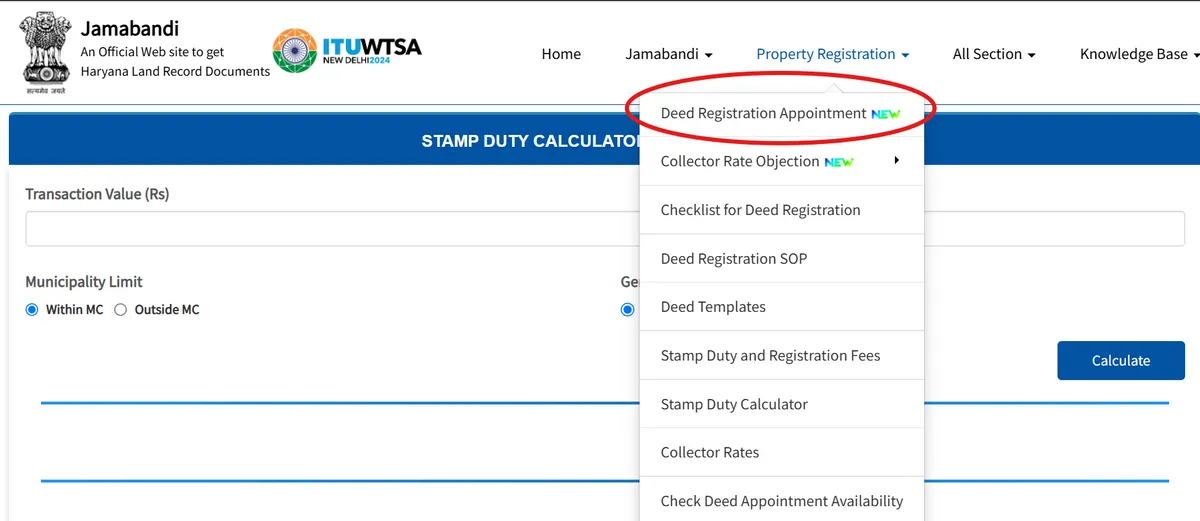
- Enter details such as district, tehsil, and the next (N) days. Click on search to check availability.
- On the day the slot is booked, the buyer, seller, and two witnesses must go to the sub-registrar’s office to complete the registration process.
Procedure for Registering a Property Deed
To register the title deed stamp duty in haryana you must follow the below steps:
Step 1: Visit Jamabandi’s website. Click Deed Templates for the download of templates from the Registration of Property Menu Bar.
Step 2: After you have downloaded the template for deeds as you require Fill in all the information on the deed.
Step 3: Go to the office of the Sub-Registrar on the date and time you have chosen. The registration clerk will send the deed to the Sub-Registrar.
Step 4: If the sub-registrar signs the deed, data will be pulled and the deed will then be loaded into HARIS that is a system that integrates land records.
Step 5. When you register, it is in HARIS. The officer will be updating all details about the buyer and seller and e-stamp details on paper and transaction costs. Following that, a live image will be taken.
Step 6. The Sub-registrar officer will issue a regularization of the deed after getting the biometrics of both the seller and buyer. The Land registry is printed and given to each of the parties. Additionally the Tehsil office has uploaded the land registry to its Jamabandi website.
Benefits of Paying Stamp Duty in Haryana
The stamp duty in haryana varies based on various factors, as explained above. However, you must also know about the various benefits of paying stamp duty, as listed below.
- Legal Recognition: Stamp duty payment legally recognises and validates your transaction. Hence, it is essential to specify ownership rights.
- Proof of Ownership: Paying stamp duty establishes ownership rights, and these can be used for future legal transactions.
- Prevents Legal Disputes: Stamp duty payment reduces the risk of legal disputes.
- Protects the Buyer’s Interest: It protects the buyer’s interest in the property by ensuring legal ownership.
- Infrastructure Development: The revenue generated from stamp duty payments helps the government with infrastructure development. Hence, it contributes towards improving the standard of living for citizens.
How to Purchase e-Stamps Online in Haryana?
If you’re planning to purchase E-stamps in order to pay the registration and stamp duty fees on the internet in Haryana Here’s what you should be aware of.
- The Online Government Receipts Accounting System (e-GRAS) platform is the most popular place to make tax and non-tax revenue payments online.
- To purchase electronic stamps You must sign up for the e-GRAS website.
- It’s a simple platform that can accept payments using both online as well as by hand.
Buying Stamps Offline Procedure
If you prefer to use the offline option, here’s the way to buy stamp duty in haryana.
- Visit the Treasury office to purchase greater than 10,000 rupees in stamp papers.
- All you have to do is make a deposit of your money into the State Bank of India (SBI) under the heading ‘0030-Stamp & Registration’.
- This is a great option for people who prefer traditional method of payment and wish to avoid online payment.
Tips for Stamp Duty in Haryana
Prior to paying stamp duty in haryana keep the following points in your mind:
- A registered property needs to be stamped prior to or on the following working day after registration. If the property is not within the area, it is able to be stamped within three months.
- Execution of property refers to the time the time when the seller and buyer have signed the papers to complete the transaction.
- A stamp paper must contain details of every one people involved in the transaction.
- A stamp paper must not exceed six months after the date of the transaction.
- Additionally, you can be able to pay stamp duty in haryana through adhesive stamps. When the stamp is executed the adhesive stamp will be taken away, and cannot be used again.
Documents Required for Property Registration
To register a property and become its legal owner, certain documents are required. Remember, when registering a property, all documents, except for wills, must be submitted to the sub-registrar’s office within four months of the date of execution, as per Section 23 of the Registration Act, 1908.
- Sale deed
- Identity proof of seller and buyer- PAN Card, Ration Card, Voter ID, Passport, Driving License
- Address proof of seller and buyer
- Society from No-objection Certificate (NOC)
- Identity proof of two witnesses
- Map of building or plan
- Digital photograph of property layout
- Ownership proof- Copy of assessment of Mutation or original sale deed.
Stamp Duty in Haryana Exemptions
Stamp duty in Haryana could be available to certain types of buyers, like first-time buyers and women. Buyers in these categories may qualify to receive some discounts or lower rates for stamp duty. Transactions involving land used for agricultural or charitable institutions are also exempt from the stamp duty charge.
As part of a new update in a recent update, the CM of Haryana also announced an exemption from Stamp duty in Haryana for buying land to build cow shelters. Alongside removing property tax on cow shelters’ land and shelters, the government will provide a four-fold increase in the fodder grant to 20 rupees per cow.
The government also emphasized the fact that there is no need to submit a land change application in the case of establishing new cowsheds.
Stamp Duty in Haryana Contact Details
Find below the contact information of the Stamp Duty in Haryana customer care team.
- Official Address: Revenue & Disaster Management Department Haryana, New Haryana Secretariat, Sector-17, Chandigarh
- Nodal Officer: Under Secretary Revenue
- Phone Number: 0172-2714033
Tips to Save on Stamp Duty Legally
A house is an investment of a significant amount. So, everyone is looking at ways of saving money at each step of the process. If you’re doing this, then you should be aware of the possibility to cut down on stamp duty in haryana
While the stamp duty charge is an compulsory charge by the government, you can take legal steps to lower it.
Property Registration in a Woman’s Name: Name Stamp duty in Haryana for female-owned properties in Haryana is just 5%, while it’s 77% for males. Therefore, you should make the property registered under the name of a woman if it is possible to avoid stamp duty. If you’re planning an acquisition with a partner, make sure you make sure that the woman is the owner in charge.
Choose the Right Property Type: the right property type when buying a property solely as an investment. For instance, buying agricultural land is subject to lower stamp duty in haryana or commercial properties. Therefore, you could lower your stamp duty by choosing either a residential or agricultural property.
Opt for Joint Ownership: Joint ownership is another method to cut down on stamp duty in haryana. This will allow you to qualify to receive several exemptions. In addition, joint ownership helps in long-term legal and financial planning.
Common Mistakes to Avoid During Property Registration in Haryana
The stamp duty in haryana requires you to be knowledgeable and cautious. A minor error could lead to delays in the process or incurring hefty penalties. Therefore, it is essential to avoid common mistakes, as in the following list.
- Incorrect or insufficient documents are the most frequently encountered mistake. Make sure you have all documents required to register for the property.
- Calculate the tax on registration and stamp duty in advance to avoid any last-minute surprises about the cost.
- There are also mistakes made by individuals with appraisal of properties. Incorrect valuation of property can cause legal enforcement.
Online Deed Registration in Haryana Mandatory from Nov 01
The Haryana government plans to have 100 percent of deeds that are registered electronically across all 22 districts of the state beginning on November 1st 2025. This will be a complete overhaul of the manual system using one, single interface which will make stamp duty in haryana one of first states to go paperless for property registration.
The new system will be implemented through the official portal for deed registration that is connected to state land documents.
Key Features of the Online Portal
The online portal for Sale deed stamp duty in haryana is an integrated platform with some of the latest features.
- Integrated Portal: Filling out forms, uploading documents, scheduling appointments, making fee payments, and tracking status—all on a single, user-friendly platform.
- Phased Rollout: To ensure a smooth transition, the system has been implemented in three phases, with the mandatory rollout for the final set of districts (Phase III) on November 1, 2025.
- Three-Tier Digital Verification: Every transaction is rigorously verified digitally by: 1. Registration Clerk-1 (RC-1), 2. Registration Clerk-2 (RC-2), and 3. Sub-Registrar, with digital signature verification at each level.
- Auto Mutation (Title Conversion): After final verification by the Sub-Registrar, the registered deed is automatically sent electronically to the Patwari for immediate mutation and land record updates, without any additional physical application by the citizen.
- Digital Output: The system automatically generates three final, digitally signed copies of the registered deed: one for the citizen, one for records, and one for the Patwari.
- All Property Types Included: All types of properties are covered, including residential, agricultural, government, panchayat and defense-owned land, and transfers and sales of co-owned apartments.