The Registration Bill 2026 is a proposed law that aims to replace India’s century-old Registration Act 1908. The new bill focuses on digitization, transparency, speedy property registration, and prevention. With the rapid growth of digitization and the increase in real property transactions, the government has proposed modern reforms to simplify the property registration process.
This article will explain the key features of the Registration Bill 2026, including its objectives, benefits, and a detailed comparison with the existing Registration Act of 1908.
What is the Registration Act, 1908?
The Registration Act 1908 is the primary law governing property document registration in India. Passed during the British colonial period, it outlines the rules for registering sale deeds, lease deeds, and gift deeds, as well as mortgages and other legal documents.
Key Features of Registration Act, 1908
- Mandatory registration of certain property documents.
- Physical presence required before Sub-Registrar.
- Manual record-keeping system.
- Paper-based documentation.
- Limited scope for digital registration.
Although the Act has been in operation in India for over a century, it was designed for a paper-based system and has no provisions for modern digital processes.
What is the Registration Bill 2026?
The Registration Bill 2026 legislation that has been proposed to modernize India’s system of document registration. It is aimed at introducing the complete registration of property online and electronic records, as well as online verification, and standardized procedures.
The Bill intends to:
- Amend the Registration Act 1908.
- Allow complete online registration for property documentation.
- Increase transparency and reduce fraud.
- Improve the institutional and administrative framework.
- Make registration mandatory for additional documents.
Objectives of the Registration Bill 2026
The main objectives of the Registration Bill 2026 include:
1. Digital Transformation of Property Registration
The Bill promotes online submission of documents, digital verification, and issuance of electronic registration certificates.
2. Reduce Property Fraud
With digital records and identity authentication, the new system aims to reduce forged documents and illegal property transfers.
3. Ease of Doing Business
Faster property transactions benefit buyers, sellers, financial institutions, and investors.
4. Transparency and Accountability
Clear grounds for refusal and standardized procedures ensure fair implementation across states.
Key Features of Registration Bill 2026
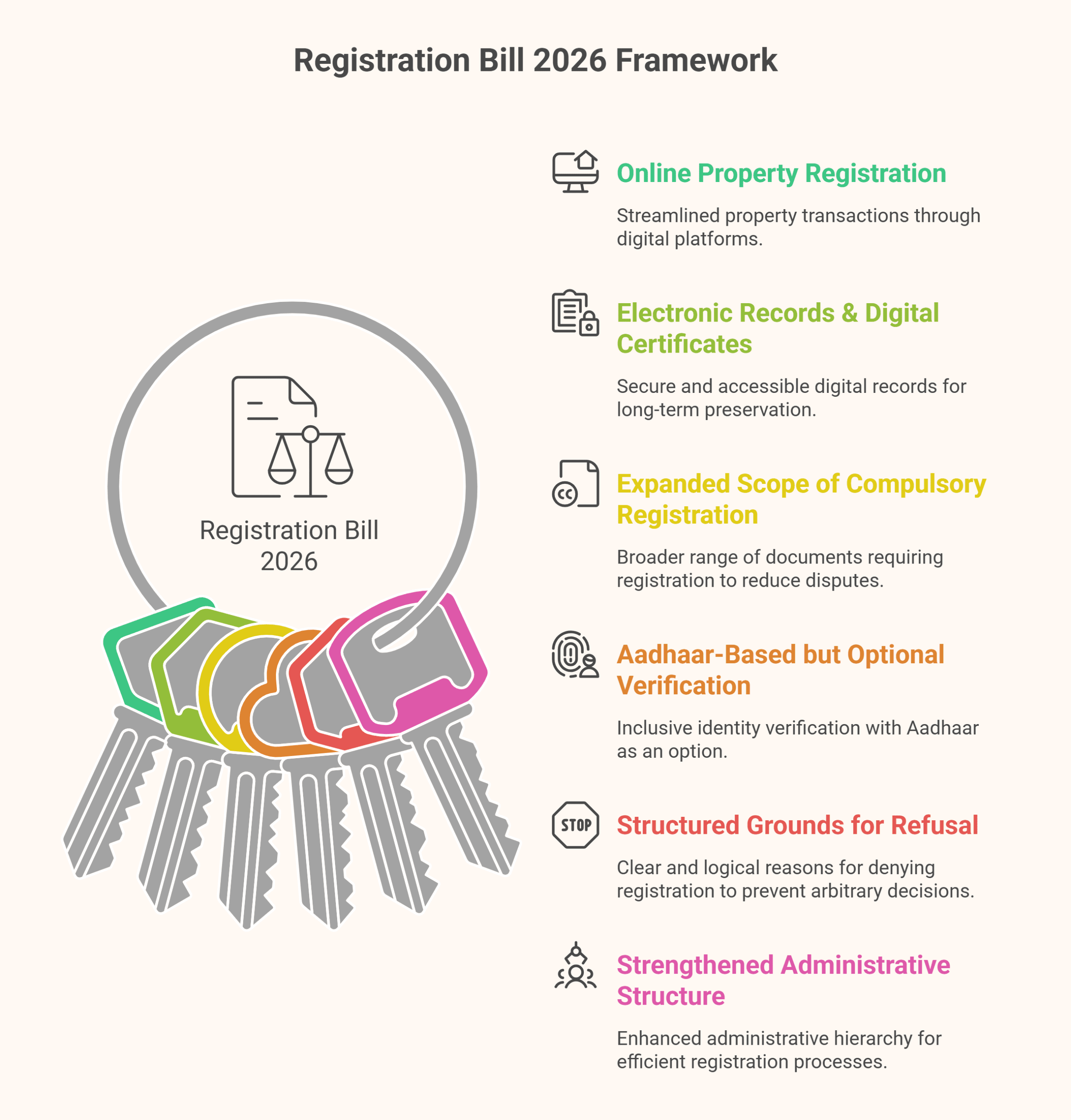
1. Online Property Registration
One of the major modifications under the Registration Bill 2026 is the full online registration. Sellers and buyers of property are able to:
- Send documents to us electronically.
- Verify identity electronically.
- Complete registration without repeat office visits.
- Receive digital registration certificates.
This helps reduce the time for processing and paperwork.
2. Electronic Records & Digital Certificates
Contrary to the 1908 Act that relies heavily on records that are physically stored and records, the new Bill encourages:
- Electronic document storage.
- Digital registration certificates.
- Secure digital database management.
- Tamper-proof record maintenance.
This will ensure long-term preservation as well as an easy access to the records.
3. Expanded Scope of Compulsory Registration
The Registration Act, 1908, only required certain documents to be registered. The Registration Bill, 2026, expands this list to include:
- Agreements to sell.
- Powers of attorney.
- Equitable mortgages.
- Court orders affecting property.
- Sale certificates issued by authorities.
This helps reduce disputes arising from unregistered agreements.
4. Aadhaar-Based but Optional Verification
The Bill allows identity verification via Aadhaar authentication. However, it doesn’t create Aadhaar mandatory. Alternative documents that are valid and legally valid can be used for verification.
This ensures inclusivity while maintaining security.
5. Structured Grounds for Refusal
Registration Bill 2026 provides specific and logical reasons to deny registration, including:
- Improper document execution.
- Identity mismatch.
- Incomplete property description.
- Non-payment of required fees.
This reduces arbitrary decisions by registering authorities.
6. Strengthened Administrative Structure
Registration Bill 2026 improvements to the administration hierarchy, which includes:
- Appointment of additional registration officers.
- Defined supervisory roles.
- Better monitoring mechanisms.
This enhances accountability and efficiency.
Comparison: Registration Act 1908 vs Registration Bill 2026
Below is a detailed comparison of both laws:
| Feature | Registration Act, 1908 | Registration Bill 2026 |
| Nature of Law | Colonial-era legislation | Modern digital framework |
| Registration Mode | Physical & paper-based | Online & digital |
| Record Maintenance | Manual record books | Electronic database |
| Identity Verification | Physical appearance required | Aadhaar-based or alternative digital verification |
| Registration Certificate | Physical copy | Digital & electronic copy |
| Scope of Documents | Limited | Expanded list |
| Refusal of Registration | Broad discretionary powers | Structured & defined grounds |
| Transparency | Limited | High transparency & digital tracking |
Benefits of Registration Bill 2026
1. Faster Property Transactions
Digital processes reduce delays and eliminate unnecessary visits to sub-registrar offices.
2. Increased Transparency
Online tracking and digital records minimize corruption and manipulation.
3. Reduced Litigation
Compulsory registration of more documents reduces property disputes.
4. Support for NRIs & Remote Buyers
Online systems make it easier for NRIs and remote investors to register property without being physically present.
5. Boost to Real Estate Sector
Simplified procedures improve investor confidence and ease of doing business.
Challenges and Concerns
While the Registration Bill 2026 is progressive, some challenges may arise:
- Data security and privacy concerns.
- Implementation challenges in rural areas.
- Digital literacy gaps.
- State-level infrastructure readiness.
Successful implementation will depend on strong cybersecurity measures and uniform adoption across states.
Impact on Property Buyers and Sellers
For property buyers and sellers, the Registration Bill 2026 means:
- Reduced paperwork.
- Less dependency on middlemen.
- Transparent property records.
- Faster ownership transfer.
- Secure digital documentation.
This could significantly modernize India’s property market.
Conclusion
The Registration Bill 2026 is a significant overhaul of India’s property registration system. In addition to replacing the centuries-old Registration Act of 1908, it allows for digital registration, greater document coverage, standardized processes, and greater transparency.
If implemented properly, this bill will transform the way property transactions are conducted in India, making them faster and safer. It will also make them more secure. This is a major step towards digital governance and modern land record management.
frequently asked questions
Ques. What is the Registration Bill 2026?
Ans. Registration Bill 2026 is a proposed law to modernize property registration in India by introducing online processes, digital records, and improved transparency.
Ques. How is Registration Bill 2026 different from the old law?
Ans. Registration Bill 2026 replaces the paper-based system with digital registration, electronic certificates, and expanded compulsory document registration.
Ques. Does Registration Bill 2026 allow online property registration?
Ans. Yes, Registration Bill 2026 enables online submission, digital verification, and electronic registration certificates to simplify property transactions.
Ques. Who benefits from Registration Bill 2026?
Ans. Homebuyers, sellers, NRIs, and real estate investors benefit from faster processing, reduced fraud, and transparent digital property records.
Select 82 more words to run Humanizer.