On December 5, 2025, the Reserve Bank of India (RBI) took a significant step to boost economic growth. It cut the repo rate by 25 basis points to 5.25%. This move is expected to have a far-reaching impact on the housing market. This is the fourth time the RBI has cut the repo rate – the first rate cut will occur in February 2025.
While borrowers may be happy with the expected reduction in home loan interest rates, the real question is how quickly banks will pass on the benefits, and what does this mean for homebuyers and existing homeowners? Let’s take a closer look at the impact of this rate cut.
What Does a Home Loan Interest Rate Reset Mean?
A home loan interest rate reset is a fixed change in the interest rate on your floating-rate home loan. The lender reviews the rate periodically. This can be every three months, six months, or once a year. The reset date and frequency are usually mentioned in your sanction letter.
At each reset, the bank compares its current benchmark rate to the previous rate. If the benchmark has moved up or down, your effective lending rate changes. This is simply what a basic interest rate reset means.
EMI changes following a rate change can occur in two ways: the bank can increase or decrease your EMI. Or it can keep your EMI the same and change your loan tenure. Sometimes it does a combination of both.
1. What Is the Role of RBI in Home Loans?
The Reserve Bank of India (RBI) is India’s central bank. It regulates and makes rules and regulations.:
- Interest rate frameworks
- Banking norms
- Loan policies for financial institutions
Although the RBI doesn’t directly provide home loans, it sets benchmark rates that influence what banks and NBFCs will charge you. These policies ensure transparency, fair practices, and financial stability in the lending ecosystem.
2. Understanding Repo Rate and Its Impact
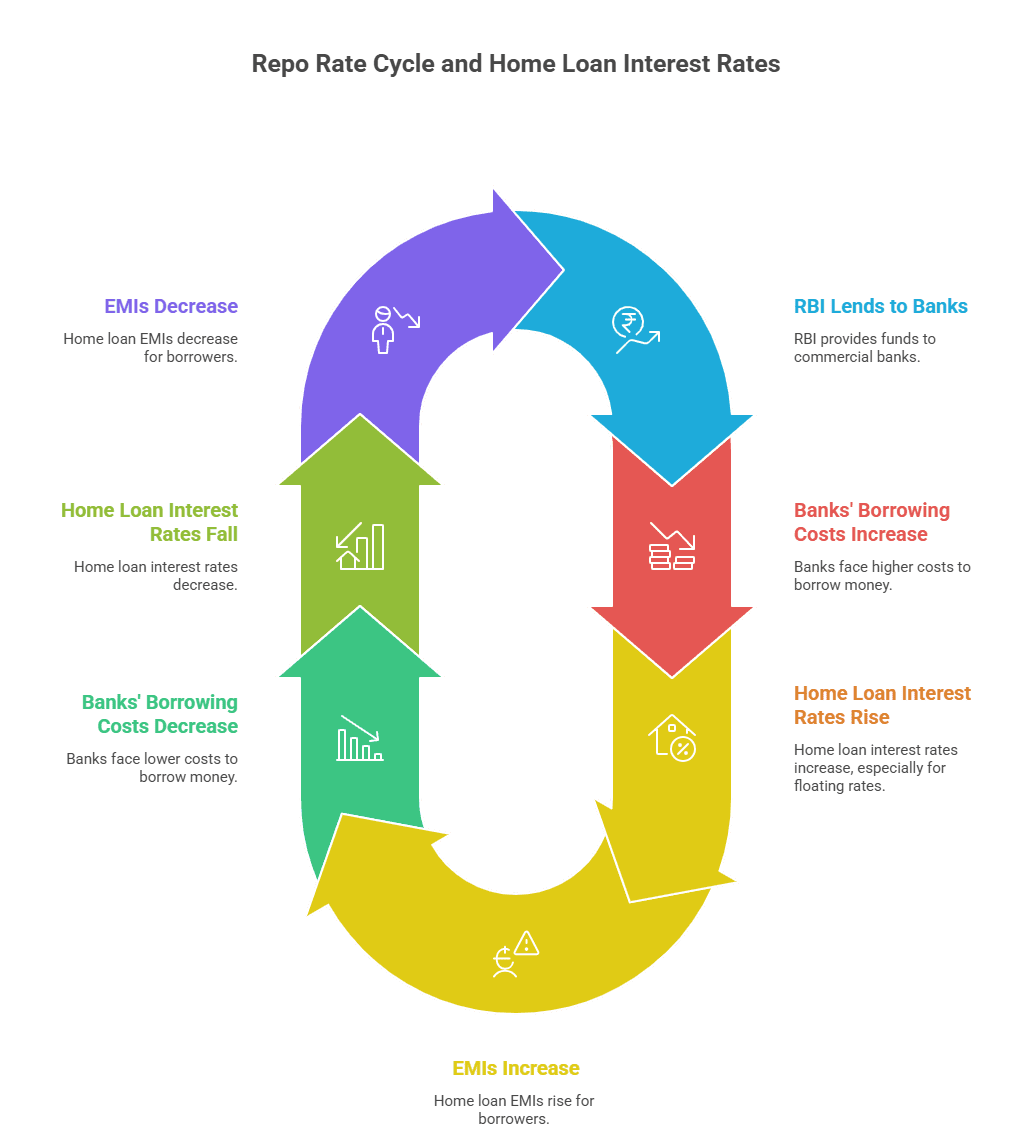
The repo rate is the rate at which the RBI lends money to commercial banks.
- When the repo rate rises, banks’ borrowing costs increase.
- This increases home loan interest rates, especially for floating-rate borrowers.
- When the repo rate falls, banks can reduce loan rates, thereby reducing your EMI.
As of now, most floating-rate loans in India are linked to the repo rate through the external benchmark lending rate (EBLR) system.
Repo Rate Impact on Home Loan EMI
Nowadays, most floating-rate loans are linked to an external benchmark. For many banks, this is the RBI’s repo rate. When the Reserve Bank of India increases the repo rate, the cost of funds for banks also increases. Banks then pass on this increase to borrowers.
That’s why the repo rate has such a significant impact on home loan EMIs. A 0.25% increase in the repo rate can increase your lending rate by the same amount. Over the long term, even this small change can increase your total interest expense by lakhs of rupees.
To see how different lenders are reacting, you should track current home loan interest rates. This gives you an idea of whether your bank is keeping pace with the market or charging more than others.
What happens when the repo rate decreases?
However, it has been observed that when the Reserve Bank of India lowers its rates, other banks take some time to reduce their loan rates to customers. This delay reduces the immediate impact of the repo rate reduction on borrowers. On the other hand, when the repo rate rises, banks are quick to increase their loan rates. Therefore, in April 2016, the RBI implemented the Marginal Cost of Funds Based Lending Rate system to change the way commercial banks operate.
MCLR is an internal reference for commercial banks to determine the interest rate they can charge on loans. Under this system, banks are required to adjust their interest rates as soon as the repo rate changes. This ensures that the impact of a lower repo rate is felt more quickly, leading to lower home loan EMIs. Overall, the impact of a repo rate cut not only benefits borrowers by making loans more affordable, but also improves transparency in the way lenders and financial institutions calculate interest on advances.
New repo rate effective date and what it means for borrowers
Whenever the RBI announces a new repo rate, both borrowers and financial institutions closely monitor it. The repo rate’s effective date is the point at which the changed rate begins to impact borrowing and lending costs. This date is crucial because it determines when the new interest rates on loans, including home loans, will become effective.
The RBI’s update on repo rate changes prompts financial institutions to adjust their lending rates accordingly. Most home loans in India are linked to either the RBI repo rate or the MCLR (Marginal Cost of Funds-Based Lending Rate). This ensures that borrowers feel the impact of the repo rate immediately. For example, a rate decrease can reduce home loan EMIs, while an increase can increase monthly payments.
Floating Rate Home Loan EMI Impact in Numbers
Consider a simple example: You have a floating-rate home loan of Rs 40 lakh for 20 years. Your starting rate is 8% per annum.
- EMI at 8% ≈ Rs. 33,458 per month
After one year, the bank resets your floating rate home loan and increases your rate to 9%. What happens now?
If the bank keeps the tenure the same and only changes the EMI:
- EMI at 9% ≈ Rs. 35,989 per month
After the reset, your EMI will increase by approximately ₹2,500 per month. This translates to an additional ₹30,000 in expenses over a year.
If, instead, the bank keeps your EMI at ₹33,458 and extends the term, your loan could extend for a few more years. You’ll end up paying more interest overall, even though the monthly impact may seem small.
How is the New EMI Calculated After the Rate change?
Banks use a standard formula to calculate loan EMIs. When home loan interest rates reset, they plug the new interest rate and remaining tenure into the same formula. This gives them a revised EMI figure.
You can use a home loan EMI calculator to see the impact of any rate changes.
Try this simple process:
- Enter your current loan amount, rate, and remaining term. Note the EMI.
- Increase the rate by 0.25% or 0.50% and keep the term the same.
- See how much the EMI increases.
- Then keep the EMI the same and change the term until the calculator matches your EMI.
This exercise clearly shows you how banks work with tenure and EMI to manage the impact of rate changes.
EMI Change After Rate Revision vs Tenure Change
When rates reset, lenders prefer to extend the tenure first, especially if you’re already paying a high EMI. This keeps your monthly expenses stable, reducing your chances of default. Longer tenures have a hidden cost: You pay more interest over time.
If you can afford it, ask your bank for an EMI increase instead of just extending the tenure. A slightly higher EMI now can save you a lot of interest in the future. You can test different combinations with an EMI calculator before talking to your lender.
If you’re planning a new loan, use a home loan eligibility calculator first. Don’t borrow more than you’re eligible for. Keep a buffer for future interest rate changes.
How to Handle EMI Increase After Reset
When your EMI goes up after a reset, you have a few options:
- Increase EMIs and keep the tenure the same: This is better if your income has increased. This can help avoid the long-term burden of extra interest.
- Part-prepay the loan: If you have savings, making a one-time prepayment reduces your principal. This can bring the EMI or tenure back under control.
- Refinance with another lender: If other banks are offering lower rates, you can shift your loan. Check the processing charges and terms before making the shift.
- Ask for a step-up EMI option: If your income increases, you can move to an increasing EMI pattern instead of making a big jump all at once.
Whichever you choose, first model different scenarios using a home loan EMI calculator. Then, make a decision based on your real cash flow and risk comfort.
Tips to prepare for future rate resets
You can’t control when home loan interest rates reset, but you can prepare for it.
- If you can afford to pay early, avoid taking the longest term.
- Keep your EMI at 35–40% of your take-home income, no more.
- Build an emergency fund with at least six months’ EMI.
- Track your bank’s rate compared to market home loan interest rates.
- Whenever your income changes, recheck your borrowing capacity on the eligibility calculator.
Rate cycles are a part of every floating loan. If you understand how they work and plan with simple tools, you can minimize the shock of each reset. Your goal should be clear: keep EMIs manageable, reduce the term whenever possible, and avoid paying excessive interest.