Property owners in Delhi are subject to the MCD property tax. The Municipal Corporation of Delhi (MCD) regulates property tax payments. MCD property tax can be paid online. Learn more about the MCD property tax.
Property owners in Delhi are required to pay property tax annually, and those with long-standing arrears have now received some relief. The Municipal Corporation of Delhi (MCD) has extended the deadline for its Property Tax Settlement (SUNIYO) scheme to January 31, 2026. Under this scheme, outstanding arrears and penalties will be waived upon payment of the property tax for the 2025-26 financial year. Here’s complete information on how to avail of this benefit and how to make online payments.
The Municipal Corporation of Delhi (MCD) is the civic body responsible for maintaining infrastructure in Delhi through funding and tax collection. To help property owners pay their house tax on time and without any hassle, the authority has made the entire process online. Furthermore, the authority has decided to waive house tax for the financial year (FY) 2025-26 to reduce the financial burden on Delhi homeowners. Read on to learn about Delhi’s tax rates and how to pay them online.
MCD property tax rate 2025-26
In Delhi, property tax is calculated based on eight categories, ranging from A to H. Each category has a different tax rate and unit area value per square meter, which are determined as follows:
| Category | House tax | Property tax on commercial property | Unit area value (Rs per sq metre) |
| A | 12% | 20% | 630 |
| B | 12% | 20% | 500 |
| C | 11% | 20% | 400 |
| D | 11% | 20% | 320 |
| E | 11% | 20% | 270 |
| F | 7% | 20% | 230 |
| G | 7% | 20% | 200 |
| H | 7% | 20% | 100 |
In addition to the category and rate, the MCD uses these multiplicative factors to calculate the tax rate.
| Age factor | |
| Construction year | Age factor |
| 2000 onwards | 1 |
| 1990-99 | 0.9 |
| 1980-89 | 0.8 |
| 1970-79 | 0.7 |
| 1960-69 | 0.6 |
| Before 1960 | 0.5 |
| Use factor | |
| Use factor | Property type |
| 1 | Residential property |
| 1 | Non-residential public purpose |
| 2 | Non-residential public utility |
| 3 | Industry, entertainment and clubs |
| 4 | Restaurants, hotels up to 2-star rating |
| 10 | 3-star and above hotels, towers, hoarding |
| Structure factor | |
| Construction type | Structure factor |
| Kuchha | 0.5 |
| Pucca (RCC Building) | 1 |
| Semi-pucca | 1 |
| Occupancy factor | |
| Occupancy type | Occupancy factor |
| Vacant plot | 0.6 |
| Self-occupied | 1 |
| Rented out | 2 |
Tax rates for commercial properties, vacant land, and farmhouses:
The MCD has set these tax rates for different types of commercial and other properties.:
- Commercial property (less than 1,500 square feet): 20 percent tax for categories A to E and 15 percent tax for categories F to H.
- Commercial property (more than 1,500 square feet): A uniform tax rate of 20 percent for all categories (A to H).
- Industrial property (vacant land/covered area): 15 percent of the annual value for all categories (A to H).
- Residential farmhouse: 20 percent of the annual value for all categories (A to H).
- Non-residential farmhouse: 20 percent of the annual value for all categories (A to H).
How to Calculate MCD Property Tax in Delhi?
The MCD (Municipal Corporation of Delhi) primarily uses the ‘Unit Area System’ for property tax calculation in Delhi. The formula for calculating MCD property tax is as follows:
Property Tax = Annual Value X Tax Ratio
Where
- Annual Value = Unit Area Value X Unit Area X Age Factor X Occupancy Factor X Structure Factor
- Tax Rate = Tax rate published by MCD for A-H categories for that year.
Delhi is primarily divided into 8 different categories, segmented from A to H, based on which property tax rates are determined. (MCD Online)
Formula To Calculate Property Tax
Property tax annual value = Value per unit area X Unit area of the property X Age factor X Structure factor X Occupancy factor,
where
Unit Area Value – This specific value per square meter is determined for the built-up area of the property.
Age Factor – The age factor of the property and its value range between 0.5 and 1.0. Newer properties are taxed more heavily because they have a higher market value.
Occupancy Factor – Properties that are rented out are taxed more than owner-occupied properties because rental income constitutes an additional source of income.
How to Pay MCD Property Tax Online in Delhi?
Delhi is one of the very few municipal bodies that offers you the option to pay Delhi house tax online, in addition to the traditional offline method prevalent everywhere else.
Below are the main steps you need to follow to pay MCD property tax in Delhi using either of these methods.
Step 1: First, you need to log in to the official MCD website – mcdonline.nic.in.
Pay Property Tax Online at MCD
Step 2: Go to the online services page of your area’s municipal corporation. Then click on the ‘Property Tax’ tab.
Step 3: You will need to log in using your registration or sign-up details. If you have registered before, you will need to log in according to your preferred registration/sign-up details. If you are a new user and have not registered yourself yet, follow the given process.
Login at the MCD Website to Pay Online | Create a New User
Step 4: You will see a link at the bottom of the page that says “Click here to sign up/register as a new user”. Click on that link.
Step 5: Select Register as a Citizen.
Step 6: Fill in your first name, father’s/husband’s name, and country code.
Step 7: After this, you will get the option to register using your mobile number/email ID
Step 8: To calculate your tax, you need to go to the search page to view the details of your registered property. If you have registered your property before, you will need to search using your UPIC (Unique Property ID Code). If you haven’t registered your property yet, you will need to register it first and then generate a UPIC..
Step 9: You would have to fill in all the following details:
- Ownership details – Ledger folio number, property type, type of ownership, etc.
- Property details – House number, residential address
- Contact details – Email ID, phone number, bank details, etc.
- Building details – Floor number, purpose of use, covered area, etc.
- Include any outstanding amounts, if applicable.
Step 10: You need to carefully review the details you have entered and then click on the ‘Accept’ tab.
Step 11: Then you need to click on the ‘Submit’ tab and finally make the payment.
Step 12: You have the option to pay using a debit card/credit card or net banking.
Step 13: After making the Delhi property tax payment through online mode, you will need to click on ‘Generate Challan’ to display the Pay online Challan Delhi.
Step 14: Then you will need to download the Delhi property tax receipt containing your payment details for any future reference.
Different zones under MCD
The three civic bodies of Delhi, the East Delhi Municipal Corporation (EDMC), the North Delhi Municipal Corporation (NDMC), and the South Delhi Municipal Corporation (SDMC), were merged in May 2022 to form a single entity, now known as the Municipal Corporation of Delhi (MCD).
This unified MCD manages an area of 1,397.3 square kilometers, which is divided into 12 administrative zones. The head office is located at Dr. S.P. Mukherjee Civic Centre, JLN Marg, New Delhi-110002.
| Zone Name | |
| Central Zone | South Zone |
| City-SP Zone | West Zone |
| Civil Lines | Najafgarh Zone |
| Karol Bagh | Rohini |
| Keshav Puram | North Shahdara Zone |
| Narela | South Shahdara Zone |
Source: MCD official website
List of Delhi colonies with categories
| Category | Main colonies |
| A | Anand Niketan, Basant Lok DDA Complex, Bhikaji Cama Place, Friends Colony, Friends Colony East, Friends Colony West, Golf Links, Kalindi Colony, Lodi Road Industrial Area, Maharani Bagh, Nehru Place, New Friends Colony, Panchshila Park, Rajendra Place, Shanti Niketan, Sunder Nagar, Vasant Vihar |
| B | Anand Lok, Andrews Ganj, Defence Colony, Greater Kailash I, Greater Kailash II, Greater Kailash III, Greater Kailash IV, Green Park, Gulmohar Park, Hamdard Nagar, Hauz Khas, Maurice Nagar, Munirka Vihar, Neeti Bagh, Nehru Enclave, Nizamuddin East, Pamposh Enclave, Panchsheel Park, Safdarjang Enclave, Sarvapriya Vihar, Sarvodaya Enclave |
| C | Alaknanda, Chittaranjan Park, Civil Lines, East of Kailash, East Patel Nagar, Jhandewalan Area, Kailash Hill, Kalkaji, Lajpat Nagar I, Lajpat Nagar II, Lajpat Nagar III, Lajpat Nagar IV, Malviya Nagar, Masjid Moth, Munirka, Nizamuddin West, Panchsheel Extension, Punjabi Bagh, Som Vihar, Vasant Kunj |
| D | Anand Vihar, Daryaganj, Dwarka, East End Apartments, Gagan Vihar, Hudson Line, Indraprastha Extension, Janakpuri, Jangpura A, Jangpura Extension, Jasola Vihar, Karol Bagh, Kirti Nagar, Mayur Vihar, New Rajinder Nagar, Old Rajinder Nagar, Rajouri Garden |
| E | Chandni Chowk, East End Enclave, Gagan Vihar Extension, Hauz Qazi, Jama Masjid, Kashmere Gate, Khirki Extension, Madhuban Enclave, Mahavir Nagar, Moti Nagar, Pahar Ganj, Pandav Nagar, Rohini, Sarai Rihilla |
| F | Anand Parbat, Arjun Nagar, Daya Basti, Dilshad Colony, Dishad Garden, BR Amdedkar Colony, Ganesh Nagar, Govindpuri, Hari Nagar, Jangpura B, Madhu Vihar,ÊMajnu Ka Tila, Mukheree Park Extension, Nand Nagri, Uttam Nagar, Zakir Nagar Okhla |
| G | Ambedkar Nagar Jahangirpuri, Amdedkar Nagar East Delhi, Amber Vihar, Dabri Extension, Dakshinpuri, Dashrath Puri, Hari Nagar Extension, Vivek Vihar Phase I, Tagore Garden |
| H | Sultanpur Majra |
Property Tax On Commercial Properties
| Property Area | Category | Rate of Tax* |
| Less than Covered Area 1500 sq.ft. | A, B, C, D, and E | 20% |
| Less than Covered Area 1500 sq.ft. | F, G, and H | 15% |
| More than Covered Area 1500 sq.ft. | A, B, C, D, E, F, G, and H | 20% |
* The tax rate is calculated on the annual value of vacant land or a portion thereof, or the covered area of buildings.
Property Tax on Vacant Land
Industrial property tax will be 15% of the annual value of vacant land or a portion thereof, or the covered area of a building, across all categories, namely A, B, C, D, E, F, G, and H.
Property Tax on Farmhouses
The property tax rates for farmhouses are as follows:
- For residential farmhouses: 20% of the annual value of the vacant land or part thereof, or the covered area of the buildings in all categories, i.e., A, B, C, D, E, F, G, and H.
- For non-residential farmhouses: 20% of the annual value of the vacant land or part thereof, or the covered area of the buildings in all categories, i.e., A, B, C, D, E, F, G, and H.
MCD Property Tax Waiver Scheme
The Delhi Municipal Corporation has announced a property tax waiver scheme. Under this scheme, residents who pay their property tax dues for the year 2024-25 will receive a waiver on all previous property tax arrears. The property tax waiver scheme also includes:
- Residents who own properties ranging from 100 square yards to 500 square yards will receive a 50% tax rebate.
- Homeowners with properties of 100 square yards or less are completely exempt from house tax.
- Housing apartments previously did not receive any house tax exemption. However, under the new tax rebate scheme, approximately 1300 housing apartments are now eligible for a 25% reduction in tax.
- Even commercial properties located in rehabilitation areas can benefit from the tax exemption.
The objective behind promoting this scheme is to reduce the tax burden on citizens and curb the growing corruption in tax collection. To facilitate easy payment of property tax, MCD offices will remain open on Saturdays until March 31, 2025. The offices will be open from 10:00 AM to 5:00 PM.
Delhi Property Tax- User Charge Fee and 10% Rebate
According to the latest update, the Municipal Corporation of Delhi (MCD) has made the user charge optional for property tax payers in Delhi. The “user charge” is essentially a waste collection fee levied by the MCD on property owners in Delhi. It was previously included as an additional component in the annual property tax bill. The charge amounted to ₹600 for residential properties and a higher amount for commercial properties, added to the total MCD tax payable. This charge has now been made optional for taxpayers, meaning payment is at their discretion. This decision came into effect on April 1, 2025. Additionally, the MCD has also offered a 10% rebate to taxpayers who pay their taxes before July 31, 2025.
Municipal Corporation of Delhi (MCD)
The Municipal Corporation of Delhi, also known as MCD, is the municipal body of Delhi. In 2022, on May 22nd, the three separate civic bodies—South Delhi Municipal Corporation, North Delhi Municipal Corporation, and East Delhi Municipal Corporation—were merged back into a single entity under the name MCD.
The Municipal Corporation of Delhi (MCD) caters to the needs of approximately 20 million citizens residing in nearly 250 wards of Delhi. The MCD is a major civic body under the National Capital Region and one of the largest municipal corporations in the world. It is estimated that the MCD covers an area of approximately 1397.3 square kilometers.

Also Read: Stamp Duty in Delhi
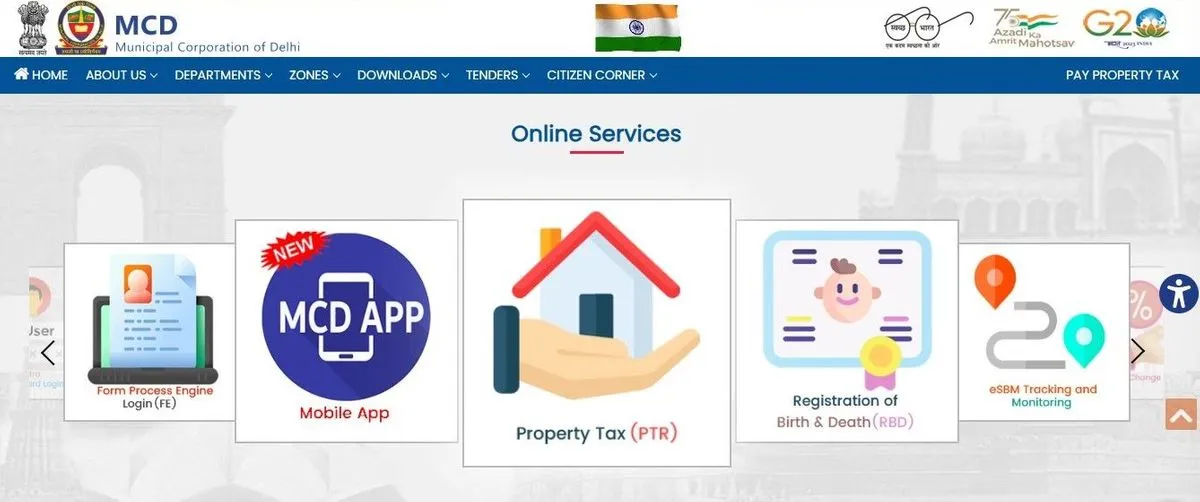
MCD Online Mobile App
To make access to services easier for citizens, MCD Online has launched a mobile application called the MCD App. This app is also known as the Unified Payments App. You can download this app from the Google Play Store and the Apple App Store. Alternatively, you can visit the MCD Online website and scroll down to the online services section. From there, click on the MCD App link.
MCD Website Online Services – MCD Mobile App
This will take you to the download center, where you can download the MCD app from the required app store.
MCD App Download Page

After downloading the MCD online mobile application on your smartphone, you can access and utilize Delhi house tax services.
- Pay your Delhi property tax without any hassle.
- View your Delhi house tax payment transaction history.
- Generate and easily download MCD property tax payment receipts.
- Register Delhi property tax complaints and get your issues resolved quickly.
- Contact the Delhi Municipal Corporation customer care team and get answers to your questions.
How to Pay MCD Property Tax Using the Mobile App?
One of the easiest ways to pay your MCD property tax is by using the Delhi Municipal Corporation app. The MCD property tax mobile application offers several great features, such as quick registration, easy navigation, real-time updates, transaction history, and more, making it convenient for taxpayers to pay their property tax. This mobile app supports multiple payment options, including credit cards, debit cards, mobile wallets, and internet banking. Mobile app users can choose their preferred payment method and follow these steps to pay their taxes on time.
- Step 1: Download the MCD app on your mobile phone. This mobile app is available on both the Google Play Store and the Apple App Store. You can choose your preferred app store based on the operating system you are using.
- Step 2: Log in to the app using your registered mobile number and verify it with an OTP.
- Step 3: Then go to the registered property details and click on Pay Tax for the desired UPIC, select the financial year, and submit.
- Step 4: You can then make the payment digitally and check the tax calculation for the same financial year. Payment can be made using a credit card, debit card, or net banking. After successful payment, download the tax receipt by clicking on Download Receipt to save the property tax receipt.
Download MCD Mobile App: Click Here
MCD Property Tax: Pay Property Tax in Delhi Without Property ID
You may have forgotten your property ID or may not have it. However, you can still pay your MCD property tax online without a property ID. Paying property tax without a property ID is only applicable for first-time users.
- Step 1: Go to the official MCD property tax website @https://mcdonline.nic.in/ and then select your category – NDMC, SDMC, and EDMC.
- Step 2: Click on Property Tax, and a new page will open in a new tab.
- Step 3: Click on ‘Click here if Property ID has not been allotted yet’.
- Step 4: A form will open where you will need to enter the property ownership details. Now, click on ‘I have read and accept the declaration given above’ and then click on ‘Submit’.
- Step 5: A Property ID will be sent to your registered mobile number. This Property ID can be used for future reference.
- Step 6: Payment can be made using a debit card, credit card, or internet banking. You can obtain the property tax receipt later.
Conditions for Availing of Delhi House Tax Rebate
Here are some conditions that taxpayers must meet to avail the Delhi property tax rebate.
- The property in question must have a residential occupancy factor. Residential properties being used for commercial purposes are not eligible for the Delhi house tax rebate.
- The MCD property tax rebate is granted to properties spanning a maximum of 200 square meters. For DDA and CGHS units, the size limit is 100 square meters.
- The property must be self-occupied and not rented out or leased.
- The Delhi property tax rebate is applied differently to jointly owned properties. The rebate amount should be divided among each eligible property owner based on their ownership share.
MCD Property Tax – How To Get Your Property Geo-Tagged?
The Delhi Municipal Corporation’s Property Tax Department has issued guidelines stating that property owners must geo-tag their properties. To geo-tag their properties, users need to download an app from the Play Store and follow the instructions.
Step 1: Download the Unified Mobile App (UMA) or visit the website mcdonline(dot)nic(dot)in/mcdapp(dot)html.
Step 2: Select the Citizen option on the UMA app and enter your login details.
Step 3: Select the UPIC option for geo-tagging using your registered mobile number.
Step 4: Select the UPIC for the property, then click ‘Geo-tagging’. A map location will pop up on the screen.
These steps will help you geotag your property, which means assigning a precise latitude and longitude to your property. However, creating a UPIC ID is mandatory to geotag your property. Users who do not have a UPIC ID will need to register and create one first.
How to Get Wrong User Charges Removed from Your MCD Tax Bill
Sometimes, user charges (such as those for services like garbage collection) appear on your MCD property tax bill, even if you are not using those services. However, you can request that they be removed. Here’s how to do it:
Step 1: Go to the MCD Property Tax Portal
Step 2: Log in and check your property details.
Step 3: Look for the “Register Complaint” or “Correction Request” option.
Step 4: Select “Incorrect User Charge” as the reason.
Step 5: Upload any supporting documents if needed (such as a copy of your private waste collection contract or a notice from your gated community).
Step 6: Submit the request and wait for the MCD to review it.
If you prefer offline assistance, you can also visit your nearest MCD Zonal Office. Corrections typically take a few days.
Rebates on Delhi House Tax
The MCD office in Delhi provides certain exemptions to different categories of property taxpayers in Delhi under various circumstances:
- A 15% discount is offered for paying property tax in a lump sum during the first quarter of the year.
- DDA or CGHS flats with an area up to 100 square meters are given a 10% discount on their annual value.
- Physically challenged individuals and senior citizens are given a 30% discount on only one property.
- Ex-servicemen are given a 30% discount on their house tax.
- Group housing flats are given a 20% discount if the payment is made by June 30th of the financial year.
Exemption Under Delhi Property Tax
The MCD exempts some bodies and individuals from paying Property tax. They are:
- Vacant buildings or land used as heritage buildings/for charitable purposes/worship/public cemeteries.
- If the property is being used for agricultural purposes.
- If a building or land is owned by a corporation.
- The property owner is an ex-serviceman or the widow of a soldier killed in action, and uses the property for self-residence, without renting out any part of the house.
- The property of a person who died while on parliamentary or police duty.
- The property owner is under the MCD (Municipal Corporation of Delhi) and is disabled but still on duty.
- The property owner is a sportsperson and has won several awards in various international sports.
Quick, Simple and Transparent: MCD’s Property Tax Calculator Unveiled
The Municipal Corporation of Delhi (MCD) has launched a new online tool for calculating Delhi property tax. Residents can now easily calculate their property tax online. This user-friendly calculator allows citizens to determine their tax amount without logging in or requiring the assistance of any intermediary. This initiative is part of the MCD’s plan to improve digital transparency and increase revenue.
MCD Property Tax – Suniyo Yojana 2025-26
The Delhi government’s amnesty scheme for property tax defaulters has been extended to the financial year 2025-26. Under this scheme, taxpayers falling under the MCD property tax jurisdiction can pay their outstanding property tax principal amount without any interest or penalties. Residents can avail of this scheme and pay their property tax dues until September 30, 2025.
Property taxpayers of all categories in Delhi can avail of this scheme. Under the ONE PLUS FIVE scheme, taxpayers are required to pay the principal tax amount for the current financial year (FY 2025-26) plus the previous five years (i.e., FY 2020-21 to FY 2024-25). Tax for previous years is only payable if it has not already been paid. This applies to all types of properties – residential, commercial, and unauthorized. Over 1,800 help camps are operational across Delhi. The MCD has also waived the waste user charge since June 1st. After payment, property owners will receive a No Objection Certificate (NOC) as proof of payment.
The benefits of the Suniyo Yojana 2025-26 include a 100% waiver on interest and penalties for these six years. This waiver will apply to both the rateable value method and the unit area method of property tax assessment. However, if a taxpayer fails to pay their outstanding dues under this scheme, they will be required to pay the full amount of their property tax arrears, including interest and penalties. Furthermore, if property tax remains unpaid, the MCD may initiate recovery proceedings under the DMC Act, 1957.
Delhi’s Suniyo Scheme Brings Record Property Tax Boost for MCD
In just three months, the MCD property tax amnesty scheme, named Suniyo (Property Tax Settlement Scheme), has successfully collected ₹304 crore, significantly more than the previous Samriddhi scheme, which collected only ₹84.23 crore in the same period.
Between June and August 2025, the Suniyo scheme attracted 102,142 taxpayers, a significant increase compared to the 38,805 participants in the Samriddhi scheme during 2022-23. This represents a 163.22% increase in participation, with over 63,000 additional taxpayers joining the scheme.
Monthly collection breakdown shows:
- June: INR 96.28 crore (INR 35.30 crore from residential and INR 60.98 crore from commercial sectors)
- July: INR 150.57 crore
- August: INR 58 crore.
| Zone | Revenue Collected (INR Crore) | Taxpayer Count |
| Narela | 44.80 | – |
| Karol Bagh | 28.69 | – |
| MCD Headquarters | 25.78 | – |
| South Zone | 24.78 | – |
| City SP Zone | 24.36 | – |
| Keshavpuram | 20+ | – |
| Shahdara (South) | 20+ | 2nd Highest |
| Shahdara (North) | 20+ | – |
| West Zone | 20+ | 12,623 (Highest) |
| Central Zone | 20+ | – |
| Rohini | 16.27 | – |
| Civil Lines | 13.68 | – |
| Najafgarh | 12.97 | – |
MCD Integrates Trade Licence with Property Tax System
The Municipal Corporation of Delhi (MCD) has approved a major reform by integrating the General Trade and Storage License (GTL) with the property tax system.
This move aims to significantly reduce the compliance burden for businesses and streamline processes under the ‘Ease of Doing Business’ framework.
Details of the integration are provided here:
- Separate Application Eliminated: The General Trade/Storage License (GTL), issued under Section 417 of the DMC Act, will be integrated into the property tax payment system. Business owners will no longer need to file a separate application or obtain a separate license document.
- New Fee Structure: The General Trade License fee will now be levied at a flat rate of 15% of the annual property tax applicable to the business premises.
- Combined Payment: Traders and business owners can now pay their trade license fee along with their annual property tax.
- License Validation: An endorsement on the property tax payment receipt will serve as the valid license.
- Applicable Trades: The General Trade and Storage License system covers over 463 types of trades, ranging from small local grocery and paan shops to art galleries, showrooms, retail outlets, warehouses, and godowns.
- Objective: This reform is designed to safeguard MCD’s revenue while significantly reducing the ‘license-permit raj’ and curbing opportunities for harassment. The previous fee structure was complex, based on the type of trade, area, and locality category, often requiring inspector visits.
- Compliance: Although the license is now integrated, the validity of the receipt as a license is contingent upon compliance with necessary legal regulations, such as pollution control and fire safety norms, as mandated by the authorities.
- Revenue Context: Historically, the General Trade License fees collected amounted to approximately 20% of the property tax collected from those properties. The new 15% rate is an estimate to prevent revenue loss and simplify the process. In the last financial year, over 34,000 General Trade Licenses were issued, generating revenue of ₹56.66 crore, while ₹289 crore was collected as property tax from the same properties.
How to Contact MCD?
The contact information for the department that handles MCD property tax-related matters is given below:
| Contact information | |
| Department | IT Department |
| Address | Dr. S.P.M. Civic Centre, Minto Rd, SKD Basti, Press Enclave, Ajmeri Gate, New Delhi, Delhi, 110002 |
| Email Id | [email protected] |
| Call center number | 155305 |
The Municipal Corporation of Delhi (MCD) has become more efficient and transparent with the merger of its constituent bodies and changes to the property tax payment system. The shift to a Unique Property Identification Code (UPIC) ensures better property tracking and tax compliance. The MCD encourages citizens to fulfill their responsibilities promptly, as paying property tax is now easier and more convenient than ever before.
Read more: PMC Property Tax in Pune Easy Giude