Buying a home involves significant expenses. Learn how to correctly claim deductions on your home loan and stamp duty payments using Section 80C and Section 24b.
Buying a property in India involves a significant financial commitment that goes beyond the base price of the unit. You’ll also face significant one-time expenses every month, such as home loan EMIs and registration fees. The Indian Income Tax Act offers specific relief to help you manage these liabilities through structured deductions. Knowing which parts of your payment qualify for tax breaks ensures you don’t waste money during the assessment year.
Understanding Home Loan Tax Benefits under Section 80C
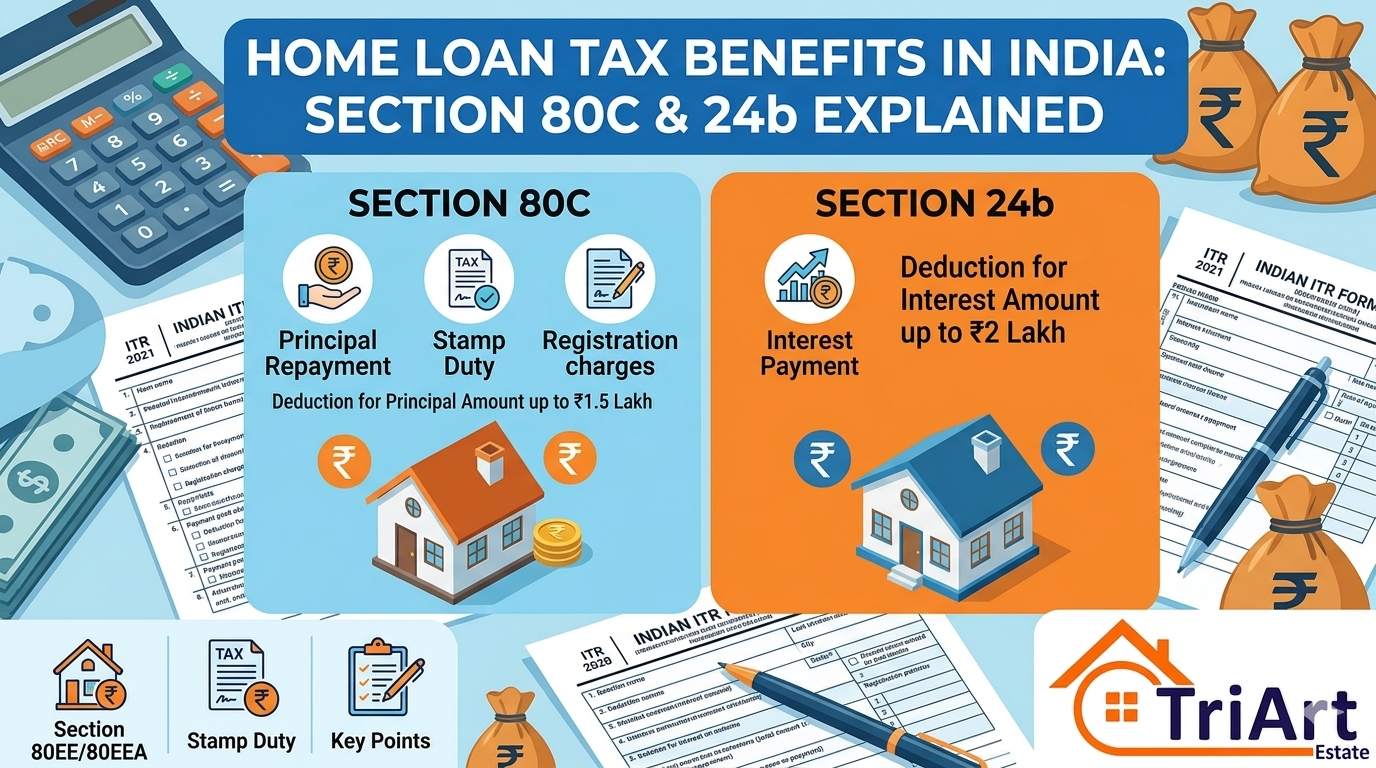
Under Section 80C of the Income Tax Act, you can claim a tax deduction on the principal amount paid on your home loan. This deduction also applies to the registration and stamp duty charges on your property. The maximum housing loan tax exemption under Section 80C is ₹1.5 lakh per financial year.
Section 80C Home Loan Tax Benefits Explained
Let us look at the benefits of claiming tax deduction under Section 80C for home loan repayment:
- Principal Repayment
Under Section 80C, you can claim a deduction on the principal amount paid on your home loan. This includes the equated monthly installments (EMIs) paid each month. The maximum deduction limit is ₹1.5 lakh per financial year.
For example, if your annual principal repayment is ₹2 lakh, you can claim a deduction of ₹1.5 lakh under Section 80C. - Registration and Stamp Duty Charges
In addition to principal repayment, you can also claim a deduction for the registration and stamp duty charges paid to purchase your home. This allows you to save tax while fulfilling the legal obligations associated with property ownership.
For example, if you paid ₹50,000 as registration and stamp duty charges for your new house, you can claim a deduction of ₹50,000 under Section 80C. - Joint Home Loan Benefits
If you have taken a joint home loan with another person, both co-applicants are eligible for tax benefits under Section 80C. Each co-applicant can claim a deduction on their share of the principal repayment amount, within the overall limit of ₹1.5 lakh. - For example, if you and your spouse take a joint home loan, and your share of the principal repayment is ₹1 lakh, while your spouse’s share is also ₹1 lakh, you can both claim a deduction of ₹1 lakh each under Section 80C.
Tax Deductions on Home Loan Interest (Section 24b)
Distinguishing Between Self-occupied and Let-out Property
Section 24b allows you to deduct the interest portion of your loan from your taxable income. If you live in the house, the maximum deduction is ₹2 lakh per year. Previously, there was no interest claim limit for rental properties. However, the current rules limit the set-off of losses from house property against other income heads to ₹2 lakh. Use the Home Loan EMI Calculator to see how your interest compares to these limits.
Pre-Construction Interest Guidelines
You can’t claim interest deduction while the property is still under construction. Once you receive a completion certificate or take possession, you can start claiming it. The law allows you to claim interest paid during construction in five equal annual installments. This start date begins the year construction ends.
Stamp Duty and Registration Charges: The Often Overlooked Deduction
Learn the ins and outs below.
Eligibility Criteria for Stamp Duty Claims
Many buyers forget that stamp duty and registration fees are also deductible under Section 80C. Because these expenses often run into lakhs, they can quickly deplete your ₹1.5 lakh limit. You must claim these expenses in the same financial year in which you pay them. If you miss this opportunity in the year of purchase, you cannot carry forward the benefit.
Who Can Claim?
Only the person who officially owns or co-owns the property and pays the money can apply for this relief. If you’re paying for a home registered solely in your spouse’s name, you may lose the opportunity to claim these expenses against your income.
Additional Tax Exemptions for First-Time Homebuyers
Understanding Section 80EE / 80EEA
The government has introduced Section 80EEA to provide an additional interest deduction of up to Rs 1.5 lakh to first-time home buyers, over and above the limit under Section 24b.
- The stamp duty value of the home must be less than ₹45 lakh.
- You must not own any other residential property on the date of loan approval.
- Check your home loan eligibility calculator to ensure that your loan amount fits within the specific limits set by the tax department.
Maximising Benefits Through Joint Home Loans
Taking out a loan with a co-borrower, such as your spouse, is a smart move. If both are co-owners and contribute to the EMIs, both can claim deductions. This effectively doubles the family tax benefit. If their incomes support it, couples can claim up to ₹4 lakh (₹2 lakh each) for interest and ₹3 lakh (₹1.5 lakh each) for principal.
Essential Checklist: Conditions for Claiming Tax Deductions
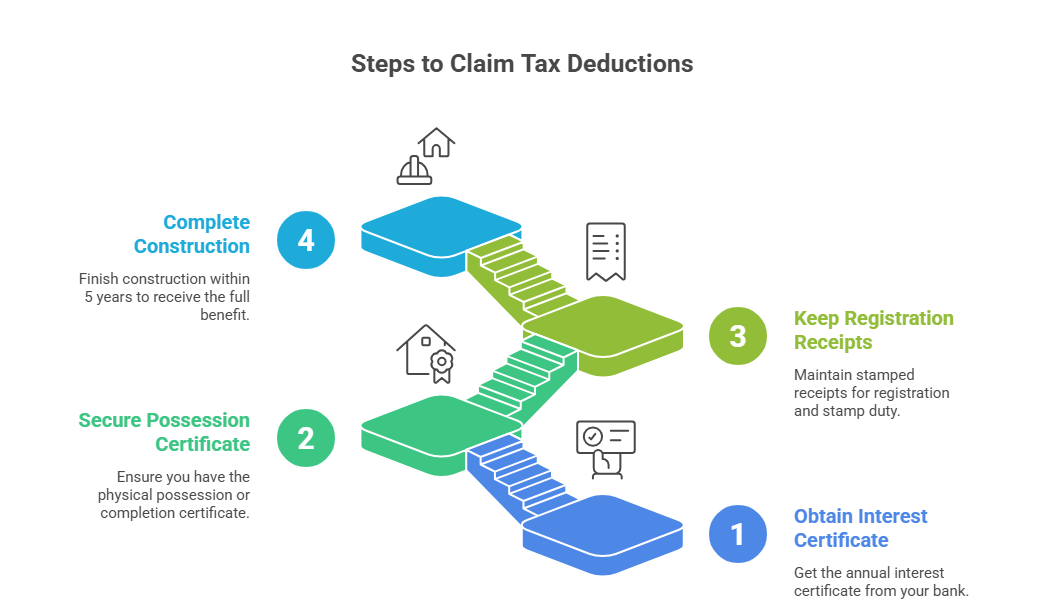
To ensure the tax authorities accept your claims, keep your paperwork ready.
- Obtain an annual interest certificate from your bank.
- Ensure you have a physical possession certificate or completion certificate.
- Keep the stamped receipts for registration and stamp duty payment.
- To receive the full ₹2 lakh interest benefit, you must complete the construction within 5 years.
Wrapping up on What Counts for Tax Deduction
Avoid claiming deductions for a house that is still a skeleton of concrete pillars. You need possession to trigger Sections 24b and 80C (except for the pre-construction interest spread). Also, do not forget that 80C is a crowded section. If your EPF and insurance already hit Rs. 1.5 lakh, your principal repayment provides no extra tax saving.
Structuring your property purchase correctly saves significant cash. Tax planning should start the moment you sign the allotment letter.
Read more: Smart Financial Tips for New Homeowners in India – Cost & Budget