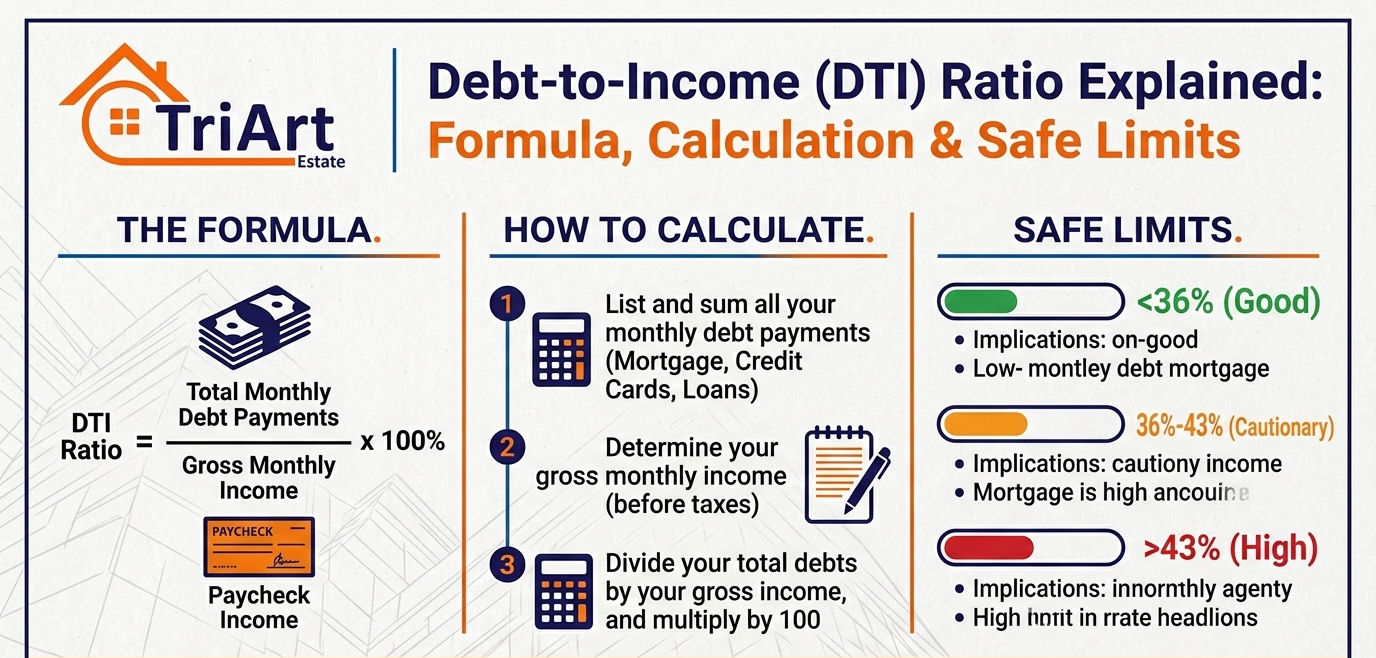
This blog explains the debt-to-income ratio in simple terms, demonstrates how to calculate DTI with examples, and shares practical tips for keeping it within a safe range before taking on a large loan.
When you apply for a loan, banks don’t just look at your salary. They also check how much of your salary is already going toward EMIs and other fixed payments. This balance between your income and your loan expenses is called the debt-to-income ratio, or DTI.
If you understand DTI, you can get a better idea of how banks view your profile. You can also plan your loan better and avoid over-borrowing.
What Is Debt-to-Income (DTI) Ratio?
The debt-to-income (DTI) ratio compares your regular monthly debt payments to your monthly gross income. It’s expressed as a percentage. DTI includes debt and most sources of income, but excludes things like utility bills and unverified income. Lenders use your DTI ratio as an approval factor when applying for a loan, and consider a lower percentage to be more favorable.
Key Takeaways
- Your debt-to-income ratio compares your monthly debt expenses to your gross income, expressed as a percentage.
- Lenders use your DTI ratio to help determine your repayment likelihood when applying for a personal loan, mortgage, or other credit product.
- Lenders generally don’t prefer a DTI ratio higher than 36%, but the cutoff can sometimes be as high as 50%.
- If your DTI ratio is too high to qualify for a loan, you can lower it by increasing your income, reducing your total debt, or both. It’s also worth checking your credit report to ensure your high DTI ratio isn’t the result of a mistake.
Debt-to-income ratio formula
You don’t need any advanced math to determine your DTI. The formula for the debt-to-income ratio is given below:
Debt-to-Income Ratio = {Total Monthly Debt EMIs} / {Total Monthly Income} x 100
Where:
– Total Monthly Debt EMIs = The sum of all EMIs and fixed debt payments you make each month.
– Total Monthly Income = Your take-home salary (and that of your co-applicant, if you apply together).
When people talk about DTI (debt-to-income ratio), they mean exactly this percentage.
Steps to calculate Debt-to-income ratio
Let’s take an example of the debt-to-income ratio.
Suppose your monthly income is Rs. 80,000 per month (net salary). Your EMIs and fixed liabilities are:
– Car loan EMI: Rs. 10,000
– Personal loan EMI: Rs. 7,000
– Credit card EMI (on converted purchases): Rs. 3,000
Total monthly debt EMI = 10,000 + 7,000 + 3,000 = Rs. 20,000
Now apply the debt-to-income ratio formula:
DTI = {20,000}/{80,000} x 100 = 25%
So your debt-to-income ratio is 25%.
If you have Rs. If you take out a new home loan with an EMI of 25,000, your new calculation will be:
– Old debt EMI: Rs. 20,000
– New home loan EMI: Rs. 25,000
– Total EMI = Rs. 45,000
New DTI = {45,000}/{80,000} x 100 = 56.25%
This shows how quickly another loan can increase your DTI.
You can also use a home loan EMI calculator to test different EMI amounts and see how they change your DTI. This makes it easier to calculate the ratio.
Why Lenders Care About Debt-to-Income Ratio
Financial institutions have their own concerns. They want to know if you can comfortably repay. The debt-to-income ratio helps them determine this.
If your DTI is too high:
– You have less money left for daily expenses.
– You’re more likely to miss an EMI if something goes wrong.
– You appear more risky on paper, even if you have a good job.
Because of this, DTI directly impacts:
– Loan eligibility – how much you can borrow.
– Approval chances – whether your loan is approved or not.
– Pricing – some lenders may offer better terms to lower-risk profiles.
Before applying, you can try a home loan eligibility calculator to see how much you can get at different EMI levels. To be safe, combine this with your DTI calculation.
What Does Your DTI Ratio Include?
Debts like home loans and revolving debt, as well as income from salary and child support, should also be considered when calculating your DTI ratio. Here’s more information about what to include in your calculation:
Debts Typically Included
Housing Expenses
- Mortgage or rent payment
- Property taxes
- Homeowners/renters insurance
- HOA fees (if applicable)
- Maintenance fees
Revolving Debt
- Credit card minimum payment (not total balance)
- Home equity line of credit (HELOC) payment
- Other line of credit minimum payment
Installment Loan Payments
- Student loans
- Personal loans
- Auto loans and leases
- Recreational vehicle loans (boats, motorcycles, RVs)
- Co-signed loan payments
- IRS installment agreements
Other Debt Obligations
- Child support payments
- Alimony/spousal support
- Time-share payments
- Any court-ordered payments
Income Typically Included
- W2 income and tips
- Self-employment income based on tax returns
- Pension and other retirement income
- Investment income from rental properties and stocks
- Regular payments from lottery winnings
- Alimony/spousal support
- Child support
- Social Security benefits
What Does Your DTI Ratio Exclude?
Debt in your DTI ratio doesn’t include utility bills and retirement contributions, and income doesn’t include one-time payments and cash sources that can’t be verified. Here’s what you should exclude from your calculation.
Debts/Expenses Typically NOT Included
- Utility bills (electricity, water, internet, phone)
- Insurance premiums (except those included in mortgage payments)
- Grocery and dining expenses
- Entertainment or subscription services
- Medical bills not financed by a loan
- Childcare expenses (unless a formal loan is in place)
- Retirement contributions
- Solar panel leases, power purchase agreements (PPAs), or other similar agreements
Income Typically NOT Included
- One-time payments or unexpected receipts (inheritance, lottery)
- Income from household members not listed in the loan application
- Short-term sources of income that are expected to end soon
- Undocumented cash income that cannot be verified
What is a Good Debt-to-Income Ratio?
There’s no single magic number, but many lenders use a few broad ranges as a guide:
– Less than 30% – Very comfortable.
You’re spending less than a third of your income on EMIs. Banks like this.
– 30%–40% – Healthy zone.
This is still acceptable for many salaried borrowers.
– 40%–50% – Borderline.
Banks will check further details. They may limit the loan amount or ask for a co-applicant.
– Above 50% – Risky.
Most lenders become wary. Some may reject new loans or ask you to repay old debt first.
For home loans in India, many lenders prefer a final DTI (after adding new EMIs) around 40%–45% or lower.
How Debt-to-Income Ratio Connects to Interest Rates and EMI Planning
Your debt-to-income ratio and home loan interest rate are separate entities, but they’re actually linked.
– A high DTI can make lenders more conservative with you.
– Even if you get a loan, they may not offer the best rates.
– A low DTI, a good credit score, and a stable job together increase your chances of getting a good offer.
When planning a new home loan, test different EMIs with a home loan EMI calculator. Then, plug those EMIs into your DTI calculation. You’ll see which EMIs keep your ratio within a safe zone.
If rates rise in the future and your EMIs increase, your DTI will also increase. Therefore, it’s wise not to borrow more than the maximum limit lenders are willing to offer. Leave some room.
How to Improve Your Debt-to-Income Ratio
If your DTI seems high, you can work on it before applying for a larger loan. Here are some simple steps:
1. Pay off smaller, higher-value loans first.
Start with credit card EMIs or personal loans. Paying off one or two EMIs can quickly reduce your DTI.
2. Avoid taking on new consumer loans.
If you’re planning a home loan, delay buying a new gadget or car on EMI. Each new EMI hurts your ratio.
3. Increase income where possible.
It’s not always easy, but any raise, bonus, freelance income, or a second salary in the family helps. Higher income lowers DTI, even if the EMI remains the same.
4. Increase the term carefully.
Longer terms reduce EMIs and improve DTI in the short term. However, this increases the total interest. Always check the long-term cost using an EMI calculator.
5. Compare offers
Track different home loan interest rates in the market. A slightly lower rate can reduce EMIs and improve your DTI without changing your loan amount.a
Online Tools to Manage Debt-to-Income (DTI) Ratio smartly
You do not have to guess your numbers. You can combine three simple tools:
- A home loan eligibility calculator is a helpful tool for keeping your debt under control.
- It allows you to adjust the amount, tenure, and other options until you’re comfortable with the EMI.
- Online resources with the latest home loan interest rates are also helpful in planning your loan.