The Delhi-Alwar RRTS is also known as the Delhi-Alwar Regional Rapid Transit System (RRTS). It is one of the eight corridors that form part of the National Capital Region Transport Corporation (NCRTC). The NCRTC is a joint venture between the Central Government of India and the state governments of Delhi, Haryana, Uttar Pradesh, and Rajasthan. The NCRTC will develop high-speed rail lines under the ‘Namo Bharat’ network.
Overview of Delhi Alwar RRTS
The Delhi-Alwar RRTS is a train service that covers a distance of 196 kilometers via Rapid Rail Transit; it has been designed by the NCRTC. It will incorporate both semi-high-speed and high-speed rail transit capabilities. This Delhi-Alwar RRTS will connect Delhi to Alwar in Rajasthan. It will pass through Gurugram, Manesar, Rewari, Bhiwadi, Neemrana, Sotanala, and several other such cities. This project was announced in May 2026, and it gained rapid momentum following an inter-state agreement reached between the governments of Haryana and Rajasthan. Furthermore, it is estimated that construction work on this project will commence in 2026.
Delhi Alwar RRTS – Quick Facts
Here are some of the quick facts on Delhi Alwar RRTS
| Items | Details |
| Name | Delhi Alwar RRTS |
| Developed By | NCRTC |
| Length | 196 km |
| Number of Stations | 22 |
| States Covered | Delhi, Haryana, Rajasthan |
| Number of Phases | 3 |
| Phase-wise Division | Phase 1: Delhi to SNB Urban Complex, i.e.e around 106 kmPhase 2: SNB to Sotanala, i.e. around 33 kmPhase 3: Sotanala to Alwar, i.e around 25 km |
| RRTS Begins From | Sarai kale Khan, Delhi |
| RRTS Ends at | Alwar, Rajasthan |
| Expected to Begin From | 2026 |
Delhi Alwar RRTS Route Map
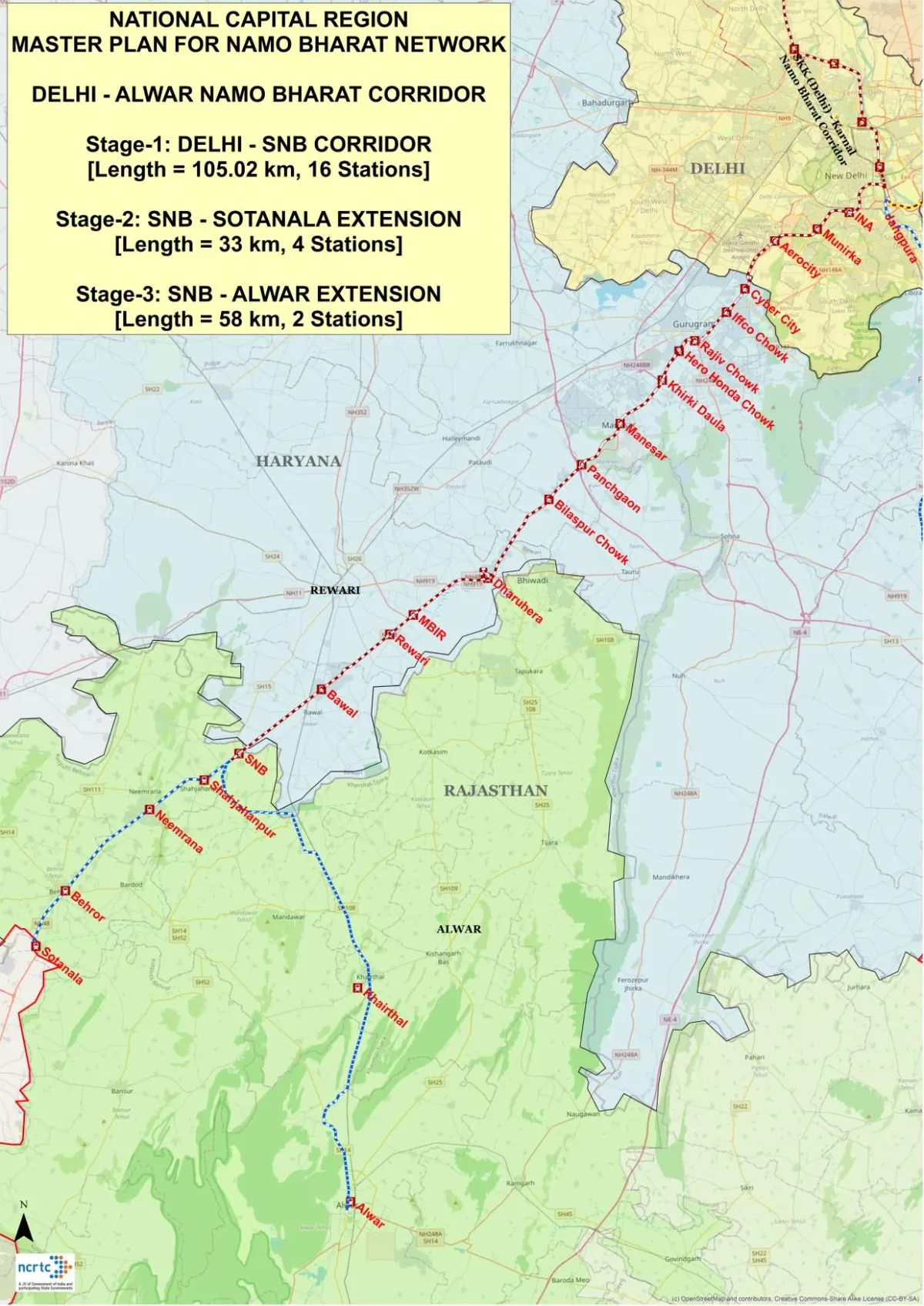
The Delhi Alwar RRTS route map showcases the entire length of the line. The line is sectioned in three parts. The first section is from Delhi to SNB corridor, the second is from SNB to Sotanala Extension, and third is till Alwar Extension.
Delhi Alwar RRTS – Key Stations
The full list of specific stations is not accessible. However, a few major stations that are expected to receive coverage by Delhi Alwar RRTS are Sarai Kale Khan INA Aerocity, Sarai Kale Khan and Aerocity within Delhi. Followed by Gurgaon, Manesar, and Rewari in Haryana. Lastly, Bhiwadi, Sotanala, and Alwar in Rajasthan. In these stations There are several important nodes. They are:
- Manesar: Hub for industrial and auto players. Manesar also has residential real estate that individuals can live as well as invest.
- Bhiwadi: Industrial DNA with a lot of energy.
- Rewari: is emerging as a logistic powerhouse due its access to the freight routes.
- Alwar: Tier-2 charm connects to Tier-1. Expect education, tourism, and IT.
Sarai Kale Khan Multi-Modal Interchange Hub
The construction setup for the Delhi-Alwar RRTS is based entirely on the flawless link-up with the Sarai Kale Khan Multi-Modal Interchange Hub that serves as the primary control point for the entire NCR quick travel grid. Instead of functioning as an unconnected stop the massive station was designed to handle large crowds that cross state lines and acts as the primary meeting point for the three Phase-1 routes that are part of the Namo Bharat system: Delhi-Meerut the Delhi-Panipat route, as well as the Delhi-Alwar.
The design layout is focused on interoperability, which allows commuters to switch between state routes without going via physical gates to exit or switching trains. The continuous journey model dramatically reduces the friction in regional travel. In order to ensure that last-mile connectivity is effective the hub has an enclosed walkway for pedestrians and skywalks that connect the RRTS platforms with the existing infrastructure
- Delhi Metro Network: Direct integration with the underground Pink Line station.
- Indian Railways: Seamless access to the railway station of Hazrat Nizamuddin.
- Inter-State Buses: Direct connection to the nearby Kale Khan ISBT. Kale Khan ISBT.
Effective Design: By stacking the transit layers horizontally on top of each other, this hub cuts walking distances from local public transportation, Mainline railways and high-speed rail corridors to less than five minutes.
Sarai Kale Khan Transit Integration Matrix
| Transit Mode | Connected Infrastructure | Primary Benefit |
| High-Speed Rail | Delhi-Meerut / Panipat / Alwar RRTS | Cross-platform, single-ticket interchange |
| Intra-City Metro | Delhi Metro Pink Line Loop | Direct access to central and eastern Delhi |
| National Rail | Hazrat Nizamuddin Station | Connections to premium central and southern trains |
| Road Transport | Sarai Kale Khan ISBT Complex | Immediate link to inter-state public bus fleets |
Delhi Alwar RRTS – Impact on Real Estate
With the construction of the Delhi-Alwar RRTS corridor, the real estate sector in the vicinity is poised to attract substantial investment. As the RRTS expands, there is a strong likelihood that new residential developments will emerge in this region. A bullish trend has been observed in Delhi regarding investments in commercial, industrial, and residential real estate—a trend that is expected to persist even after the completion of the Delhi-Alwar RRTS.
Listed below are some key localities where property prices are projected to witness the most significant appreciation as a result of the Delhi-Alwar RRTS expansion.
Bhiwadi
- Currently, the prices of flats in Bhiwadi range between ₹30 lakh and ₹40 lakh.
- Following the commencement of the RRTS, prices are expected to rise by 20–30 per cent over the initial three years.
- This projected increase in demand is expected to come from buyers in the residential real estate sector. Additionally, demand within the warehousing sector is also anticipated to rise.
Rewari
- It is anticipated that ‘mixed-use zoning’ could expand across the entire region.
- Among plots of all sizes, medium-sized plots—currently priced under ₹25 lakh in the outer zones—are likely to attract the attention of investors.
- This area offers ample opportunities for both co-working spaces and student housing.
Manesar
- In terms of commercial properties, this region in Manesar is already a hotspot. It is expected that the expansion of the RRTS will lead to further residential growth extending from Gurgaon.
- In the near future, this area is expected to witness the development of lifestyle townships and planned developments.
Alwar
- As the RRTS develops in this region, it is poised to become a preferred destination for investment.
- In terms of real estate development, the region is expected to witness an expansion of townships, villas, and integrated residential complexes.
- Driven by the rising demand for residential spaces—fueled by a growing population—the retail and commercial real estate markets in this region are also likely to experience a surge in activity.
New Flyover and Route Adjustments for Delhi Alwar RRTS
It is anticipated that by 2026, the Delhi-Alwar RRTS project will have moved beyond the planning stage and entered the phase of large-scale procurement. In the updated report for 2026, several major infrastructural enhancements have been outlined to facilitate the train’s passage through the city’s congested areas. Foremost among these is the agreement to construct a massive elevated viaduct over NH-48. This will enable the high-speed rail line to traverse above the roadway, thereby avoiding the substantial land acquisition costs associated with busy intersections such as Hero Honda Chowk.
Key Project Milestones
- Construction: Major civil works and groundbreaking activities are scheduled to commence in August 2026.
- Strategic Route Realignment: The rail line will now run alongside the Delhi-Gurgaon Expressway, starting from Aerocity. By bypassing the older and congested areas of Gurgaon, the train will be able to travel at higher speeds. This offers a more direct route for corporate professionals residing in Cyber City as well as for airport-bound passengers.
- Engineering Modifications: The rail line has been designed to pass through an underground tunnel at Hero Honda Chowk before transitioning to an elevated track near Kherki Daula. Subsequently, the line will proceed towards Manesar, running along the left side of the highway.
- Phased Commissioning: Although the entire 164-kilometre-long line is scheduled to be commissioned in November 2031, the NCRTC aims to make the Gurgaon-SNB Priority Section operational for passengers by 2028–2029.
Real Estate Impact of Delhi Alwar RRTS
This high-speed connectivity is currently transforming the property market in this region. In effect, it is converting industrial hubs such as Manesar, Dharuhera, and Rewari into suburbs situated just outside the capital. Consequently, there is a surge in demand for flats in Manesar and in Alwar, located in close proximity to the RRTS route. This project has established these locations as preferred destinations for individuals seeking long-term residency. With the expected reduction in travel time between Delhi and Alwar to just 104 minutes, property prices in these satellite cities have witnessed an annual appreciation of 10 to 15 percent, as buyers seek affordable housing options without compromising on connectivity.
Summing Up on Delhi Alwar RRTS
The Delhi-Alwar RRTS is not merely a plan confined to paper; it is soon set to become a reality, and work on it has already commenced. It is anticipated that this corridor will drive up property values across the entire region. The RRTS is poised to soon trigger an appreciation in the prices of real estate and land in areas such as Manesar, Bhiwadi, Rewari, Neemrana, and Alwar. The Delhi-Alwar RRTS is a new-age corridor that places a strong emphasis not only on speed and connectivity but also on long-term investment potential.
frequently asked questions
Ques. What is the Delhi-Alwar RRTS corridor?
Ans. The Delhi-Alwar RRTS is a high-speed regional transit corridor designed to improve connectivity between Delhi, Gurugram, Rewari, and Alwar.
Ques. How will the Delhi-Alwar RRTS impact real estate in NCR?
Ans. The corridor is expected to boost property demand, increase land value, and encourage residential and commercial development across NCR regions.
Ques. Which areas will benefit the most from the Delhi-Alwar RRTS?
Ans. Areas like Gurugram, Manesar, Bhiwadi, Rewari, and Alwar are likely to see major infrastructure and real estate growth.
Ques. Why is the Delhi-Alwar RRTS important for commuters?
Ans. The RRTS will reduce travel time, improve daily commuting, and provide faster, more comfortable transportation across NCR.