In Delhi, the circle rate represents the base price at which a property is sold. It is the minimum threshold below which a property—whether it be a house, land, or a commercial establishment—cannot be legally sold. Delhi’s circle rates are available online. For plots, flats, and multi-story residential properties located within DDA or private colonies, please refer to this blog post to obtain information regarding the circle rates for various categories of properties in Circle Rate in Delhi.
What is the Circle Rate in Delhi?
Circle Rate in Delhi assist the state government in determining property values across different localities of the city, thereby helping to curb speculative pricing. In Delhi, this represents the minimum mandatory price at which a property can be sold. Property Circle Rate in Delhi are typically reviewed on a regular basis to ensure that they remain aligned with prevailing market prices. Prospective buyers should be aware that in Circle Rate in Delhi, stamp duty and registration charges are calculated based on the higher of the following two figures: the declared value of the property, or the value determined according to the circle rate applicable to that specific locality.
Factors Affecting Circle Rate in Delhi
Circle Rate in Delhi vary across different areas, based on the following factors:
- Market Value: When determining the circle rate for a specific Circle Rate in Delhi, the value of the house is one of the factors the government takes into consideration. In most cases, the market value of a property is higher than its circle rate.
- Usage: The manner in which a property is utilized is another factor that influences its circle rate. Properties used for commercial purposes have higher circle rates compared to those used for residential purposes.
- Amenities/Facilities: The facilities and amenities available on a property can either increase or decrease its circle rate. Properties equipped with modern amenities—such as a running track, guest accommodation, a swimming pool, etc.—typically command higher circle rates.
- Location of the Property: Location is a key factor in determining Circle Rate in Delhi. The circle rate for a home in an ordinary location is lower compared to that in a posh locality.
- Type of Construction: The type of property Circle Rate in Delhi can also influence the circle rate. The circle rate for government-owned property is typically lower than that of a property developed by an independent real estate developer.
Based on these parameters, the zones have been classified into eight groups, ranging from A to H. Specifically, however, those areas with the highest scores—and where the finest facilities are available—have been placed in Category A. Conversely, those areas with the lowest values have been classified under Category H.
How Circle Rate in Delhi is Different from the Market Rate ?
As mentioned, Circle Rate in Delhi are determined by the government. However, market rates are established by taking into account various factors, including the amenities and facilities available in the locality. Here are some tips to help you compare Circle Rate in Delhi with market prices.
- Property Registration: In Delhi, property registration can only be done at the ‘circle rate.’ However, property owners may demand market rates when selling their homes.
- Stamp Duty Calculation: Just like property registration, stamp duty charges in Delhi are calculated based on circle rates.
- Revision: In Circle Rate in Delhi are reviewed less frequently compared to market rates. Circle rates are not revised more than once a year. However, market rates fluctuate frequently based on market conditions and the demand-supply dynamics in a specific locality.
How do you know the SRO Office to Know Circle Rate in Delhi?
This is a step-by-step procedure to figure out your SRO office to know the Circle Rate in Delhi the following manner:
Step 1: Visit the https://esearch.delhigovt.nic.in/Search_dict_detail.aspx.
Step 2: Once you reach the website, click on ‘Find SR Office’. Enter the location and the visual code.
Step 3: The list of Sub-Registrar’s offices can be viewed on the screen.
How to Check the Delhi Circle rates?
To find the circle rates for the city of Delhi, you must follow the steps given below.
Step 1: Visit the link https://revenue.delhi.gov.in/.
Step 2: Select the ‘Notice Board’ option on the homepage.
Step 3: Click on ‘Previous Notification’.
Step 4: To view Delhi’s latest circle rates, click on 2014; a list of notifications will then appear.
Step 5: Click on the notification – Revised Circle Rates in Delhi, effective from September 23, 2014.
Category-Wise Classification of Areas for Circle Rates in Delhi
For the purpose of determining properties Circle Rate in Delhi, various localities in the city have been classified into categories ranging from ‘A’ to ‘H’.
| Localities | Categories |
| Friends Colony (East & West), Kalindi Colony, Maharani Bagh, Golf Links, Lodi Road Industrial Area, Nehru Place, Panchshila Park, Shanti Niketan, Vasant Vihar, New Friends Colony, Rajendra Place, Sunder Nagar, Anand Niketan, Bhikaji Cama Place, Basant Lok DDA Complex, Friends Colony | Category A |
| Sarvapriya Vihar, Anand Lok, Defence Colony, Sarvodaya Enclave, Andrews Ganj, Greater Kailash (I, II, III and IV), Green Park, Hamdard Nagar, Maurice Nagar, Neeti Bagh, Nizamuddin East, Panchsheel Park, Gulmohar Park, Hauz Khas, Munrika Vihar, Nehru Enclave, Pamposh Enclave, Safdarjung Enclave | Category B |
| Alaknanda, Civil Lines, East Patel Nagar, Kailash Hill, Chittaranjan Park, East of Kailash, Jhandewalan Area, Kalkaji, Malviya Nagar, Lajpat Nagar (I, II, III and IV), Munirka, Punjabi Bagh, Vasant Kunj, Masjid Moth, Nizamuddin West, Som Vihar, Panchsheel Extension. | Category C |
| Jasola Vihar, Kirti Nagar, Rajinder Nagar (New & Old), Karol Bagh, Mayur Vihar, Rajouri Garden, Daryaganj, East End Apartments, Hudson Lane, Janakpuri, Jangpura Extension, Anand Vihar, Dwarka, Gagan Vihar, Indraprastha Extension, Jangpura A | Category D |
| Chandni Chowk, Gagan Vihar Extension, Jama Masjid, Khirki Extension, Mahavir Nagar, Pahar Ganj, Rohini, East End Enclave, Hauz Qazi, Kashmere Gate, Madhuban Enclave, Moti Nagar, Pandav Nagar, Sarai Rihilla | Category E |
| Majnu Ka Tila, Nand Nagri, Zakir Nagar Okhla, Arjun Nagar, Dilshad Colony, BR Ambedkar Colony, Govindpuri, Jangpura B, Mukherjee Park Extension, Uttam Nagar, Anand Prabhat, Daya Basti, Dilshad Garden, Ganesh Nagar, Hari Nagar, Madhu Vihar | Category F |
| Ambedkar Nagar Jahangirpuri, Amber Vihar, Dakshinpuri, Hari Nagar Extension, Tagore Garden, Ambedkar Nagar East Delhi, Dabri Extension, Dashrath Puri, Vivek Vihar Phase I | Category G |
| Sultanpur Majra | Category H |
Circle Rates in Delhi 2026 for Residential Land
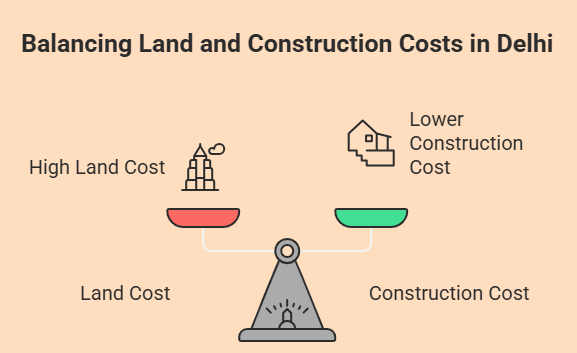
The administrative jurisdiction of the New Delhi Municipal Council (NDMC) comprises residential plots ranging from categories A to H. The circle rates for all residential plots in Delhi are provided below.
| Category | Land Cost | Construction Cost for Residential Properties in Delhi |
| A | Rs 7.74 Lakh Per Sq Mtr | Rs 21,960 Per Sq Mtr |
| B | Rs 2.46 Lakh Per Sq Mtr | Rs 17,400 Per Sq Mtr |
| C | Rs 1.6 Lakh Per Sq Mtr | Rs 13,920 Per Sq Mtr |
| D | Rs 1.28 Lakh Per Sq Mtr | Rs 11,160 Per Sq Mtr |
| E | Rs 70,080 Per Sq Mtr | Rs 9,360 Per Sq Mtr |
| F | Rs 56,640 Per Sq Mtr | Rs 8,220 Per Sq Mtr |
| G | Rs 46,200 Per Sq Mtr | Rs 6,960 Per Sq Mtr |
| H | Rs 23,280 Per Sq Mtr | Rs 3,480 Per Sq Mtr |
Circle Rates in Delhi 2026 for Commercial Land
The table below displays the circle rates for commercial properties Circle Rate in Delhi.
| Category | Land Cost | Construction Cost for Residential Properties in Delhi |
| A | Rs 7.74 Lakh Per Sq Mtr | Rs 25,200 Per Sq Mtr |
| B | Rs 2.46 Lakh Per Sq Mtr | Rs 19,920 Per Sq Mtr |
| C | Rs 1.6 Lakh Per Sq Mtr | Rs 15,960 Per Sq Mtr |
| D | Rs 1.28 Lakh Per Sq Mtr | Rs 12,840 Per Sq Mtr |
| E | Rs 70,080 Per Sq Mtr | Rs 10,800 Per Sq Mtr |
| F | Rs 56,640 Per Sq Mtr | Rs 9,480 Per Sq Mtr |
| G | Rs 46,200 Per Sq Mtr | Rs 8,040 Per Sq Mtr |
| H | Rs 23,280 Per Sq Mtr | Rs 3,960 Per Sq Mtr |
Circle Rate in Delhi for Flats
Circle Rate in Delhi for flats vary based on the type of flat. The table below illustrates the circle rates in Delhi.
| Area | DDA, society flats (per sq metre) | Private builder flats (per sq metre) | Multiplying factors for private colonies |
| Up to 30 sq metres | Rs 50,400 | Rs 55,400 | 1.1 |
| 30-50 sq metres | Rs 54,480 | Rs 62,652 | 1.15 |
| 50-100 sq metres | Rs 66,240 | Rs 79,488 | 1.2 |
| More than 100 sq metres | Rs 76,200 | Rs 95,250 | 1.25 |
| Multi-storey apartment | Rs 87,840 | Rs 1.1 lakhs | 1.25 |
Circle Rate in Delhi for Agricultural Land
The circle rates for agricultural land in Circle Rate in Delhi are as follows:
| District | Green belt villages (in Rs crore per acre) | Urbanised villages (in Rs crore per acre) | Rural villages (in Rs crore per acre) |
| South | 5 | 5 | 5 |
| North | 3 | 3 | 3 |
| West | 3 | 3 | 3 |
| North-west | 3 | 3 | 3 |
| South-west | 3 | 4 | 3 |
| New Delhi | 5 | 5 | 5 |
| Central | NA | 2.5 | 2.5 |
| South-east | NA | 4 | 2.5 |
| Shahdara | 2.3 | 2.3 | 2.3 |
| North-east | NA | 2.3 | 2.3 |
| East | NA | 2.3 | 2.3 |
What is the Age Factor Followed for Circle Rate in Delhi?
The age-related factor adopted for calculating circle rates in Delhi is as follows:
| Factor | Pre-1960 | 1960-69 | 1970-79 | 1980-89 | 1990-2000 | 2000 Onwards |
| Rate | 0.5 | 0.6 | 0.7 | 0.8 | 0.9 | 1 |
What is the Circle Rate in Delhi for Plots?
The administrative jurisdiction of the New Delhi Municipal Council (NDMC) comprises residential plots falling under categories A through H. The circle rates for all residential plot categories in Circle Rate in Delhi are provided below.
| Categories | Cost of Construction per Square Meter (Rupees) | Minimum rates for valuation of land for residential use (Per Square Meter in Rupees) |
| A | 21,960 | 7,74,000 |
| B | 17,400 | 2,46,000 |
| C | 13,920 | 1,60,000 |
| D | 11,160 | 1,28,000 |
| E | 9,360 | 70,080 |
| F | 8,220 | 56,640 |
| G | 6,960 | 46,200 |
| H | 3,480 | 23,280 |
Agricultural Land Circle Rates in Delhi
Delhi Chief Minister Arvind Kejriwal has recently approved an increase in the circle rates for agricultural land in Delhi. Officials from the Revenue Department had proposed raising the circle rates for land situated near the Yamuna Barrage.
Previously, the circle rate for agricultural land was fixed at ₹53 lakh per acre. However, considering the geographical location of the land, these rates have been revised upwards. Currently, agricultural land is categorized into distinct categories, such as ‘Urban Villages’ and ‘Rural Villages’.
The new circle rates for the agricultural land based on their location are as follows:
| Location of Agriculture Land | New Circle Rates (per acre) |
| South Delhi and New Delhi | Rs 5 Crores |
| North, West, Northwest and Southwest Delhi | Rs 3 Crores |
| Central and Southeast Delhi | Rs 2.5 Crores |
| Shahadra, Northeast, East Delhi | Rs 2.25 Crores |
The rates for urban village settlements located in South-West Delhi stand at ₹4 crore. The rates will remain the same for both rural and urban villages. These rates were last revised in 2008—that is, more than 10 years ago.
How to Calculate the Circle Rate in Delhi for Different Property Types
To determine the Circle Rate in Delhi applicable to various types of properties, the formulas used for calculating the Circle Rate in Delhi are provided below.
- Independent Plots: To determine the Circle Rate for your personal plot in Delhi, you need to multiply the size of the plot (based on its location) by the Circle Rate amount (per square meter).
- Builder Floors: To determine the Circle Rate in Delhi for a specific construction floor, multiply the total built-up area by the minimum construction cost. Subsequently, you can multiply the resulting figure by the factor associated with the age of the building.
- DDA/Society Flats: To calculate the circle rate for DDA and society flats in Delhi, multiply the built-up area of the flat by the minimum construction cost of the house. Subsequently, multiply this total amount by the age-related factor of the property.
- Multi-Storey Apartments: To determine the Delhi Circle Rate for a multi-storied residential building, simply multiply the total built-up area by the applicable Circle Rate in Delhi.
- Residential Houses: To determine the Delhi Circle Rate for a residential building, simply multiply the total built-up area by the minimum construction cost at which the house was constructed. Subsequently, divide this result by the ‘Age Factor’ (a coefficient determined based on the building’s age) applicable to that structure.
What are the Different Multiplying Factors for Calculating the Circle Rate in Delhi?
The following is the multiplying factor used to calculate circle rates for various types of structures in Delhi:
| Structure | Multiplying Factor |
| Pucca | 1 |
| Semi-Pucca | 0.75 |
| Kaccha | 0.5 |
Legal and Valuation Challenges in Delhi Circle Rates
For homebuyers in Delhi, valuation and legal issues often pose significant challenges. While circle rates are determined by the government, market prices are constantly fluctuating. This gives rise to various complications. Buyers should be aware of these risks before registering a property.
Circle rate may not match the real value.
In many places, circle rates are typically lower than market prices. As a result, a discrepancy arises in the recorded value of a property.
Tax authorities may use circle rates even if you pay less.
If the value of the sold property is lower than the circle rate, tax authorities may still determine the capital gains based on the higher circle rate.
Valuation disputes can delay registration.
If the declared price and the circle rate do not match, the Sub-Registrar may inquire about the price. This could slow down the process, or even bring it to a complete halt.
Wrong category classification can affect cost.
Some colonies are mistakenly placed in lower or upper categories. This can result in an unfair increase or decrease in stamp duty.
Buyers may pay more in stamp duty.
If circle rates increase, the minimum registration value also rises. Consequently, buyers are required to pay higher taxes, even if the actual market price of the property is not particularly high.
Legal disputes often arise when property owners challenge the circle rates. Some owners seek judicial intervention to rectify the classification or valuation of their properties, while others demand a fresh survey of their residential colonies. Before making any payments, buyers must verify the correct property category, the prevailing circle rates, and the current market value.
Potential complications can be avoided by promptly obtaining the necessary information—either through the Revenue Department’s website or by consulting a legal expert.
Frequently Asked Questions
Ques. What is the Circle Rate in Delhi 2026?
Ans. The Delhi Circle Rate 2026 is the minimum property value fixed by the government for property registration and stamp duty calculation.
Ques. Why is the Delhi Circle Rate important?
Ans. Circle rates help determine the legal property value and prevent undervaluation during property sale and registration.
Ques. Are Delhi Circle Rates different for each area?
Ans. Yes, Delhi properties are divided into different categories and zones, and each area has its own circle rate.
Ques. How can I check the latest Delhi Circle Rate 2026 list?
Ans. You can check the updated area-wise circle rate list through the official Delhi government notification and property registration portal.