The Securitisation and Reconstruction of Financial Assets and Enforcement of Security Interest Act, 2002 (SARFAESI Act) was enacted with the objective of empowering banks to recover non-performing assets (NPAs) without the intervention of the courts. The SARFAESI Act of 2002 is a landmark in the recovery of NPAs.
The current legal framework pertaining to banking laws can be unable to keep up with the ever-changing demands of the financial industry. The lack of a solid law was remedied through the creation of the SARFAESI Act. This SARFAESI Act 2002 has helped tremendously in recovering loan defaults and in reducing the number in non-performing assets (NPAs) at banks, as well as financial institutions.
Narasimham Committee and Andhyarujina Committee were established through the Central Government for the purpose of looking at the general changes in the banking industry and determining the modifications to the legal system that is currently in place for banks.
These committees suggested creating new laws for securitization and granting financial institutions the right to hold securities and sell them in a timely manner without any court intervention, and these recommendations were implemented in the form of the SARFAESI Act.
What is SARFAESI Act, 2002, and where is it applicable?
SARFAESI Act Meaning – SARFAESI Act is a law that allows Indian banks and financial institutions to sell or auction the assets/properties of credit defaulters without any intervention from the courts. SARFAESI full form is Securitisation and Reconstruction of Financial Assets and Enforcement of Security Interest Act.
Under the SARFAESI Act, a Central Registry of Securitisation Asset Reconstruction and Security Interest (CERSAI) is also constituted. CERSAI is a completely online central registry of security interests. CERSAI was created to check the frauds, where multiple loans are taken from different banks using teh same assets as collateral.
The latest amendment of Sarfaesi Act, 2002 states that “an act of regulating securitization and reconstruction of various financial assets and enforcement of security interest and in providing for a central database of security interests that are specifically created on the rights of property, and for those matters connected therewith or incidental thereto.”
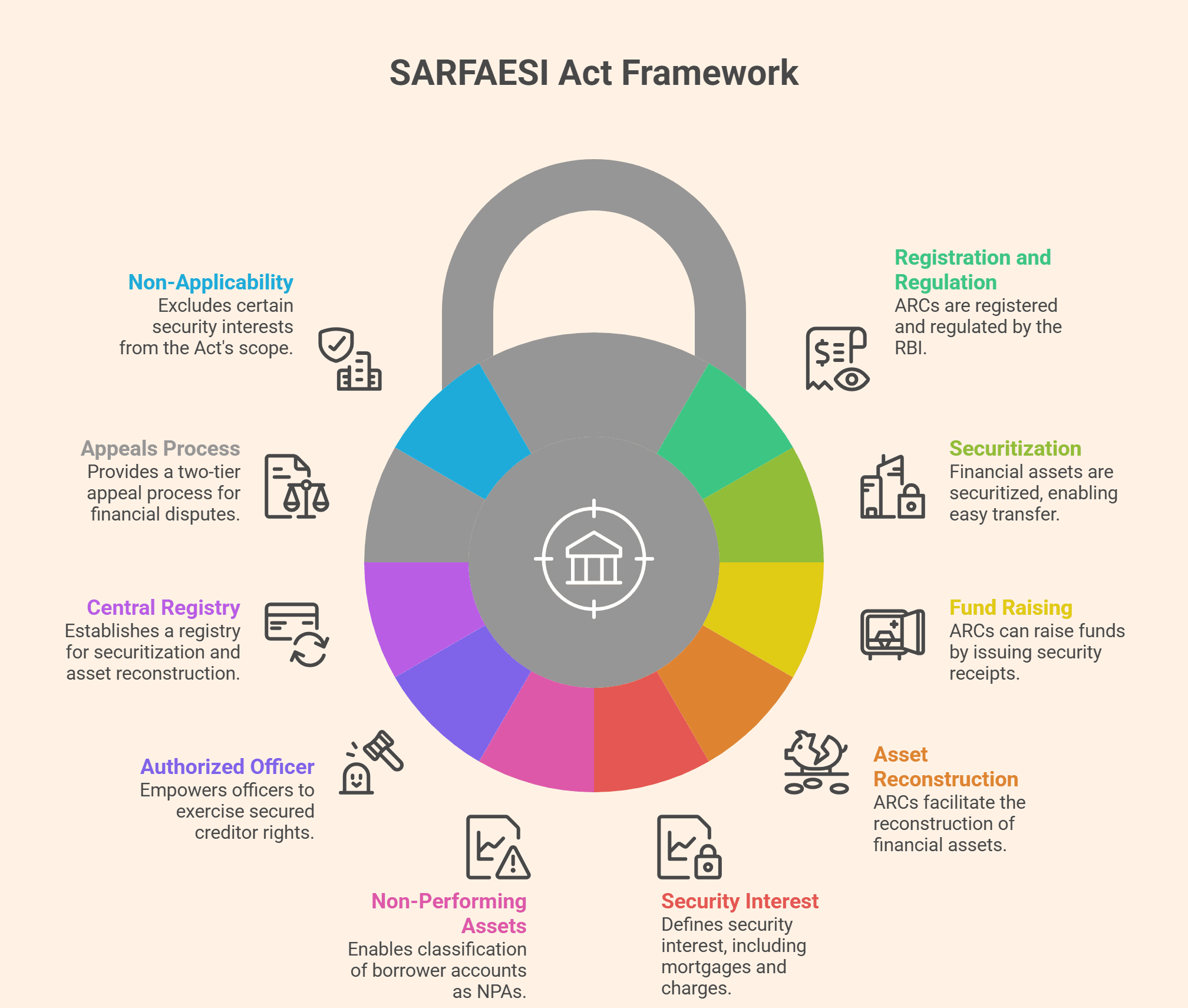
This SARFAESI Act deals with the below-mentioned aspects:
- Registration and regulation of Asset Reconstruction Companies (ARCs) by the Reserve Bank of India (RBI).
- Securitization of various financial assets of financial institutions and banks, whether or not there is an underlying security.
- Facilitating the easy transfer of financial assets through ARCs, enabling the acquisition of financial assets of financial institutions and banks by issuing bonds or debentures or any other security that functions like a debenture.
- The SARFAESI Act also empowers Asset Reconstruction Companies (ARCs) to raise funds by issuing security receipts to a group of qualified buyers.
- Facilitating the overall reconstruction of various financial assets acquired by enforcing securities or changing management or exercising any other right granted to financial institutions and banks.
- Defining ‘security interest’ as a type of security, including mortgages and charges on immovable properties, given for the due repayment of any financial assistance provided by a financial institution or bank.
- The SARFAESI Act enables the classification of a borrower’s account as a Non-Performing Asset in accordance with the various directions or guidelines issued by the Reserve Bank of India (RBI) from time to time.
- The authorized officer shall exercise the various rights of a secured creditor in this particular case in accordance with the rules prescribed by the Government of India.
- The Government of India may establish or cause to be established a Central Registry for the purpose of registering transactions relating to securitization, asset reconstruction, and creation of security interests.
- Appeals against the actions of any financial institution or bank to the concerned Debt Recovery Tribunal and a second appeal to the Appellate Debt Recovery Tribunal.
- Non-applicability of certain provisions of the Act to security interests in agricultural land, loans below ₹1 lakh, and cases where 80% of the loan has been repaid by the borrower. The SARFAESI Act paves the way for applying the proposed law to financial institutions and banks and empowers the central government to extend the application of the law to financial companies and other entities under the non-banking sector as well.
What are the objectives of the SARFAESI Act, 2002?
The major objectives of the Sarfaesi act 2002 are as follows:
- The rapid and efficient recovery of Non-Performing Assets (NPAs) for financial institutions and banks.
- It allows financial institutions and banks to auction residential and commercial properties when a borrower defaults and fails to repay their loan.
Recovery Methods Under the SARFAESI Act 2002
Non-performing assets (NPAs) are recovered via the SARFAESI Act through the following three methods-
- Securitisation: NPAs are recovered through the securitisation method by converting assets, such as auto loans or homes, into marketable securities. These are then sold to raise funds. Qualified Institutional Buyers (QIBs) acquire these financial assets via schemes formed by asset reconstruction companies or scrutinisation.
- Asset Reconstruction: The Act’s provisions allow loaning institutions to manage a borrower’s business, acquire it, or sell it to recover debt payments via Asset Reconstruction.
- Enforcement of security without the intervention of court: Financial institutions can issue notices to those who have obtained a secured asset from the borrower if they fail to repay the amount. They can demand the party to pay the outstanding amount. They can also claim payment from the borrower’s debtor without the court’s intervention.
What are the necessary documents required in the Sarfaesi Act, 2002?
E-Form CHG-9 or e-Form CHG-1 is required to be filed for the application of:
- Registration or creation
- Modification of charge that includes particular of the modification of charge by Asset Reconstruction Company in terms of Securitization and Reconstruction of Financial Assets and Enforcement of Securities Interest Act, 2002 (SARFAESI Act 2002). The documents that are required in this particular context are as follows:
- Details of charges
- Registration Certificate
- An instrument that is created for the charge
- A copy of the instrument that creates or modifies the charge
- Hypothecation Deed
- Sanction Letter
In those cases when e-Form is digitally signed, any of the following are required:
- DSC of the charge holder
- Director Identification Number (DIN) of the Director
- PAN of the CEO, CFO, Manager
- The Company Secretary’s Membership Number
Formation of SARFAESI Act, 2002
The SARFAESI Act, 2002 was formulated for:
- Regulating securitization and reconstruction of financial assets
- Enforcing the security interest for
- Matters that are connected therewith or incidental thereto.
SARFAESI Act was extended to the entire India. Sarfaesi act 2002 rules are enforced for amending the four following laws:
- Reconstruction and securitization of Financial Assets and Enforcement of Security Interest Act, 2002.
- The recovery of the debts due to the Banks and Financial Institutions Act, 1993 (RDDBFI).
- Depositories Act, 1996 and for those matters that are connected therewith or incidental thereto.
- Indian Stamp Act, 1899.
SARFAESI Act 2002: Applicability
SARFAESI Act is mainly applicable in the following cases:-
- Asset reconstruction company registration
- Resolution of disputes
- Measures of asset reconstruction
- Acquisition of interest or rights in financial asset
Why is the Sarfaesi Act 2002 important?
The cooperative banks weren’t initially included under what was considered to be a bank to where it was the SARFAESI Act was applicable. In 2003, a significant notification was issued in order to bring cooperative banks into the category of banks that could benefit from this SARFAESI Act.
In 2013 in 2013, the Indian government changed this Act to include cooperative banks officially under the definition of banks qualified to utilize this Act.
In the following days, there have been petitions submitted in opposition to the legitimacy of the notification as well as the authority of the Parliament in amending the SARFAESI Act , 2002. 5th May 2002 the Supreme Court had resolved this particular issue by deciding in favor of cooperative banks operating in the field by citing the SARFAESI Act.
This particular step has greatly assisted cooperative banks to avoid inordinate delay in reclaiming bad loans which are pending in civil courts as well as cooperative tribunals. In the Indian Banking System now has 1,44 urban cooperative banks as well as rural cooperative banks that have 96,248 significant savings from the retail investor.
In light of their magnitude, and to ensure a seamless operation of cooperative banks, speedy repayment of default loans is vital.
Appeal and Limitation Procedures under SARFAESI Act
When a financial institution has taken actions under the law, the borrower has certain legal rights. The law offers an easy procedure for appealing and time limitations.
First Appeal to DRT (Debt Recovery Tribunal)
The borrower may contest the decision before the DRT. The appeal must be filed within 45 days of the date of receipt of the bank’s request.
Pre-Deposit Requirement
In order to file an appeal, the borrower needs to pay half of his amount due on amount. The tribunal may reduce the amount to 25 percent if there are legitimate justifications.
Further Appeal to DRAT
If the borrower isn’t pleased with the DRT decision, a second appeal may be filed with the Debt Recovery Appellate Tribunal (DRAT). This process must be completed in the timeframe of 45 days.
Limitation Periods
All appeals must be subject to the strict limitations times. If the deadline exceeds the time limit the appeal could be dismissed. Extensions can be granted only in cases where there is sufficient evidence to support the request.
Final Remedy
If relief isn’t granted after DRAT, the borrower is able to make an application to for relief before the High Court under writ jurisdiction.
This procedure ensures both the rights of banks to recover and fair opportunities for the borrowers.
Frequently Asked Questions
Q1. What is the SARFAESI Act 2002?
Ans. The SARFAESI Act 2002 allows banks and financial institutions to recover bad loans by enforcing security without court intervention.
Q2. Why is the SARFAESI Act 2002 important?
Ans. The SARFAESI Act 2002 helps banks reduce non-performing assets (NPAs) and speeds up loan recovery in India.
Q3. What documents are required under the SARFAESI Act 2002?
Ans. Documents under the SARFAESI Act 2002 include loan agreements, security documents, default notices, and possession notices.
Q4. How does the SARFAESI Act 2002 affect borrowers?
Ans. Under the SARFAESI Act 2002, borrowers may face asset seizure if they fail to repay loans, but they also have the right to appeal.