

Buying or owning property is a dream for many people, whether for investment or residential purposes. However, if your land is vacant or neglected, you may face the problem of land encroachment. Houses can also be susceptible to encroachment, especially if the property is owned by an NRI or an elderly person. Land encroachment is quite common in India, and many encroachment cases are pending in court. With such cases on the rise, it’s crucial to understand your property rights and how to deal with land encroachment legally. This article explains what the Land Encroachment Act means, what the Indian land encroachment laws say, how to deal with land encroachment legally, and much more.
What is Land Encroachment?
Land encroachment means occupying or using land belonging to another party, usually the government, without permission. This can happen in several ways, such as:
- Physical occupation: An individual or group physically occupies the land without permission.
- Construction: Building on land that does not belong to the individual.
- Agricultural use: Growing crops or using the land for farming without legal rights.
Land encroachment can have serious consequences, leading to disputes, legal battles, and loss of property rights.
Private Land Encroachment Act: Section 441 of the Indian Penal Code, 1860, deals with land encroachment.
Difference Between Land Encroachment and Trespassing
Sometimes people confuse land encroachment with trespassing. However, these are two different terms. Encroachment is an act in which someone illegally uses another person’s property. On the other hand, trespassing means entering someone’s property without their permission or against their will. There are three types of trespassing.:-
- Regarding a person: When a person is prevented from doing something they previously did.
- Regarding movable property: When an owner is hindered in using their movable property.
- Regarding property or land: A person enters another person’s property or land with the intention of taking possession of it.
Land Encroachment Act, India
Section 441 of the Indian Penal Code (IPC), 1860, deals with trespass on land and property. According to Section 441, trespass occurs when a person unlawfully enters someone else’s property. This is done with the intention of committing an offense, intimidating the owner to gain possession of the property, or remaining there. For trespass on land, the punishment is prescribed under Section 447 of the IPC. If a person is found guilty, they can be fined up to 550 rupees and sentenced to imprisonment for up to three months. The law defines trespass as follows:-
- Section 441 also applies to encroachment on private land, and this is an offense under Section 442.
- The judiciary can prevent or restrain encroachments under the Land Encroachment Act.
- The judiciary can also order compensation for encroachment according to the Land Encroachment Act. The compensation is calculated based on the current market value of the land and the damages incurred.
- To claim damages, approach the court as per Order 39 (Rules 1, 2, and 3).
Key Provisions of Land Encroachment Acts
However, while specific provisions may vary from state to state, most land encroachment laws share several common features.:
- Definition of unauthorized occupancy: These laws typically define what constitutes unauthorized occupancy and what types of property are included (usually government lands).
- Eviction process: The law outlines the process for evicting trespassers, which often includes issuing notices, conducting investigations, and providing opportunities for defense.
- Punishment: The punishment for trespassing can include fines and imprisonment. For example, under Section 447 of the Indian Penal Code (IPC), those found guilty of trespassing on land can face a fine and imprisonment for up to three months.
- Provisions for regularization: In some cases, the law provides for the regularization of certain types of encroachments if they meet specific conditions (for example, if they are not objectionable or if the encroacher is below the poverty line).
Penalties Under the Land Encroachment Act
Under Section 447 of the IPC, related to land encroachment, an encroacher can be fined ₹550 and/or sentenced to imprisonment for up to 3 months. The punishment will be determined based on the nature of the offense.
Steps to Address Land Encroachment
If you are facing a land encroachment problem – whether you are the owner or the occupant – here are some steps you can take.:
- Documentary evidence: Gather proof of ownership (title deeds) and document instances of encroachment (photographs, witness statements).
- Inform the authorities: File a complaint with the local authorities or the revenue officials responsible for land management.
- Seek legal advice: Consult a lawyer specializing in property law to understand your options and prepare for potential legal action.
- File a lawsuit if necessary: If administrative measures fail, consider filing a civil lawsuit to obtain an injunction against the encroacher.
For Encroachers
- Understand your situation: Assess whether your occupation might be eligible for regularization under local laws.
- Seek legal advice: Consult with legal professionals about your rights and potential defenses against eviction.
- Negotiate with property owners: If possible, negotiate with the property owners to reach an amicable solution.
- Prepare for eviction proceedings: If you receive eviction notices, be prepared to present your case in court if you believe you have valid claims.
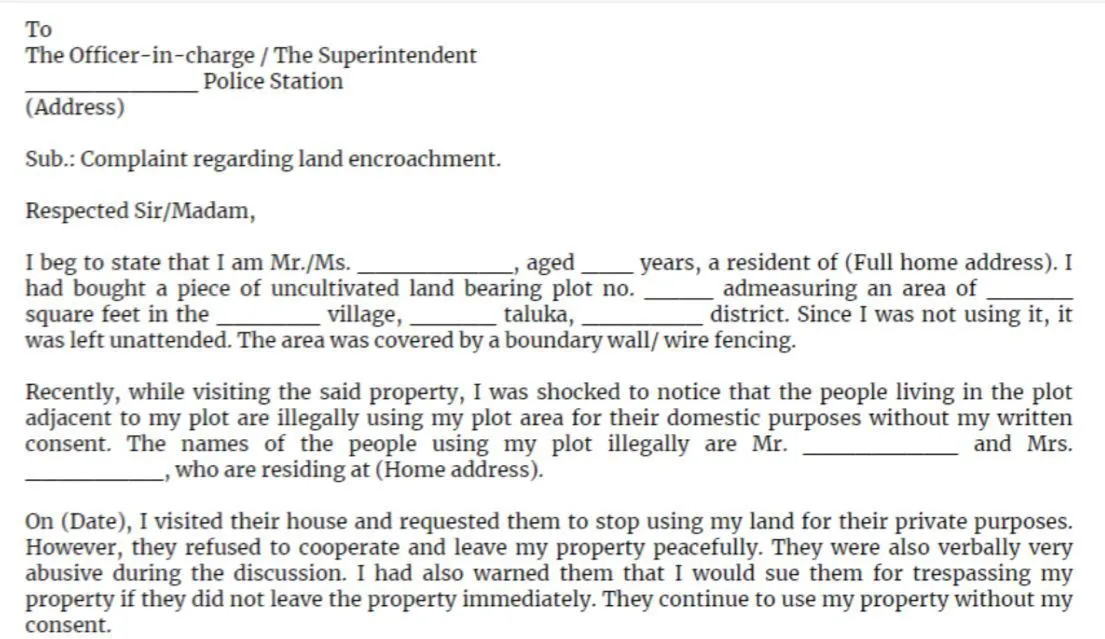
Complaint Letter of Land Encroachment Act
If you discover that your land or property has been encroached upon, the first step is to file a complaint with the authorities under the Land Encroachment Act. A sample format for a complaint letter regarding land encroachment is provided here:
How to Handle Land Encroachment Legally
Across India, states have implemented their own land encroachment acts. If such a situation arises, property owners should know how to legally deal with land encroachment. Indian law allows property owners to protect their property against encroachers. Let’s understand the legal remedies available under the Land Encroachment Act that can be used to address cases of encroachment:
- Permanent or temporary injunction– An injunction is a legal term used for an official court order under the Land Encroachment Act. In cases of land encroachment, a permanent injunction is an order that completely prevents the encroachers from using the property. A temporary injunction, on the other hand, is a court order that restrains the encroachers from using the property for a limited period.
- A property owner can file a case against encroachers under Order 39, Rules 1 and 2 of the Land Encroachment Act.
- Following this, the application will be reviewed, and then a response will need to be filed. Based on the response, the court will either reject or accept the application.
- Ex parte injunction– The justice system of India passes an ex parte injunction if only one party replies. In this case, the court does not wait for the other party’s response.
- You can give the encroacher a written notice. If the encroacher does not vacate the property within the specified time, you can take legal action.
Land Encroachment Act: Out of Court Settlement
The proper way to deal with land encroachment is through legal proceedings, although this can be a long and difficult process. It will not only take up a lot of your time but also cost you a considerable amount of money. Therefore, if you can settle outside of court, you should definitely do so.
Documents Required to Prove Ownership of Land
If you are pursuing legal action to resolve a land encroachment issue, you may need to present the following documents:-
- Title deed
- Purchase agreement
- Mutation certificate
- Utility bills in your name
Encroachers Don’t Have Any Right Over Government Land: Madras High Court
In a significant ruling, the Madras High Court has stated that no person encroaching on government land has a constitutional right to occupy the land as a shelter. In this case, the petitioner was seeking to quash Section 6 of the Tamil Nadu Land Encroachment Act, 1905. The court observed that while the Constitution of India states that all citizens of India shall have the right to reside and settle in any part of the country, this does not mean that they can reside there in an unconstitutional manner.
A person who illegally encroaches on government land will never receive legal protection. Government land is meant for public purposes, and no individual can be allowed to use it for private purposes. The bench noted that the Supreme Court of India had previously upheld the validity of the Tamil Nadu Land Encroachment Act, 1905.
Conclusion
Land encroachment is a significant challenge affecting property rights and community relations across India. Understanding the laws surrounding land encroachment is crucial for property owners seeking protection and for those who may be occupying land without authorization.
Various state-level Land Encroachment Acts provide frameworks for addressing unauthorized occupation, ensuring that due process is followed. Knowledge of these laws and their implications empowers individuals to navigate disputes more effectively and work towards solutions that protect their rights while maintaining harmony within the community.
In short, whether you are a property owner or have been accused of encroachment, understanding your legal position within the framework established by the Land Encroachment Acts of different Indian states is essential for protecting your interests.
Read more: How to Find the Owner of a Property in India



Join The Discussion